



Understanding the Mechanism Behind Male Libido Reduction Due to Confinement Stress
Unveiling the Connection Between Confinement Stress and Male Libido
Recent research conducted by a collaborative team from Tokyo Metropolitan University and the University of Iowa reveals significant insights into how confinement stress affects male sexual motivation. This study is particularly important in understanding not only the behavior of fruit flies but has broader implications for mammalian behavior, including humans.
Key Findings
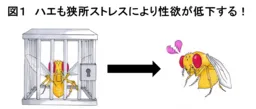
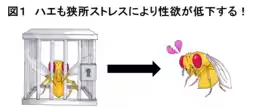
The primary observation was that when male fruit flies (Drosophila) were subjected to confinement in a small space, their subsequent sexual motivation drastically decreased. This phenomenon, identified as confinement stress, was effectively simulated using a tiny acrylic container where the flies could not move freely. The team discovered that when the males were kept in this restricted space for 30 to 60 minutes, their courtship behaviors dropped significantly. Interestingly, while the suppression of courtship behaviors lasted for an hour after the stressor was removed, longer confinement led to prolonged effects, even lasting up to five days.
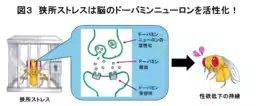
The research emphasized the role of dopamine, a neurotransmitter known to influence various animal behaviors, including motivation and reward. The findings indicated that while the immediate suppression of courtship behaviors after confinement might occur independently of dopamine, maintaining this suppression was dependent upon dopamine signaling. Experiments showed that blocking dopamine synthesis or its release led to a restoration of courting behaviors, thus underscoring dopamine’s critical role in sustaining these changes in behavior after exposure to stress. The three types of dopamine receptors identified in the flies were also crucial for the persistence of this courtship suppression.
The Role of Dopamine in Stress Responses
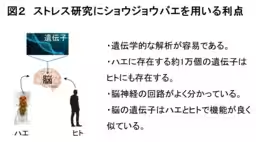
Dopamine signaling is essential in many species, including humans, for regulating motivation and behavior under stress. The research introduced a novel experimental model of confinement stress, diverging from traditional methods that often impose greater physical strain on animals. The advantage of this gentler approach enables a more nuanced analysis of how different stressors and their durations influence animal behavior and neural activity.
Dopaminergic neurons, which release dopamine, were found to be integral in modulating these behaviors. This suggests a potential pathway through which confinement stress induces lasting changes in libido and courtship behavior in male flies—first through initial pathways that do not rely on dopamine, followed by a prolonged effect mediated by dopamine signaling after activation of specific neural circuits.
Implications of the Research
The implications of this study are vast. By shedding light on the relationship between stress and sexual behavior through the lens of neurotransmission, this research invites further exploration into how stress impacts not only flies but potentially larger vertebrate species, including humans. This could provide vital insights into understanding stress-related dysfunctions such as anxiety, depression, and sexual dysfunction.
With increasing cases of mental health disorders linked to stress in modern society, understanding the underlying biological processes becomes imperative. The neurotransmitter dopamine is critical for many behavioral responses, and the findings from this study contribute to a deeper understanding of its role in the psychological effects of stress, particularly concerning libido. This may lead to novel therapeutic approaches in treating stress-related disorders in humans.
Conclusion
In conclusion, this groundbreaking research elucidates the complex interactions between stress and sexual motivation via dopamine pathways, utilizing fruit flies as a model organism. The study not only contributes to our understanding of the biological basis of behavior but also establishes a framework for future research into the neurobiological implications of stress across species. It opens new avenues for research into potential treatments for stress-related disorders, providing hope for many affected individuals seeking relief from the psychological impacts of stress.
For further details, the complete findings are published in the academic journal iScience under the title "Role of dopamine signaling in male courtship suppression induced by confinement stress in Drosophila," DOI: 10.1016/j.isci.2026.11590601281-2).
Topics Health)


【About Using Articles】
You can freely use the title and article content by linking to the page where the article is posted.
※ Images cannot be used.
【About Links】
Links are free to use.