



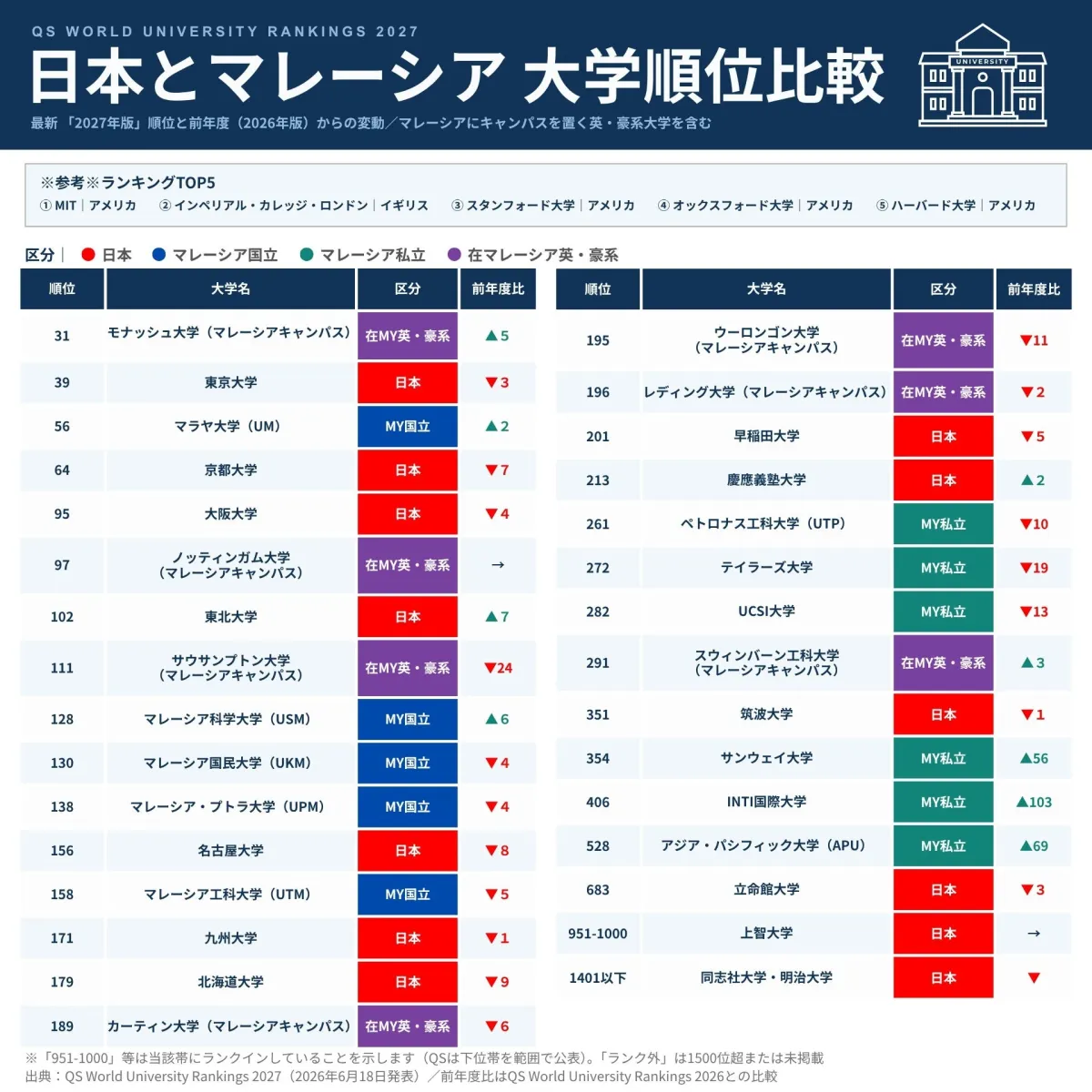
Significant Rise for Malaysian Universities in QS World University Rankings 2027
Significant Growth of Malaysian Universities in QS World University Rankings 2027
The QS World University Rankings 2027, released on June 18, 2026, by the British educational assessment organization QS, revealed impressive advancements in Malaysian universities. Global Hub Japan, Inc., which operates the Malaysia Study Abroad Support Center, has analyzed the latest rankings of major universities in Malaysia and Japan, focusing on the international acclaim attained by Malaysian higher education institutions.
Overview of QS World University Rankings 2027
The QS World University Rankings serve as an international indicator that evaluates universities worldwide using common criteria, including academic reputation, employer reputation, student-to-faculty ratio, citation per faculty, and internationalization metrics such as foreign faculty and international student ratios. This ranking has gained prominence in Japan as a reference point for assessing the global performance of universities from a perspective different from traditional admission difficulty measures.
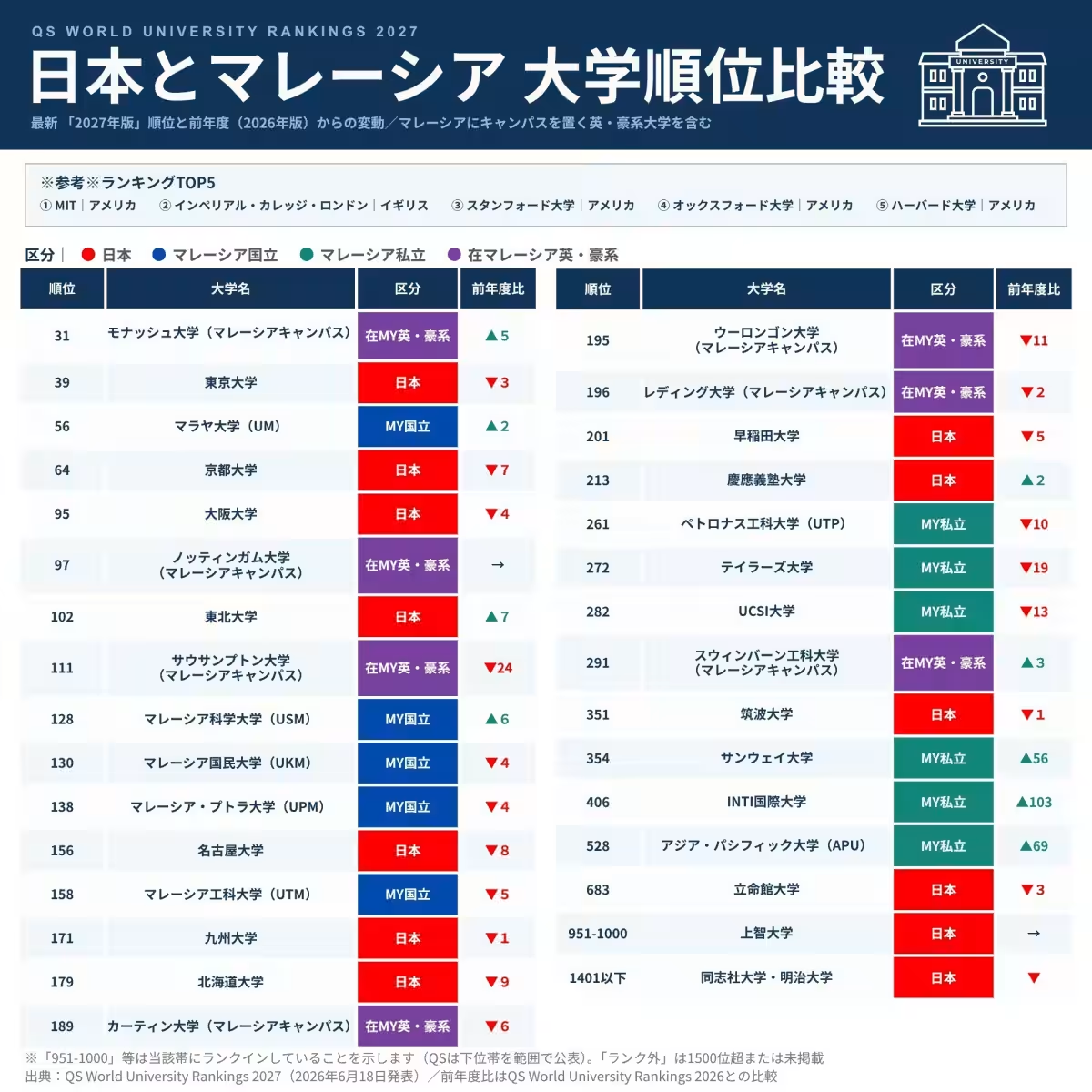
This latest data has again highlighted the international presence of Malaysian universities. The University of Malaya (UM), ranked 56th globally, surpasses Kyoto University at 64th. Notably, five national universities, including USM, UKM, UPM, and UTM, have entered the top 200. Additionally, several private universities such as Sunway University (up 56 ranks), INTI International University (up 103 ranks), and APU (up 69 ranks) exhibited remarkable improvement in their rankings.
Key Features of Malaysian Higher Education
One standout aspect of Malaysian higher education is the presence of branch campuses of prestigious Western universities. Many top universities from the UK and Australia have established campuses in Malaysia, allowing students to obtain degrees under identical curricula as those at the home institutions. This provides an environment where students can receive world-class education while remaining in Malaysia.
Analytical Insights from the Data
- - High Concentration of Universities in Top 200: A total of 11 universities within Malaysia, including Monash, UM, Nottingham, Southampton, USM, UKM, UPM, UTM, Curtin, Wollongong, and Reading, are positioned within the top 200 globally.
- - Significant Advancement of Private Universities: Private institutions like Sunway University (354th), INTI International University (406th), and APU (528th) have achieved substantial rank increases. This contrasts sharply with many major private universities in Japan, which have either maintained or dropped in rankings. This highlights the growing international recognition of Malaysian private institutions.
Differences Between Japan's Admission Scores and QS Rankings
When comparing Japan's commonly used `deviation scores` to the global QS Rankings, it is evident that the basis and purpose of the measurements differ significantly.
- - Calculation of Deviation Scores: These scores are derived from data from mock exams conducted by private preparatory schools, reflecting the relative difficulty of entrance exams without considering subsequent educational quality, faculty research achievements, or post-graduation success.
- - Structure of QS Rankings: QS utilizes a globally accepted evaluation framework focusing on academic reputation, employer assessment of graduates, citation rates per faculty, and the ratio of foreign faculty and international students. This points to the quality of education provided and social recognition as focal evaluation points.
Reasons for High Evaluation of Malaysian Universities
The QS Rankings do not necessarily measure education quality directly; they offer a comprehensive evaluation of research capabilities, academic and corporate reputation, faculty size, international presence, employment outcomes, and sustainability.
1. High Ratio of International Students: The average score for international student ratios among the top 12 Malaysian universities is 90.6, starkly contrasted by Japan's average of 27.9. Malaysian institutions welcome students from over 170 countries, reflecting a widely recognized multicultural learning environment.
2. Diversity of Faculty: The top 12 universities in Malaysia have an average score of 65.2 for foreign faculty ratios, considerably higher than Japan's 22.4. Universities with high foreign faculty numbers promote diverse educational and research environments conducive to collaboration with global institutions.
3. Notable Faculty-to-Student Ratios: Malaysian institutions provide significant attention to students with an average teacher-student ratio score of 69.1, closely following Japan's 73.4, emphasizing the importance of personalized educational experiences.
4. Robust International Research Networks: Malaysian universities engage in extensive international collaboration, shown by an average research network score of 69.4, indicating sustainable partnerships with institutions across various regions, thereby enhancing their global presence.
5. Government Commitment to Internationalization: The Malaysian government promotes English-language education not only in public but also in private and foreign university campuses, fostering competitiveness on a global stage.
Conclusion and Future Outlook
The international recognition of Malaysian universities has been rising swiftly in recent years, with the University of Malaya ranked 56th, and Universiti Sains Malaysia at 128th. With an increasing number of institutions within the top 200 globally, the surge in rankings among private universities suggests a positive correlation with enhanced recruitment of international students, hiring of foreign faculty, and collaborative research, aligning well with QS evaluation criteria.
Commentary from Global Hub Japan's CEO
Takashi Saito, CEO of Global Hub Japan, comments:
"Traditionally, Japanese students and parents considered admission scores as the primary criterion for university selection. However, university choice should not only focus on entrance difficulty but also on the educational environment and international reputation. The QS Rankings offer a crucial benchmark for assessing educational strength, research capabilities, and international perspectives, assisting in informed decisions regarding future paths. Moreover, a wealth of universities recognized globally in Malaysia provides practical knowledge and a global viewpoint, making it a sensible further study option for aspiring students."
In summary, Malaysian universities represent a growing educational hub where students can immerse themselves in a globally recognized academic environment.

Topics Other)
【About Using Articles】
You can freely use the title and article content by linking to the page where the article is posted.
※ Images cannot be used.
【About Links】
Links are free to use.