




Latest West Coast Labs Report Shows NordVPN's Minimal Impact on Battery Consumption
The Truth Behind NordVPN and Battery Life: A Comprehensive Analysis
In the realm of digital privacy, Virtual Private Networks (VPNs) often face scrutiny from users concerned about their smartphone battery consumption. A recent study conducted by West Coast Labs delves into the veracity of these concerns, specifically focusing on NordVPN, one of the most popular VPN services available today. The prevalent assumption that VPNs deplete battery life significantly has been put to the test, leading to some surprising revelations.
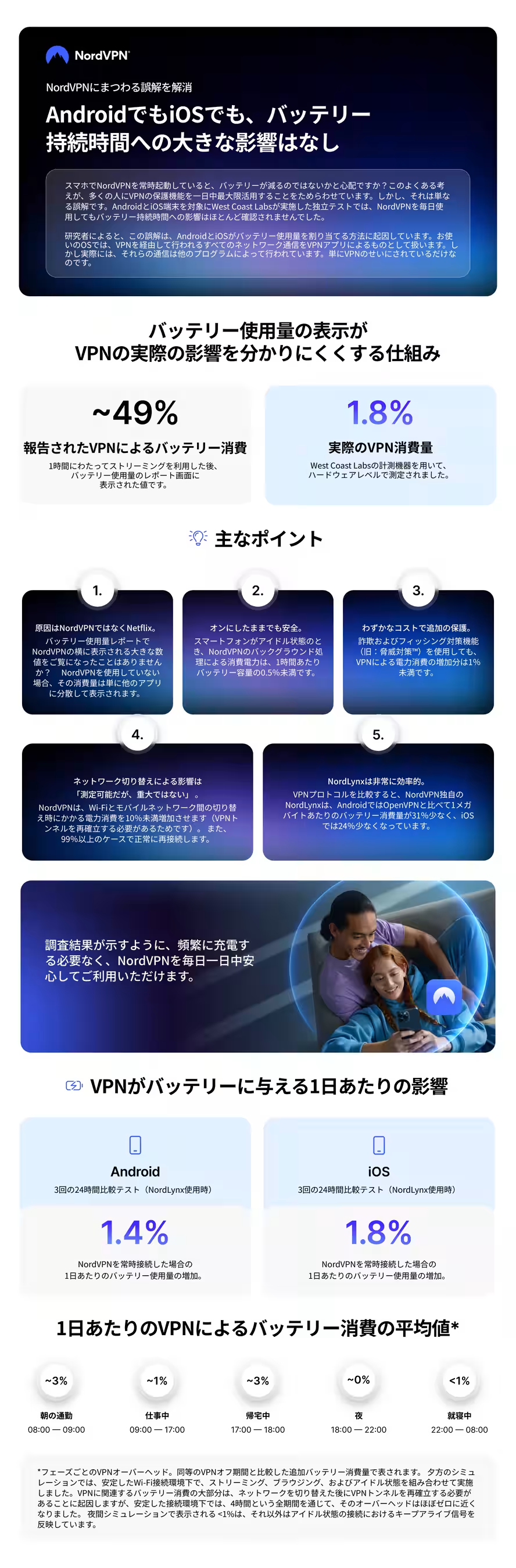
According to West Coast Labs, the notion that VPNs drain batteries heavily stems not from actual data consumption by VPN applications, but rather from imperfections in how smartphones measure battery usage. To investigate, the labs ran a series of tests on six devices, simulating varied usage scenarios while keeping NordVPN active. The findings revealed that when NordVPN was operational for 24 hours straight, battery consumption increased by a mere 1.4% on Android devices and 1.8% on iOS devices. This translates to a difference of approximately half a day in battery life over a month for high-end Android models, a negligible cost for enhanced privacy.
Marius Brzyski, Chief Technology Officer at NordVPN, highlighted, "Battery drainage is one of the primary reasons people forgo using VPNs. Upon verifying this common theory, we found it to be mostly unfounded. VPN usage often appears to have a more severe impact on battery life than it actually does."
Clarifying Misconceptions
When a VPN is activated, all internet traffic on the device is routed through the VPN. Both Android and iOS recognize this traffic as originating from the VPN app itself. Consequently, any battery drain from activities such as streaming videos or browsing could be incorrectly attributed to VPN use, skewing the perceived impact on battery life.
During one hour of continuous streaming in the West Coast Labs study, the battery consumption display indicated that an average of approximately 49% of the session's drain was due to NordVPN. However, measurements made with specialized hardware showed that the actual overhead from NordVPN ranged only between 1.6% and 2.1%. In essence, the battery monitoring systems were calculating data usage rather than actual power consumption.
In situations like commuting, where battery drain might typically be pronounced due to frequent switching between Wi-Fi and mobile data, the test results were equally enlightening. In a simulated commuting scenario, when devices switched networks every nine minutes over a two-hour period, NordVPN's overhead remained well below anticipated levels at 5.1% for Android and 6.8% for iOS, far below the established threshold of 15%. Impressively, NordVPN maintained successful reconnections in over 99 of 100 instances during network switches.
Outdated Technology and Misunderstandings
Many of the misconceptions surrounding VPN battery consumption stem from outdated technology, specifically the OpenVPN protocol, developed in 2001 before mobile devices regarded battery efficiency in their designs. West Coast Labs compared NordVPN's default protocol, NordLynx, to OpenVPN, revealing that battery consumption per unit of data was lower by 31% on Android and 24% on iOS with NordLynx.
The key difference lies in their architectures: NordLynx is based on WireGuard, a modern encryption technology that significantly reduces the processing load per data packet, resulting in efficient battery usage. During active data transfer, NordLynx kept CPU usage around 6% on Android, while OpenVPN required more than double that amount.
Moreover, in idle conditions with a VPN connected, both platforms consumed less than 0.5% of battery capacity per hour in the background.
Empowering Users Through Knowledge
Brzyski remarked, "Users deserve the right to informed choices about their online security. If battery drainage was a reason for abstaining from VPN use, we hope this report assuages those concerns. In everyday use, the impact is hardly noticeable, and you shouldn’t have to compromise on privacy and security. It turns out this was never a real concern to begin with."
Methodology of the Study
This thorough evaluation conducted in May 2026 involved three Android devices (Samsung Galaxy S24, Samsung Galaxy S25 Ultra, and Google Pixel 9) and three iOS/iPadOS devices (iPhone 15, iPhone 16, latest iPad). The researchers conducted four distinct test series, encompassing comparisons of OS characteristics and actual data consumption during streaming, a stress test simulating network transitions during commuting, protocol efficiency benchmarks, and a 24-hour scripted simulation with VPN both on and off. NordVPN successfully passed every test.
About NordVPN
NordVPN is a trusted digital privacy and security application for millions of internet users worldwide. Combining a top-tier VPN with next-gen antivirus features and Dark Web monitoring, it empowers users to navigate online more securely and privately. By защищая users from phishing attempts, scams, malicious websites, trackers, intrusive ads, and malware, NordVPN is a vital tool for enhancing online privacy. For more information, visit nordvpn.com.

Topics Consumer Technology)


【About Using Articles】
You can freely use the title and article content by linking to the page where the article is posted.
※ Images cannot be used.
【About Links】
Links are free to use.