



Understanding the Mechanism for Improved Solvent Resistance in High-Frequency Polymer Materials
Introduction
Recent research conducted by a collaborative team from Tohoku University and Taiyo Holdings has provided valuable insights into the mechanisms behind the enhanced solvent resistance of poly(phenylene ether) (PPE) materials used in high-frequency electronics. These findings, published in Polymer Chemistry, aim to address the challenges faced in the development of electronic substrates that require both processing stability and solvent resistance.
Background of the Research
As the demand for high-performance electronic components grows, there is an increasing need for materials that can maintain low dielectric properties and low signal loss, while also withstanding manufacturing processes. Poly(phenylene ether) has been identified as a potential candidate due to its low loss characteristics. However, traditional PPE materials struggle to adequately balance solvent solubility during processing, shape stability during heating, and solvent resistance post-curing.
In their efforts to solve these challenges, Taiyo Holdings has successfully developed a novel reactive PPE material, but understanding the internal structure that contributes to the high solvent resistance after curing remained elusive. Given that polymer materials undergo simultaneous processes of curing, phase separation, and changes in molecular mobility, detailed observation through experimental methods alone proved challenging. Thus, the researchers employed a combination of experimental evaluation and thermal curing simulations to uncover the mechanisms of solvent resistance in reactive PPE materials.
Research Methodology
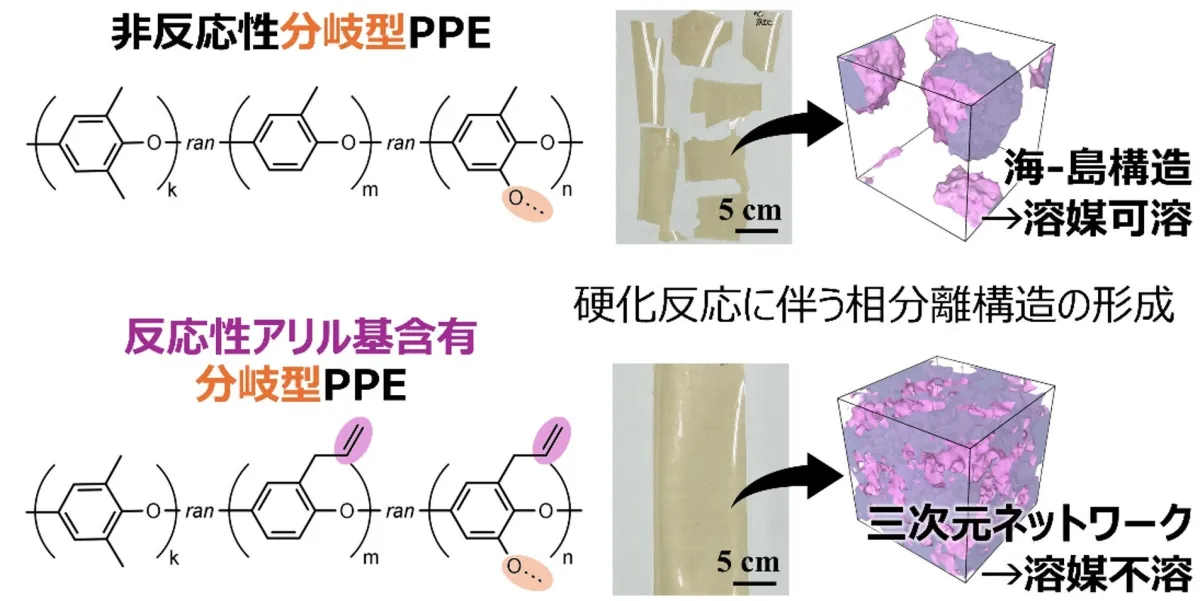
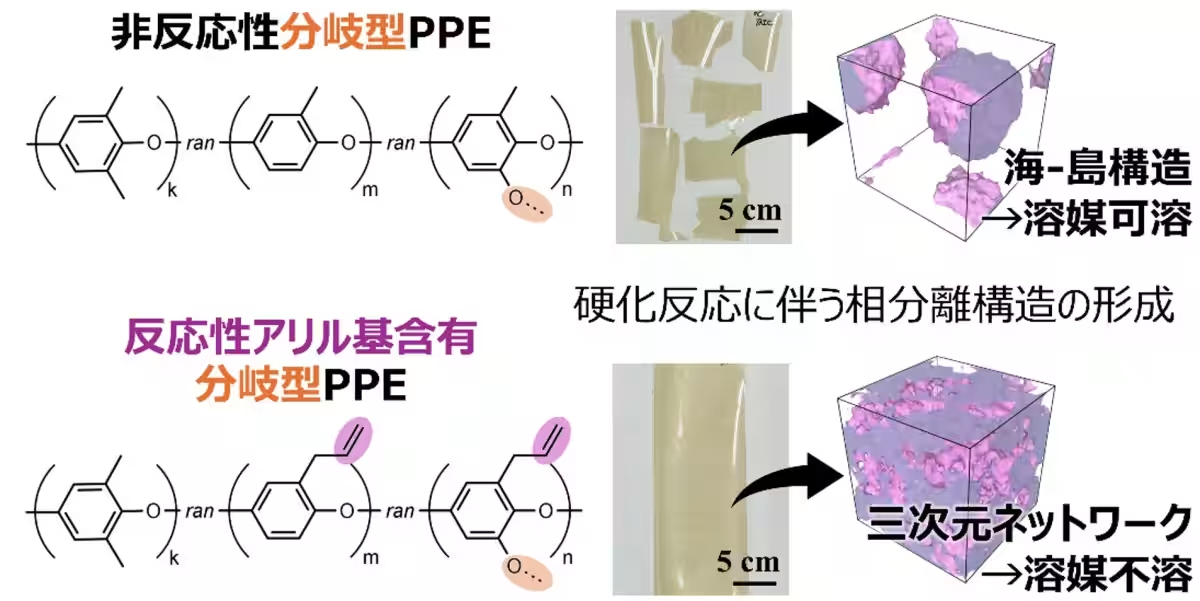
The team aimed to assess the cured film shapes, component leachability after solvent exposure, and phase separation structures of the reactive PPE material developed by Taiyo Holdings. They discovered that when reactive allyl groups were incorporated into PPE and cured with tri-allyl isocyanurate (TAIC), compared to non-reactive PPE, the films maintained their shape in solvent environments and exhibited significantly lower component leachability.
Using dissipative particle dynamics (DPD) simulations, developed by Tohoku University, the researchers were able to visualize the internal phase separation and network formation occurring during the curing reaction. The results indicated that while non-reactive PPE tends to aggregate locally with TAIC, the presence of reactive allyl groups allows the PPE chains to be integrated into the TAIC curing network, creating a three-dimensional continuous network structure.
Observations and Findings
The course of the curing reaction also revealed that the mobility of the molecules decreases over time, leading to a competition between the ability of the components to diffuse and the timing at which the curing process fixes the structure. This interplay ultimately determines the final internal structure of the material. Consequently, the researchers were able to provide an explanation of how reactive PPE materials can simultaneously achieve solvability prior to processing and solvent resistance post-curing, from the perspectives of molecular motion, phase separation, and network formation.
The findings underscore the efficacy of utilizing simulations to capture the often-elusive internal structure formation processes in polymer materials. This technique is expected to facilitate advancements in molecular design and contribute to the development of next-generation electronic materials that boast low loss and high reliability.
Future Developments
Looking ahead, the research team aims to further develop their thermal curing simulation techniques to create a comprehensive material development methodology that links molecular design, curing reactions, phase separation structures, and final properties. By doing so, they hope to visualize material internal structures that are challenging to capture through experimental means alone and accelerate the creation of next-generation electronic materials that excel in low loss, high thermal resistance, and high reliability. The collaborative partnership between Tohoku University and Taiyo Holdings will continue to advance polymer material design through the integration of experimental and simulation-based approaches.
Acknowledgments
Special thanks to the Tohoku University Cyber Science Center’s Supercomputer AOBA for providing computation resources for numerical analysis as well as CoSMIC for offering analytical tools. The research benefited from the Open Access support project of Tohoku University for promoting open access in the 2026 fiscal year.
Conclusion
As the demand for high-frequency electronic materials continues to rise, the findings from this research pave the way for improving solvent-resistant materials that are essential for enhancing the performance and reliability of cutting-edge electronic products. The collaboration between academia and industry promises to yield innovative solutions and advanced materials in the field of electronics.
Topics Consumer Technology)
【About Using Articles】
You can freely use the title and article content by linking to the page where the article is posted.
※ Images cannot be used.
【About Links】
Links are free to use.