



New Method Quantifies Speech Comprehension for Visually Impaired Users of Screen Readers
New Method Quantifies Speech Comprehension for Visually Impaired Screen Reader Users
A collaborative effort from the National Institute of Advanced Industrial Science and Technology (AIST) and several prominent universities in Japan has led to a significant advancement in assistive technology for visually impaired individuals. This breakthrough comes in the form of a new method that quantifies the speech comprehension abilities of users employing screen readers, a software essential for converting written content on computers and smartphones into synthesized speech.
Screen readers are vital tools that support visually impaired individuals in accessing information, which is crucial for education, employment, and social participation. With approximately 270,000 holders of disability certificates in Japan possessing visual impairments, the development of tailored accessibility solutions is a pressing need. The researchers, including Takahiro Miura from AIST and professors from Tsukuba University and the University of Tokyo, recognized the necessity for a method to assess the variations in speech comprehension based on individual characteristics and experiences.
Development of the Evaluation Method
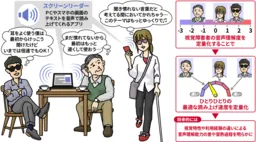
In this study, the researchers applied Item Response Theory (IRT) to distinguish between factors that contribute to speech comprehension difficulties when using screen readers. Traditionally, it was challenging to ascertain whether misunderstandings stemmed from overly complex text, rapid reading speeds, or the user’s own comprehension skills. This ambiguity necessitated a clearer analytical framework.
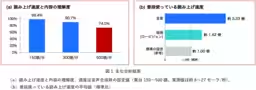
The newly developed method evaluates difficulty levels in the text and the users' comprehension capabilities on a standardized scale. By doing so, it becomes possible to identify appropriate reading speeds for each individual. The researchers created various sentences read aloud at speeds ranging from 150 to 500 words per minute. Participants, which included 11 visually impaired screen reader users, assessed their understanding of the content alongside their perceptions of clarity and ease of understanding.
The collected data allowed for a detailed separation and comparison of the level of difficulty presented by each reading speed and the comprehension abilities of individual users. This collaborative approach has yielded insightful findings; for instance, completely blind participants demonstrated a capacity for quicker speech comprehension compared to those with low vision, affirming the impact of users' experiences and their specific visual impairments on comprehension capabilities.
Implications for Accessibility
One significant outcome of this study is the establishment of a foundational dataset that can inform education and training tailored for visually impaired users. Users' reading speeds often increase as they become more familiar with screen reader functions, yet determining the most efficient speeds varies widely between individuals. These differences highlight the importance of personalized adjustments to enhance overall comprehension without introducing frustration, such as reading speeds that are either too fast or too slow.
The implementation of a standardized method to support users' understanding will facilitate a more accessible environment, ensuring that visually impaired individuals can achieve greater ease in accessing information.
Future research directions aim to extend the application of this methodology to encompass a broader population of visually impaired users, improving the precision of comprehension assessments and exploring the relationships between visual impairment characteristics, user experiences, and comprehension abilities. A long-term goal includes the development of tools for real-time evaluation of reading speeds, providing immediate feedback tailored to individual needs.
The findings of this research will be presented at the Interspeech 2026 conference in Sydney, Australia, between September 27 and October 1, 2026. This presentation will emphasize the method's potential to enhance the experiences of visually impaired screen reader users, paving the way for improved accessibility in various digital formats.
Conclusion
This innovative approach delineates a path forward for accessibility in digital environments, aiming to eliminate barriers for visually impaired individuals. Further studies will substantiate ongoing efforts towards creating a more inclusive society, where information is readily accessible to everyone, regardless of visual capabilities.

Topics Consumer Technology)
【About Using Articles】
You can freely use the title and article content by linking to the page where the article is posted.
※ Images cannot be used.
【About Links】
Links are free to use.