



Innovative Solution to Ice Slurry Buildup with Japanese Technology
Innovative Solution to Ice Slurry Buildup with Japanese Technology
Nippon Paper Industries, based in Chiyoda, Tokyo, has made significant strides in addressing a pressing challenge in ice slurry generation. This innovation, developed through collaboration with the Kochi University Advanced Manufacturing Technology Laboratory led by Professor Yasunori Matsumoto, focuses on enhancing the efficiency of ice slurry generation devices, which have gained traction for their cooling properties and potential to preserve seafood freshness during hot summer months.
The Challenges of Ice Slurry Technology
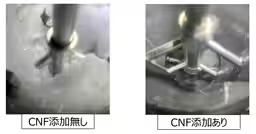
Ice slurries, defined as fluids comprising tiny ice particles dispersed in liquid, are becoming increasingly important for preventing heat-related illnesses and maintaining the freshness of seafood. However, during the ice production process, particle aggregation can lead to clogs at the discharge point of the generation device, posing a significant challenge to real-world application.
The Breakthrough Solution with Selentia®
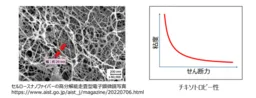
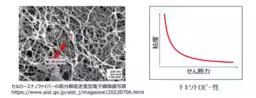
The research team turned to Selentia®, a cellulose nanofiber developed by Nippon Paper, to tackle the issue of ice particle aggregation. Selentia® exhibits unique properties, including a three-dimensional network structure and thixotropic characteristics, maintaining viscosity at rest while reducing it during flow. This transformation allows for the effective dispersion of ice particles.
Key Benefits of Using Selentia®
1. Uniform Dispersion of Ice Particles: The three-dimensional network formed by Selentia® encapsulates the ice particles, effectively preventing them from clumping together.
2. Smooth Discharge: By ensuring a smooth flow, the addition of Selentia® prevents clogs at the discharge point, enabling efficient generation.
Safety and Future Prospects
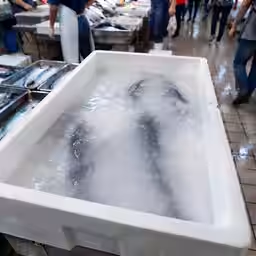
Selentia® is derived from wood and has been successfully used in numerous food products, ensuring its safety for consumers. With its ability to cool seafood rapidly and evenly, ice slurry can facilitate the transportation of fresh products over long distances.
Nippon Paper and Kochi University aim to implement the technology of the cellulose nanofiber Selentia® and incorporate it into their server-type ice slurry generation devices for social use. This advancement not only addresses the needs of the sports industry on hot days but also promises to promote seafood freshness during transportation.
Visual Imagery
The images portraying the application of the innovative ice slurry solution demonstrate its effectiveness in both sports hydration and seafood transportation.
Note: Images are AI-generated representations.
As this research progresses, it is poised to pave the way for more effective cooling technologies, contributing to improved public health and food sustainability practices across industries.
Whether it's for athletes looking to maintain optimal internal temperature before and after strenuous activities or for distributors aiming to preserve seafood freshness during transport, this innovation is indeed a game-changer in the realm of cooling technologies.

Topics Consumer Products & Retail)
【About Using Articles】
You can freely use the title and article content by linking to the page where the article is posted.
※ Images cannot be used.
【About Links】
Links are free to use.