



Unlocking the Potential of Clinical Organizational Science: Conditions for Functionality
Understanding Clinical Organizational Science (COS)
Clinical Organizational Science (COS) is an innovative framework that integrates complex system science, neuroscience, organizational psychology, and behavioral science to actively reproduce interaction structures within organizations. Rather than viewing organizational change as merely a shift in individual behavior, COS emphasizes the transformation of organizational attractors. Techniques such as Field Gradient Theory, Loop Conversion Design, and Neural Base Design are central to its application. Moreover, the concept of the 'emergence bridge' seeks to connect individual habits with organizational change at scale.
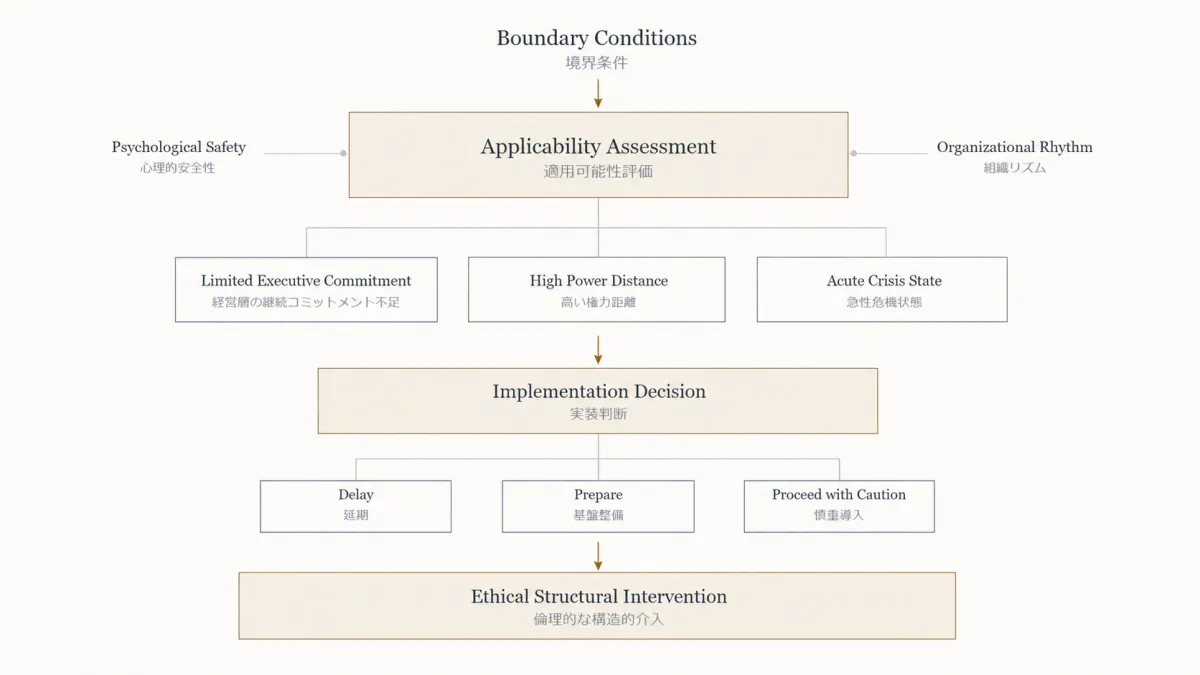
Boundary Conditions in COS Implementation
COS is not a one-size-fits-all method; certain boundary conditions can impede its effectiveness. Identifying these limitations is not a flaw but rather a necessary step towards verifying the theory and ensuring ethical implementations. Failing to acknowledge potential limitations can pose risks for both practitioners and researchers alike.
Boundary Condition 1: Lack of Sustained Commitment from Management
Organizations where management does not maintain an ongoing commitment to structural change tend to struggle with implementing COS effectively. COS focuses on altering interaction structures through consistent organizational rhythms over time, such as daily, weekly, and monthly practices. Hence, organizations that expect quick results or lack continuous leadership engagement may find it difficult to transition to new organizational attractors. Techniques like Neural Base Design rely on repetition and continuity, and without a suitable foundational layer, they can actually be counterproductive.
Boundary Condition 2: Extreme Power Distance in the Organization
Organizations characterized by a high power distance often perceive changes in dynamics, like altering from a 2-on-1 configuration, as threats rather than structural improvements. In such cases, establishing psychological safety and trust through Neural Base Design should take precedence, and any introduction of Field Gradient Theory must be approached cautiously to avoid exacerbating the existing power dynamic.
Boundary Condition 3: Organizations in Acute Crisis
Organizations facing acute crises—such as financial difficulties, accidents, legal risks, or massive personnel changes—may lack the requisite attention resources and relational bandwidth necessary for COS to succeed. During these times, prioritizing crisis management, decision-making, and stabilization efforts takes precedence over the introduction of COS. Structural interventions should ideally be considered once the organization finds equilibrium and can regain its rhythmic operations.
The Imperative of Research on Boundary Conditions
Understanding which conditions favor or hinder the success of COS is a critical area for future research. Analyzing variables like cultural differences, industry types, organizational size, leadership engagement, existing psychological safety, power distance, and overall organizational climate will provide essential insights into how COS can be effectively applied.
Commentary from Makoto Yamanaka
Yamanaka notes that portraying COS as a universal method applicable to all types of organizations is counterproductive. Each organization exhibits unique complexities and contexts. Establishing functional limitations fosters genuine practice. Particularly, implementing strong structural interventions in environments lacking psychological safety can be precarious. COS should therefore be approached thoughtfully, respecting foundational contexts and confirming boundary conditions prior to deployment.
Conceptual Analysis of COS
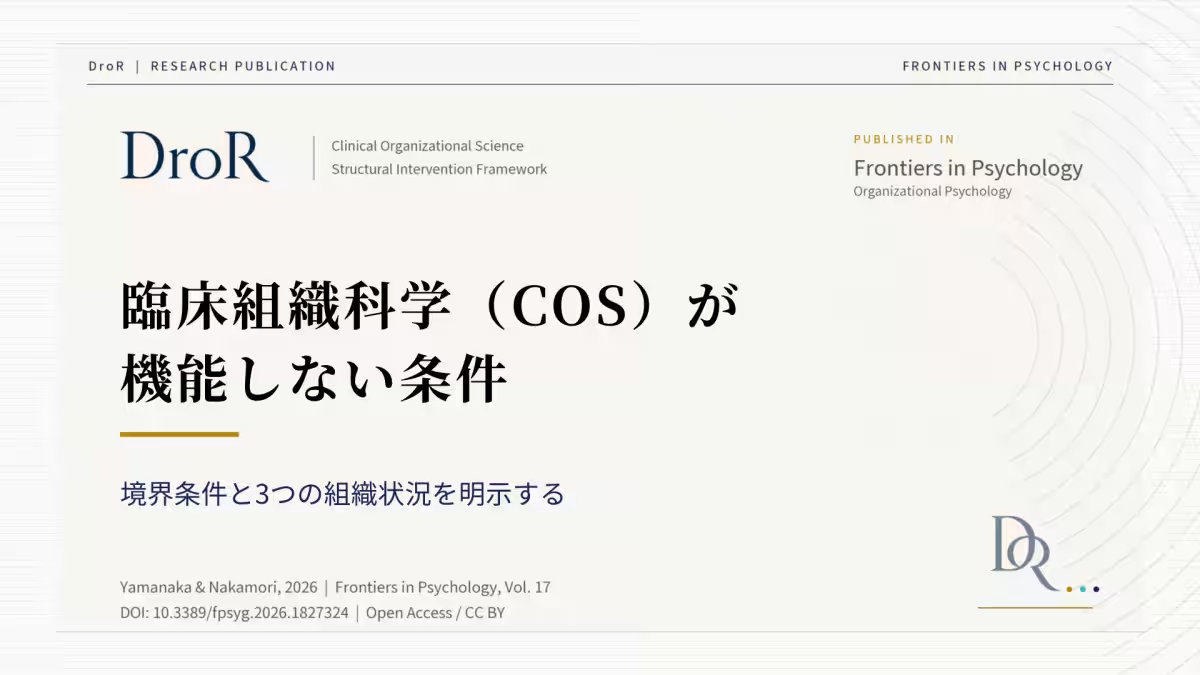
The recent paper published in the international journal 'Frontiers in Psychology' underlines COS as a Conceptual Analysis. It does not claim to have completed verification of each method but seeks to contextualize existing fragmented scientific knowledge within a theoretical framework that addresses organizational change as a structural intervention problem. It reframes existing theories related to psychological safety, organizational routines, complex adaptive systems, field theory, cybernetics, behavioral science, and implementation science through the lens of structural interventions.
Upcoming Insights
On June 5 at 15:00, we will release a summarization article titled 'Opening Clinical Organizational Science to Independent Verification—An Invitation to a Research Program.' This will offer further insights into COS and its practical implications.
About the Publishing Journal
The paper has been published in the organizational psychology section of the peer-reviewed journal 'Frontiers in Psychology.' This open-access journal covers research areas of psychology, cognitive science, and organizational psychology and presents the COS framework as a Conceptual Analysis.
Conclusion
COS, led by DroR under the direction of Makoto Yamanaka, will continue to innovate in understanding and managing the intricate dynamics within organizations through structured support. By emphasizing sustainability, ongoing management commitment, and clarity around boundary conditions, COS aims for ethical and effective organizational transformation.
Topics Other)
【About Using Articles】
You can freely use the title and article content by linking to the page where the article is posted.
※ Images cannot be used.
【About Links】
Links are free to use.