



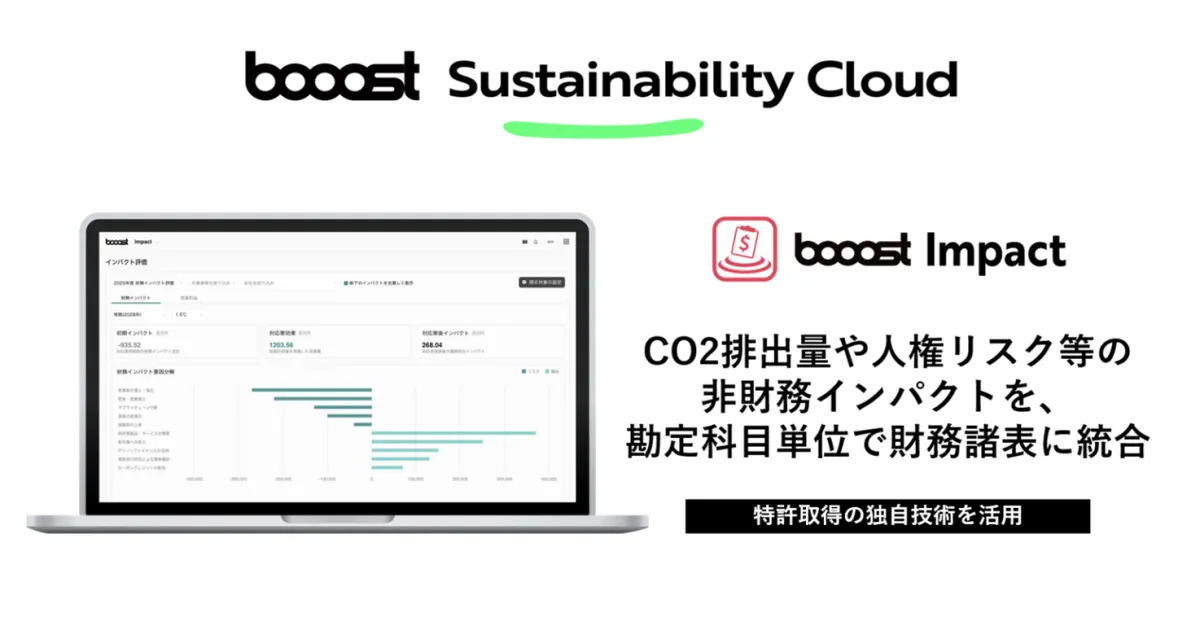
Booost Launches Unique Feature to Integrate Non-Financial Impacts into Financial Statements
Introducing 'booost Impact' - A Game Changer for Sustainability Management
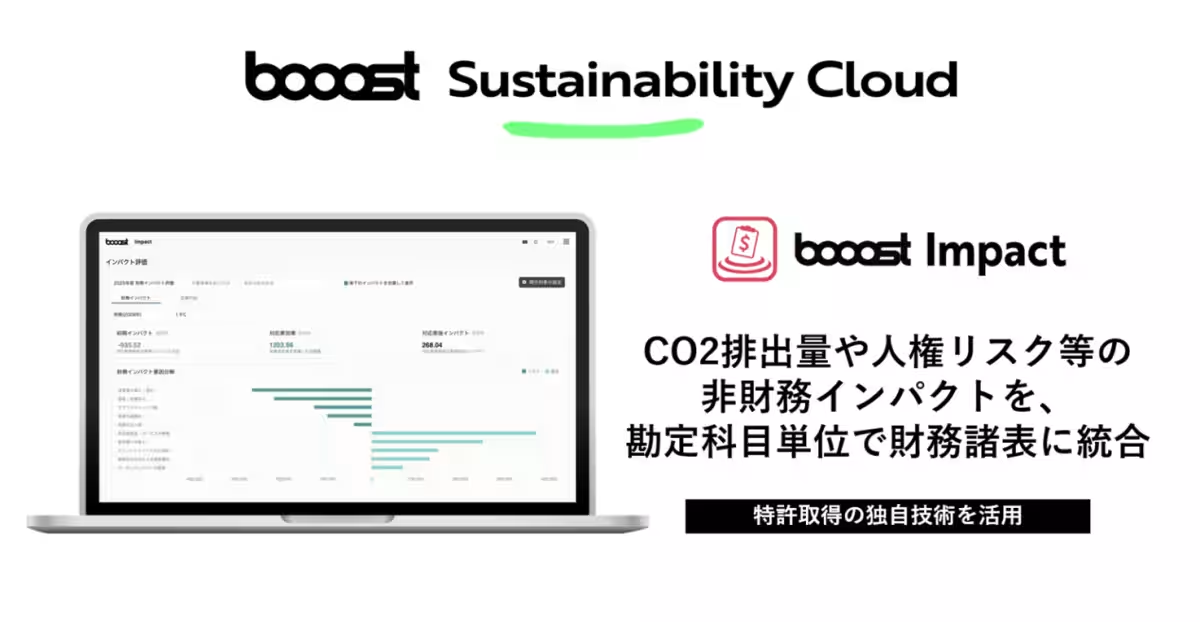
Booost, a pioneering company based in Shinagawa, Tokyo, has officially launched its innovative feature titled 'booost Impact' on October 6, 2025. This new functionality leverages their self-developed patented technology to seamlessly integrate non-financial impacts, like CO2 emissions and human rights risks, into financial statements at the account level. The launch is a significant leap forward in the realm of sustainability ERP, where Booost claims the No. 1 market share among major corporations.
The Importance of Addressing Non-Financial Impacts
In recent years, the global climate crisis and social issues have intensified the focus on sustainability, making the disclosure of related information critical for strategic decision-making within businesses. In Japan, the SSBJ guidelines, which align with international standards, were published in March 2025. This mandates the phased disclosure of sustainability-related financial information in securities reports.
As such, companies are increasingly recognizing the financial implications of factors such as climate change and human capital. However, traditional methods for articulating the financial impact of these non-financial factors face various challenges, including a lack of internal knowledge, difficulties in complying with regulatory demands, inefficient long-term impact assessment, and insufficient integration with existing accounting and ERP systems. Booost's 'booost Impact' aims to address these issues by simplifying and enhancing the visibility of these impacts.
How 'booost Impact' Operates
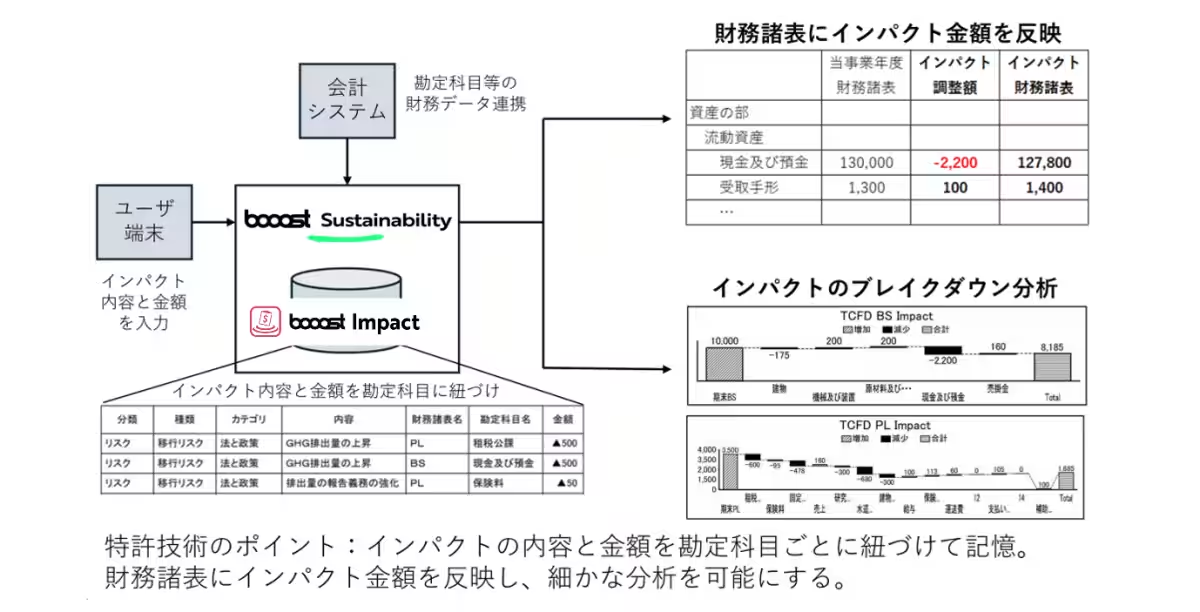
The 'booost Impact' feature enables organizations to not only identify risks and opportunities related to sustainability—such as those stemming from climate change or human rights—but also integrates these impacts into their overall financial framework. By connecting the database within the 'booost Sustainability' ERP with accounting systems, firms can effectively link the quantifiable non-financial impacts to their financial statements, aiding in comprehensive financial disclosure.
The feature supports in-depth breakdown analyses and offers a structured workflow for risk and opportunity identification, calculation, and reporting. Preset industry-specific SASB metrics streamline the process of identifying material issues more efficiently.
Key Features of 'booost Impact':
- - Materiality and Risk Management: Integrated management of risks and opportunities helps maintain a clear view of sustainability impacts on financial performance.
- - Calculation Engine for Financial Impacts: Includes a repository of preset calculation methodologies and external data that enhance the accuracy of financial calculations related to sustainability.
- - Seamless Data Integration: Allows for efficient collection of non-financial data from 'booost GX' and 'booost ESG', integrating smoothly with financial management systems like 'booost Disclosure' and 'booost XBRL'.
Looking Ahead
Through 'booost Impact', Booost aims to provide organizations with the tools necessary to achieve transparency in disclosure and effective management decisions. The company is committed to evolving the 'booost Sustainability' ERP further, enhancing it with features like 'booost Disclosure' and 'booost XBRL', all while promoting a new operational model that synergizes financial and non-financial data for better decision-making.
The Challenge of the 2026 Sustainability Problem
Booost is also tackling the looming 'Sustainability 2026 Problem', which refers to the challenges companies face in meeting new sustainability disclosure requirements amidst fears of diminishing corporate value. To address this critical issue, Booost has launched the initiative 'Japan as a Leader in Sustainability Transformation' in November 2024, which seeks to guide both operational teams and executives through various programs and commitments.
About Booost
Founded on April 15, 2015, Booost has established itself as a leader in sustainability ERP solutions, developing the comprehensive 'booost Sustainability' platform that automates the collection and monitoring of sustainability-related financial data across over 1,200 metrics. Currently, the platform is utilized by around 2,000 companies across 92 countries, with more than 192,000 active sites. This initiative aims to optimize business processes related to sustainability disclosures while facilitating consulting services aimed at enhancing overall corporate value.
For more insights, visit Booost's corporate site.


Topics Consumer Products & Retail)
【About Using Articles】
You can freely use the title and article content by linking to the page where the article is posted.
※ Images cannot be used.
【About Links】
Links are free to use.