



Revolutionary Method Enhances Battery Electrode Slurry Evaluation for Efficient Development
New Method Enhances Lithium-Ion Battery Performance
In a groundbreaking study, researchers from Tokyo University of Science, including Associate Professor Isao Shitanda and several collaborators, have developed a novel method for quickly assessing the conditions under which electrode slurries are applied in lithium-ion batteries. This method can determine optimal coating conditions utilizing just a small amount of slurry, potentially leading to significant improvements in battery material development, performance enhancement, and resource conservation.
Understanding the Importance of Electrode Slurry
The efficacy of lithium-ion batteries heavily relies on the quality of their electrodes, which are created by applying a paste-like mixture of active materials, conductive additives, and binders to metallic foils. Especially for the positive electrode, it is crucial to ensure that carbon black—acting as a conductive additive—is uniformly dispersed within the slurry. Optimizing the coating conditions, including the speed of application, is vital since variations can lead to substantial changes in the electrodes' structural properties and overall efficiency.
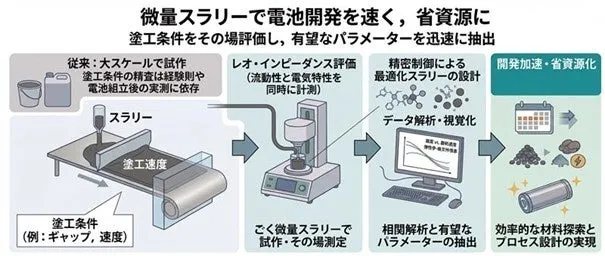
Traditionally, arriving at the optimal coating conditions necessitated constructing and testing numerous batteries, demanding considerable time, materials, and costs. The new technique allows for immediate assessment of slurry characteristics in situ, eliminating much of the previous trial-and-error approach.
The Method: Rheo-Impedance Measurement
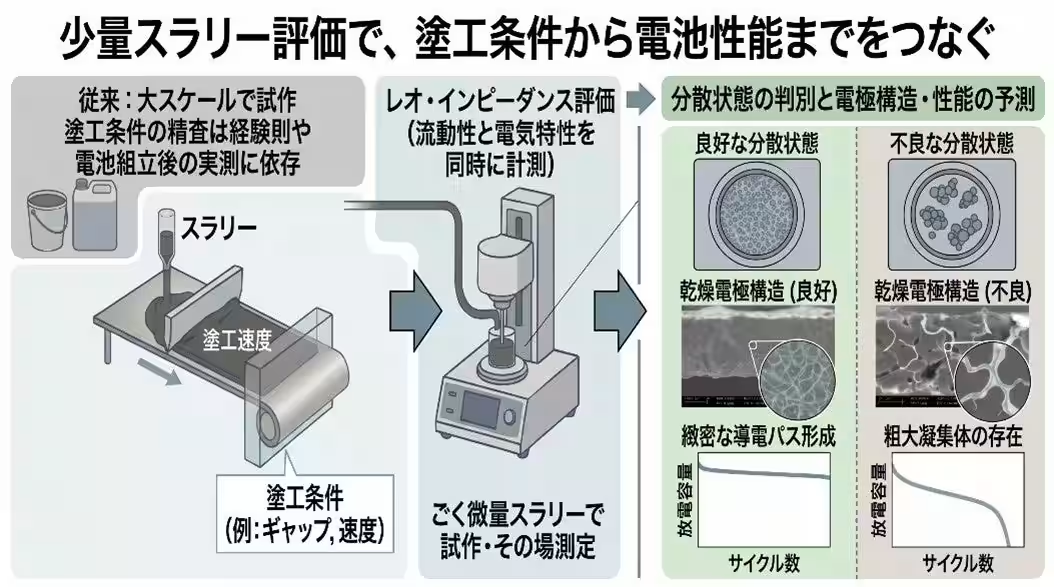
By employing a technique known as rheo-impedance measurement, the research team replicated actual coating conditions, enabling them to evaluate slurry properties on a micro-scale effectively. They discovered a clear inverse correlation between the electrical resistance of the slurry and that of the resulting electrode, revealing significant structural differences that underpin this relationship. The researchers were able to identify parameters that correlate with the performance of the dried electrodes, facilitating rapid identification of promising coating conditions prior to battery assembly.
This innovative method leverages less than 1 mL of slurry per test condition and accomplishes evaluations in approximately five minutes. It allows researchers to streamline the exploration process, considerably reducing the number of prototypes needed, as well as minimizing material waste and associated costs.
Key Findings and Implications
The study revealed that the electrical resistance of the slurry does not simply vary linearly with coating speed. Instead, it reaches a maximum at moderate speeds, suggesting that the dispersion of carbon black particles varies with the speed of application. Notably, slurries at lower speeds maintain larger aggregates, resulting in lower resistance, while moderate speeds yield a complex network conducive to optimal conductivity.
Crucially, the findings indicate that moderate coating speeds are ideal for creating the most effective conductive networks within the electrodes, leading to enhanced battery performance. When testing electrodes made under various conditions, those produced at moderate speeds demonstrated superior charge and discharge characteristics.
This evaluation method not only promises to expedite the development of lithium-ion batteries but also applies broadly to other battery materials and future technologies, paving the way for enhanced quality control and resource efficiency in battery manufacturing.
Future Outlook
Moving forward, the team anticipates expanding the applicability of this method to include negative electrode materials, next-generation battery materials, and even to inform quality control protocols in production settings. As materials continue to evolve and new, high-cost materials emerge, having a method that swiftly assesses and optimizes production conditions with minimal resources will become increasingly valuable.
Ultimately, the feasibility of reducing development times and resource usage through this method positions it as a pivotal advancement in battery technology, promising enhanced performance in everyday devices ranging from electric vehicles to smartphones. In leading this research, Professor Shitanda expressed the vital importance of bridging material research with manufacturing processes, underscoring the potential this technique holds for reshaping future battery innovations.
Topics Consumer Products & Retail)






【About Using Articles】
You can freely use the title and article content by linking to the page where the article is posted.
※ Images cannot be used.
【About Links】
Links are free to use.