



Understanding Foam Coating Mechanisms: Why Do Bubbles Slide or Spread?
Exploring Foam Transfer Dynamics
Foam, a versatile material, is commonly found in food products, detergents, cosmetics, and extinguishing agents. Despite its frequent use, the mechanics behind foam application—specifically how and under what conditions it spreads—remain poorly understood. Researchers from Tokyo Metropolitan University, led by graduate student Masaya Endo and Professor Rei Kurita, have taken significant steps toward elucidating these unknowns. By observing how foam spreads across a substrate when influenced by a board, they have unveiled critical shifts in the foam's internal structure, contributing valuable insights into both fundamental science and practical applications.
The Importance of This Research
Understanding the conditions under which foam can effectively spread is a vital issue across numerous fields, including cleaning processes and manufacturing. For instance, while washing plastic containers, foams often slide instead of spreading efficiently. This research addresses why that occurs and under what conditions foam can transition from slipping to spreading.
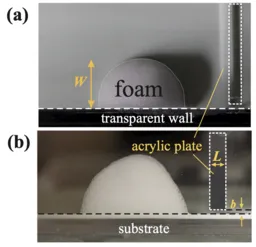
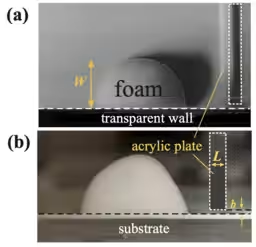
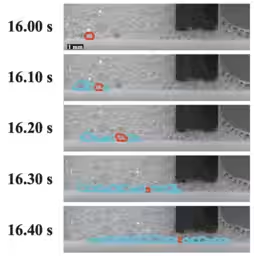
In their experiments, the team devised a method to generate foam from a surfactant solution, observing that under certain conditions, the internal bubbles within the foam exhibit movement. This movement can propagate through the foam, affecting its overall flow properties. Their findings suggest that the foam's spreading behavior can be explained by the directed percolation (DP) theory, showcasing how perturbations initiate broader dynamical transitions in foam behavior.
Key Discoveries
1. Sliding vs. Spreading: When foams are spread using a rigid board, internal bubbles move, leading to a new form of spreading behavior that occurs before a complete slip.
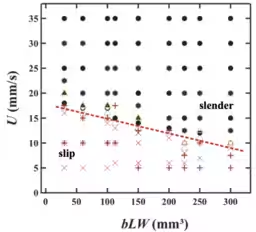
2. Boundary Conditions: The transition between sliding and spreading isn’t solely dependent on the gap or volume of foam; instead, a combination of critical parameters influences this boundary.
3. Feasibility of Control: Their research indicates that external stimuli can toggle between these two states, which could lead to innovative control methods in coating applications.
4. Link to Biological Systems: Insights gained from this foam behavior provide essential contributions to the understanding of soft jamming systems, such as the movement of cells and red blood cells within the body.
Experimental Insights
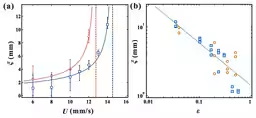
In their experimental setup, the Tokyo Metropolitan University team altered variables—such as the speed of the substrate and the gap between the foam and the board—to meticulously map out the spreading behaviors. The research revealed that foam dynamics differ significantly from those of simple liquids, highlighting the complexity of foam behavior under mechanical stress. Notably, they observed how the spreading length varied based on the velocity of application, suggesting critical behavioral shifts near specific thresholds. They noted a diverging behavior of spreading length as they approached critical speeds, alluding to relationships with critical phenomena commonly observed in physics.
The application of directed percolation theory to foam dynamics illustrates the ability of disturbances within the foam structure to lead to large-scale behavioral changes; a finding which has implications for various fields, from industrial applications to biological systems.
Implications of Findings
The research sheds light on foam slip and spread transitions, emphasizing their dependency on volume beneath the foam. This reveals that in scenarios where slip occurs, introducing disturbances can facilitate spreading. This newfound control over foam dynamics holds enormous promise for numerous industries, including food processing, cleaning supplies, cosmetics, and thermal insulation, among others. Industrially applicable solutions can enhance the efficiency of coatings and potentially lead to more effective use of multifunctional foams.
In summary, the recent study elucidates significant principles governing foam dynamics while providing foundational knowledge that is likely to spur innovations in various practical applications. Understanding how bubbles transition from slipping to spreading opens the door to advanced methodologies in numerous industrial sectors.
Topics Consumer Products & Retail)
【About Using Articles】
You can freely use the title and article content by linking to the page where the article is posted.
※ Images cannot be used.
【About Links】
Links are free to use.