



Discovering the 2025 Office Unit Price Map: Trends in the Bay Area
Trends in the 2025 Office Unit Price Map
The latest release of the Office Unit Price Map for 2025, published by Hitokara Media, focuses on the Gulf area’s office space dynamics. This year, a comprehensive survey was conducted on roughly 400 office buildings with available floor spaces of 100 to 300 tsubo in Tokyo, revealing key insights into the current real estate market.
What is the Office Unit Price Map?
The Office Unit Price Map was developed to address the discrepancies between advertised rental prices and actual transaction prices. Every year, Hitokara Media compiles and publishes this resource based on thorough research conducted by Daichi Kohata, the head of the company’s planning department. Instead of using initial rental rates, the report estimates prices close to the negotiated rates, providing a more accurate portrayal of the market trends.
Summary of the 2025 Office Unit Price Map
Here are three notable findings:
1. Significant Decrease in Vacancy Rates
- The post-pandemic recovery is driving companies back to physical offices, particularly in central Tokyo, where vacancy rates are rapidly declining. In high-demand neighborhoods, competition for properties is growing, making it increasingly challenging to secure spaces that meet companies' requirements.
2. Doubling of Areas with Rent Over ¥30,000
- This year, the number of areas where rental rates exceed ¥30,000 has doubled from five to ten, including popular locations like Omotesando, Ginza, and Roppongi.
3. Sharp Increase in Rental Rates in Key Areas
- The rental prices in the Otemachi, Marunouchi, and Yurakucho areas have significantly risen. These districts remain highly desirable, with rates exceeding ¥30,000, and Marunouchi reaching the ¥50,000 mark. Due to the high tenant retention rates, available properties are scarce and tend to be quickly leased.
Bay Area: An Unexpected Hidden Gem
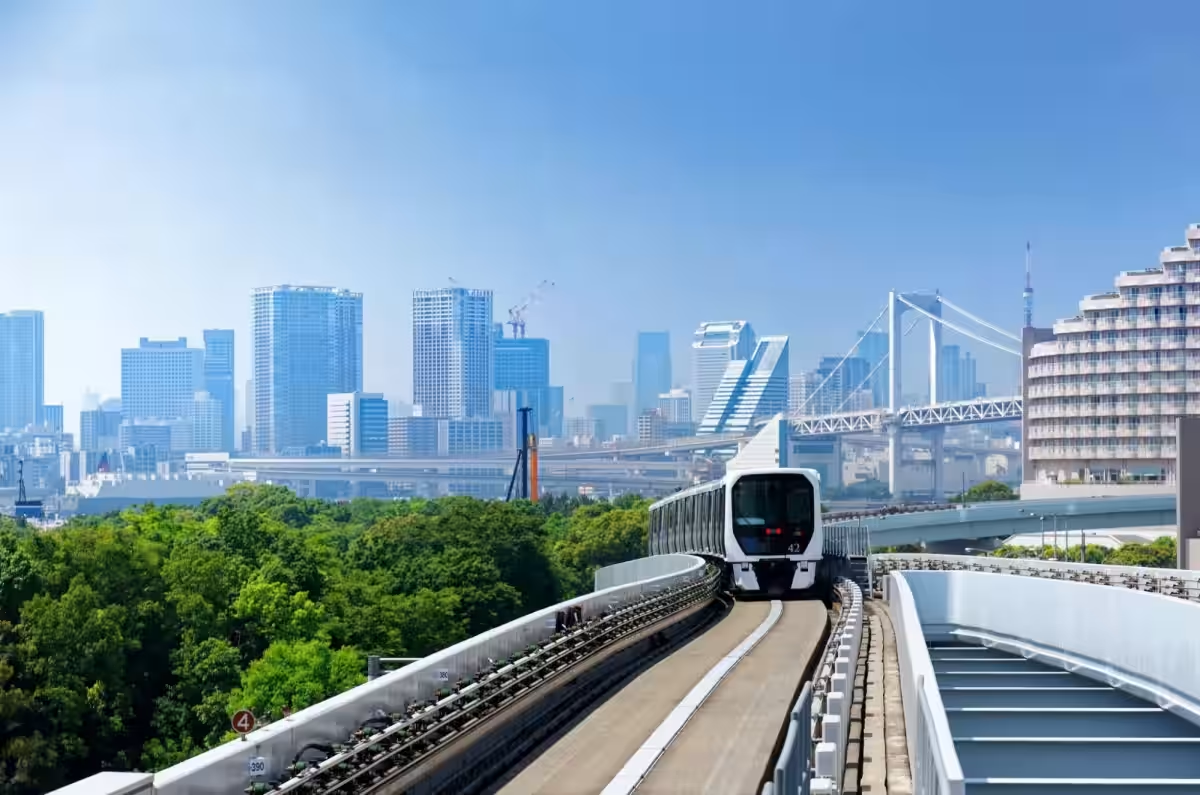
When looking to establish an office in Tokyo, the Bay Area, including Tsukishima, Kachidoki, Toyosu, Ariake, Shinonome, and Odaiba, emerges as an attractive option.
Reason 1: Cost-Effective Rental Prices
- The first notable advantage is the affordability of the rent. Rental prices in the Bay Area are roughly half of those in Shibuya, providing excellent cost performance. Moreover, some properties offer up to 12 months of free rent, significantly reducing initial investment costs.
Reason 2: Convenient Accessibility
- Although there are concerns about accessibility, transportation from Shibuya takes about 20 minutes by train. The area also boasts multiple office buildings near stations, ensuring commuting times are competitive with central Tokyo.
Reason 3: Support for Moving Costs
- The Bay Area is under a major redevelopment initiative, the Tokyo Bay eSG Project, aiming to enhance the area’s livability in the long term. Startups relocating to coastal urban centers may now be eligible for up to ¥5 million in subsidies for renovation, interior, and equipment costs.
Insights from Hitokara Media
Kohata Daichi, known for expertise in office market trends, provides extensive insights based on the Office Unit Price Map, highlighting emerging neighborhoods and the current dynamics in the office space market. Through interviews and analytical pieces, he sheds light on the relevant factors influencing the office rental landscape.
For a deeper understanding of Tokyo's evolving office market, be sure to explore the Office Unit Price Map for 2025 here.
About Hitokara Media
Established in 2013, Hitokara Media focuses on office relocation support, real estate development, and community project aids. Led by CEO Junichiro Takai, the company has been actively contributing to office space relocations across a diverse range of companies, from startups to large enterprises, maintaining a strong understanding of market trends and developments.

Topics Consumer Products & Retail)
【About Using Articles】
You can freely use the title and article content by linking to the page where the article is posted.
※ Images cannot be used.
【About Links】
Links are free to use.