



Kyushu University and BlueMeme Develop Innovative Network Analysis Technology
In an exciting development for network analysis, the research group at Kyushu University, in collaboration with BlueMeme, has launched a new technology aimed at deciphering complex networks from a group-based perspective. BlueMeme, headquartered in Chiyoda, Tokyo, has been partnering with Kyushu University since 2023 to enhance software development efficiency and sophistication through industry-academia collaboration. The research conducted by Professor Andre Fujita's team at the Institute of Bio-Defense Medicine has resulted in a novel approach to analyzing network structures, emphasizing relationships between groups rather than solely between individuals.
Traditional network analysis primarily focused on one-to-one relationships; however, many real-world scenarios, such as social media group chats, metabolic pathways, or neural activity networks, involve multiple elements interacting simultaneously. This new approach utilizes a structure known as a "hypergraph," allowing researchers to treat multiple nodes as a single cohesive unit (hyper-edge). This method provides a more realistic representation of complex interrelations that traditional one-to-one networks could not capture. The red ellipses representing hyper-edges illustrate the unique group relationships and visualize the complexities of these connections.
To facilitate this advanced analysis, Professor Fujita's team has constructed cutting-edge statistical methods by analyzing the spectra (eigenvalue distribution) contained within hypergraphs. These methods include:
This framework opens the door to structural analysis based on group relationships, paving the way for applications across various domains such as society, nature, and medicine.
Moreover, as this technology aims for real-world implementation, one of the significant challenges ahead is the computation load associated with large-scale data. The process of spectral analysis necessary for network evaluation demands considerable computational resources, which increase dramatically with larger networks. Here, quantum computing emerges as a potential solution, promising to handle complex calculations quickly and in parallel. This synergy could enable high-speed, precise analysis, particularly in rapidly evolving domains like social media and IoT, by combining quantum AI with the new analytic methods.
Examples of real-world applications made possible by this technology include:
Professor Andre Fujita comments, "Current methods focus on deterministic changes in hyper-edges or assume single observational structures. Our methodology highlights the significance of accounting for random fluctuations and structural uncertainties. With this technology, we can statistically analyze the complicated systems of the real world that involve higher-order interactions, understand the underlying generative mechanisms, and compare various systems, making it a powerful tool with broad applications."
BlueMeme's continued commitment to advancing technological development through innovative research like this aligns with its mission to address societal challenges and create new value.
BlueMeme, established in 2012, pioneered the introduction of the low-code development platform 'OutSystems' in Japan and has become a leading force in the low-code development market. With a track record of over 170 successful low-code product implementations and 4,900 service offerings utilizing low-code solutions, as well as nurturing over 6,100 OutSystems technicians, BlueMeme has been recognized as Asia's first OutSystems Premier Partner. Using its unique Agile methodology 'AGILE-DX', the company effectively operates agile and low-code techniques, striving to realize next-generation information system development that enables disruptive transformations and enhances the international competitiveness of Japanese firms.
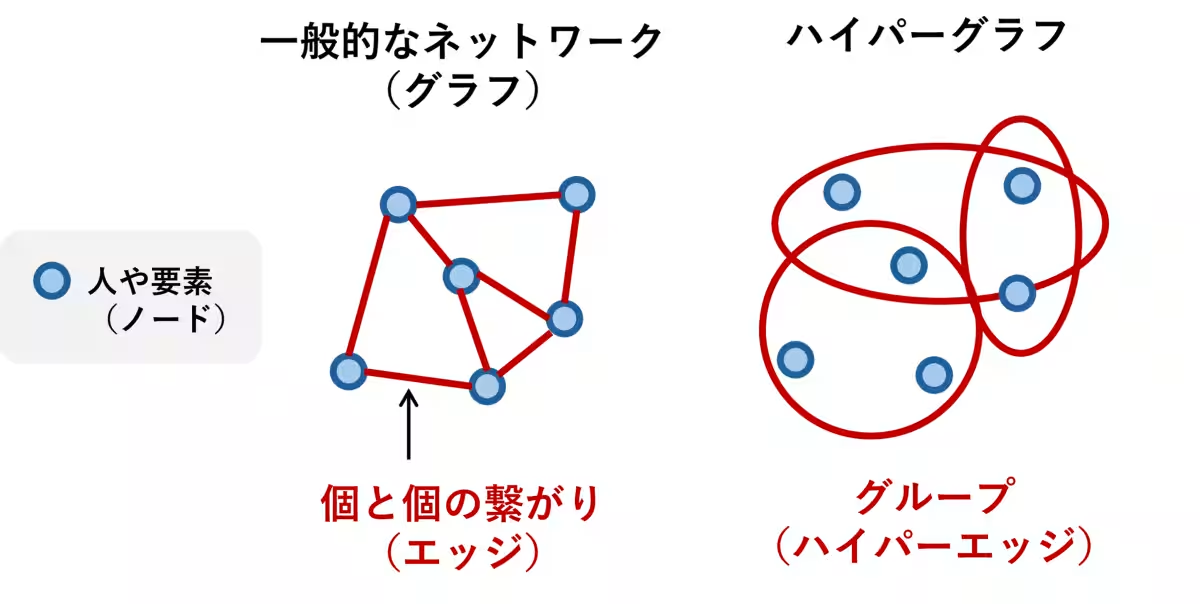
Traditional network analysis primarily focused on one-to-one relationships; however, many real-world scenarios, such as social media group chats, metabolic pathways, or neural activity networks, involve multiple elements interacting simultaneously. This new approach utilizes a structure known as a "hypergraph," allowing researchers to treat multiple nodes as a single cohesive unit (hyper-edge). This method provides a more realistic representation of complex interrelations that traditional one-to-one networks could not capture. The red ellipses representing hyper-edges illustrate the unique group relationships and visualize the complexities of these connections.
To facilitate this advanced analysis, Professor Fujita's team has constructed cutting-edge statistical methods by analyzing the spectra (eigenvalue distribution) contained within hypergraphs. These methods include:
- - Parameter estimation: Numerically capturing the intricacies of complex structures.
- - Model selection: Automatically identifying the optimal network model.
- - Structural comparison (ANOHVA): Analyzing whether multiple networks share the same generative mechanism.
This framework opens the door to structural analysis based on group relationships, paving the way for applications across various domains such as society, nature, and medicine.
Moreover, as this technology aims for real-world implementation, one of the significant challenges ahead is the computation load associated with large-scale data. The process of spectral analysis necessary for network evaluation demands considerable computational resources, which increase dramatically with larger networks. Here, quantum computing emerges as a potential solution, promising to handle complex calculations quickly and in parallel. This synergy could enable high-speed, precise analysis, particularly in rapidly evolving domains like social media and IoT, by combining quantum AI with the new analytic methods.
Examples of real-world applications made possible by this technology include:
- - Social Media Analysis: Visualizing relationships among user groups improves recommendation accuracy and optimizes information dissemination.
- - Infection Modeling: Analyzing trends of disease spread not just at the individual level but also by group enhances predictive accuracy.
- - Organizational Structure Analysis: Clarifying relationships between departments and project teams within companies aids in organizational reform and personnel placement decisions.
- - Chemistry and Biology Applications: This technique can also be applied to analyze complex natural structures such as metabolic pathways and neural networks.
Professor Andre Fujita comments, "Current methods focus on deterministic changes in hyper-edges or assume single observational structures. Our methodology highlights the significance of accounting for random fluctuations and structural uncertainties. With this technology, we can statistically analyze the complicated systems of the real world that involve higher-order interactions, understand the underlying generative mechanisms, and compare various systems, making it a powerful tool with broad applications."
BlueMeme's continued commitment to advancing technological development through innovative research like this aligns with its mission to address societal challenges and create new value.
BlueMeme, established in 2012, pioneered the introduction of the low-code development platform 'OutSystems' in Japan and has become a leading force in the low-code development market. With a track record of over 170 successful low-code product implementations and 4,900 service offerings utilizing low-code solutions, as well as nurturing over 6,100 OutSystems technicians, BlueMeme has been recognized as Asia's first OutSystems Premier Partner. Using its unique Agile methodology 'AGILE-DX', the company effectively operates agile and low-code techniques, striving to realize next-generation information system development that enables disruptive transformations and enhances the international competitiveness of Japanese firms.
Topics Business Technology)
【About Using Articles】
You can freely use the title and article content by linking to the page where the article is posted.
※ Images cannot be used.
【About Links】
Links are free to use.