



Successful Transmission of Next-Generation Error Correction Codes Over Ground-Satellite Optical Communication
Introduction
In a groundbreaking achievement, the National Institute of Information and Communications Technology (NICT), in collaboration with Nagoya Institute of Technology and Japan Aerospace Exploration Agency (JAXA), has successfully demonstrated the transmission of next-generation error correction codes designed to counteract atmospheric disturbances in ground-satellite optical communication. The realization of this technology marks a significant step forward in improving data transmission quality and facilitating the practical application of ground-satellite optical communication systems.
Background
NICT has been dedicated to advancing the practical application of ground-satellite optical communication technology, facing significant technical challenges related to overcoming atmospheric fluctuation effects. Studies have shown that atmospheric disturbances cause fading, leading to continuous erroneous data in communication. To address this issue, NICT has employed cutting-edge technologies, including optical systems for compensation and error correction codes, focusing on the latter to eliminate the complexities of controlling intricate optical systems. By utilizing next-generation codes such as 5G NR LDPC and DVB-S2, NICT has actively planned experiments aimed at demonstrating effective error correction capabilities.
Experimental Setup
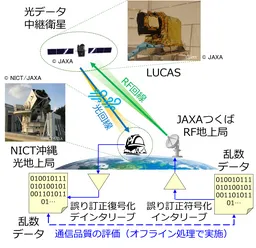
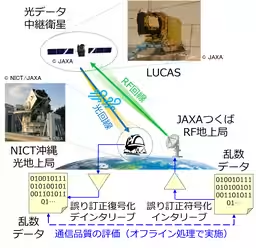
For the recent experiments, NICT utilized a 1-meter optical ground station in conjunction with the LUCAS optical inter-satellite communication system, currently operational within JAXA’s satellite systems. The ground-to-geostationary satellite communication line yielded a substantial 60 Mbps downlink, where NICT executed transmission experiments featuring both 5G NR LDPC and DVB-S2 error correction codes to address atmospheric fading impacts. Researchers adjusted interleaving and error correction code conditions based on data acquired during prior studies of atmospheric fluctuations. The comprehensive analysis of transmission data confirmed the successful correction of erroneous data caused by atmospheric disturbances, demonstrating a tangible improvement in communication quality.
Results
The experiments successfully showcased the effective application of 5G NR LDPC and DVB-S2 error correction codes, which not only possess high error correction capabilities but also offer ease of hardware implementation and the potential for interoperability with future 5G communication systems. As a result, this innovation is poised for notable contributions to the advancement of ground-satellite optical communication. The successful error correction demonstrated in this innovative experiment has opened new avenues for addressing the quality issues previously encountered in ground-satellite communications.
Future Prospects
The outcomes of this research bolster the prospect of enhancing communication quality in ground-satellite systems, thereby paving the way for the integration of terrestrial 5G communication protocols and satellite broadcasting into a cohesive space network. This progress is expected to facilitate hybrid systems that capitalize on both terrestrial and satellite communication capabilities. Furthermore, findings from this experiment will be presented at the International Conference on Space Optical Systems and Applications (ICSOS 2025) scheduled for October 28, 2025, marking a global discourse on advancements in optical communication technologies.
Collaborative Roles
The collaboration among participating organizations is distinct yet interconnected:
- - NICT: Focused on refining conditions for error correction code and interleaving, as well as evaluating the relationship between atmospheric fluctuations and error correction efficacy.
- - Nagoya Institute of Technology: Engaged in generating transmit error correction code data, decoding received data, and developing algorithms for error correction codes.
- - JAXA: Responsible for planning experiment operations, examining future integration with space missions, and managing the operations of the LUCAS onboard the optical data relay satellite.
With this significant development facing the domain of optical communication, the continued exploration and collaboration hold great promise in overcoming the complexities introduced by atmospheric conditions, yielding a more robust communication framework for the future of space communications.
Topics Telecommunications)
【About Using Articles】
You can freely use the title and article content by linking to the page where the article is posted.
※ Images cannot be used.
【About Links】
Links are free to use.