



Exploring the Future of Physical AI and Autonomous Driving: Insights from the Latest Hardware Report
The Future of Physical AI and Autonomous Driving
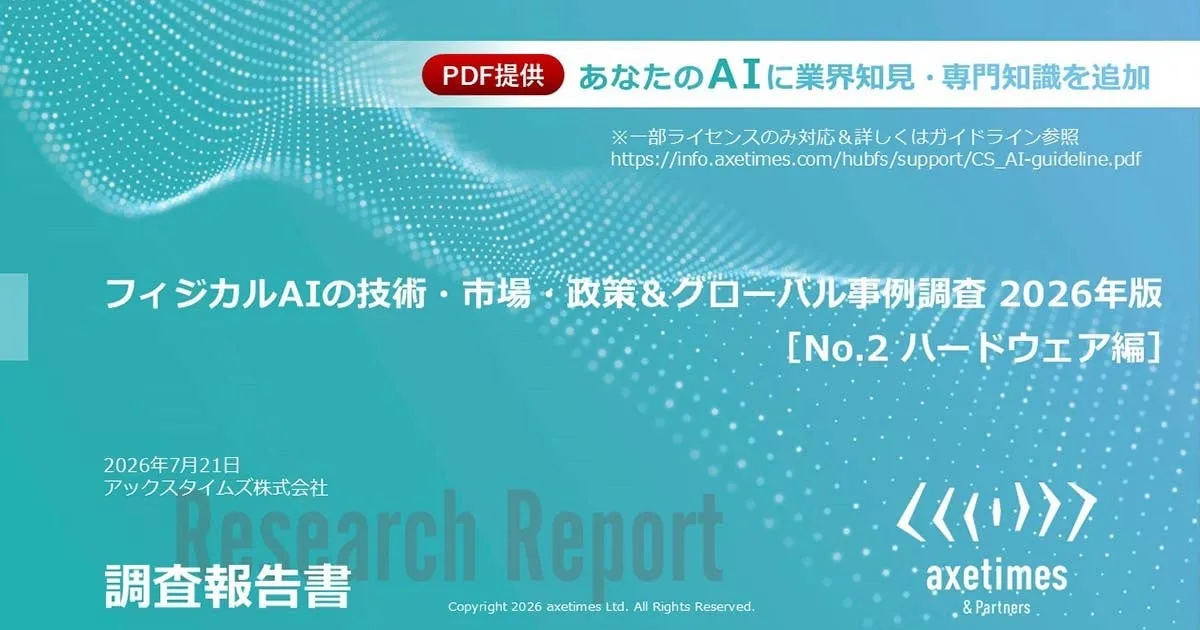
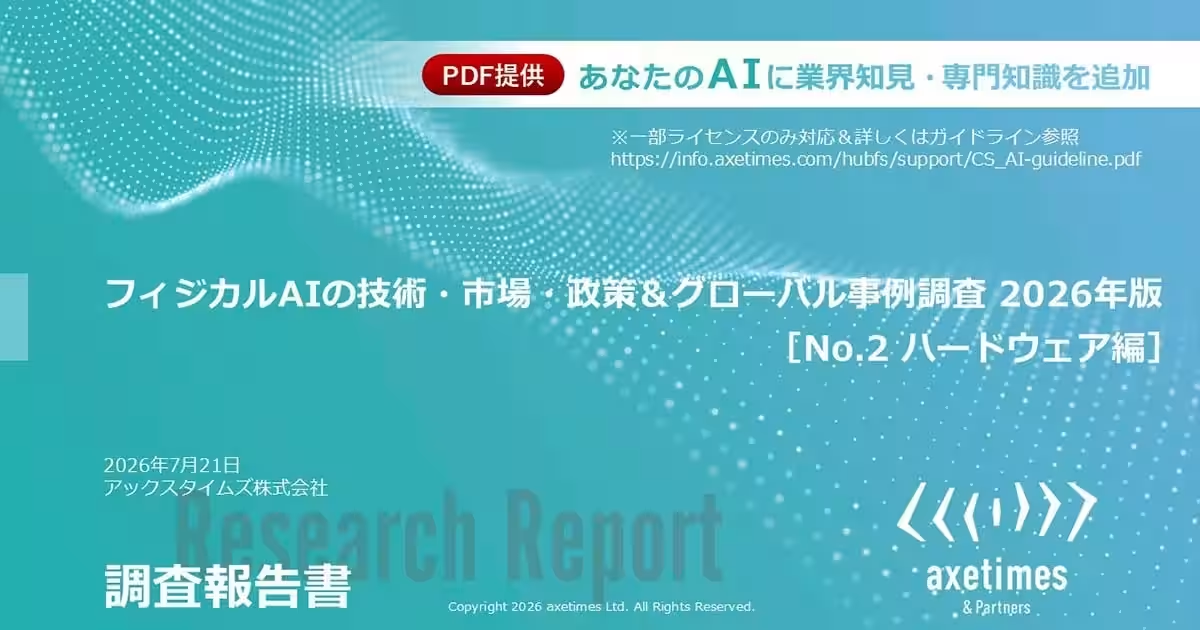
In recent years, the field of Physical AI, which encompasses robotics and autonomous driving technologies, has gained significant traction. A recent report released by AXTIMES, headquartered in Osaka, Japan, provides an exhaustive overview of the hardware technologies driving this innovative sector, encapsulated in the report titled 'Physical AI Technology, Market, Policy & Global Case Studies 2026 Edition: No.2 Hardware'. The report was made public on July 21, 2026, and aims to shed light on the market size, share, applications, and corporate strategies pertaining to Physical AI.
Overview of the Report
The report not only presents sales of the research findings but also offers seminars and lectures aimed at both corporate entities and economic associations promoting innovation and startup initiatives. Additionally, a special webinar will be hosted later for those who pre-purchase the report, showcasing an accessible channel for understanding the significant data and recommendations included.
Key contents derived from the report include:
- - A visualization of market activities through primary data from interviews and systematic public information research.
- - Insights into individual technologies covering aspects such as market size forecasts, shares, applications, and more.
- - An Excel dataset featuring a comprehensive listing of 709 case studies on technological development in the field.
Target Audience
The report is particularly beneficial for various sectors, including:
- - AI Development, IT Development, Manufacturing, Telecommunications, and Logistics.
- - Specifically for manufacturers: Robotics, Electronics, Automotive, Control Equipment, Machine Parts, and Semiconductors.
- - Strategists and researchers within Management and R&D departments looking for evidence-based insights.
The latter part of this release provides a link to a preview of the report to assist potential buyers in making informed decisions.
Background and Objectives
The rapid evolution of AI technology has fueled interest in Physical AI—technologies that perceive the real world and make autonomous decisions. The integration of AI into humanoid robots, factory automation robotics, vehicles, and drones is advancing rapidly, opening new business opportunities not only for software and AI companies but also for hardware-based sectors such as manufacturing, logistics, and the automotive industry.
However, the swift pace of technological development can create confusion in understanding the overall market environment and trends. Hence, this research aims to systematically analyze the Physical AI market through aspects like market size forecasts, structural dynamics, and policy trends, thus providing clarity and visualization of future business opportunities.
Structure of the Report
The report is divided into two main segments:
- - No.1 Overview, Policy, and Infrastructure: encompassing aggregated data and analysis across the Physical AI landscape.
- - No.2 Hardware Section: detailing market size, share, challenges, and applications for individual technologies. Additionally, an extensive Excel dataset provides a global listing of examples—709 case studies showcasing initiatives in specific areas.
The latest hardware analysis targets 19 technologies within the realm of Physical AI, offering businesses insights into market conditions and strategies for new project development.
Key Findings
Demand Stages and Market Size
The report classifies the demand for various technologies into different stages and provides projections for the global market size by 2025:
- - Initial Demand Stage:
- Humanoid Robots: ¥50 billion
- Quadrupedal Robots: ¥16 billion
- Delivery Robots: ¥10 billion
- Construction Machinery: ¥4 billion
- Agricultural Machinery: ¥1 billion
- - Demonstration Stage:
The primary hardware market exhibits varying levels of social implementation progress. Notably, passenger vehicles and robotaxis lead the market due to advancements in autonomous driving technology. By 2025, the global market for these vehicles is expected to grow significantly due to the integration of AI in traffic navigation, environment recognition, and vehicle control capabilities. The existing automotive industry provides a solid foundation for these technologies, predicting their emergence as a leading sector in the Physical AI marketplace.
Future Perspectives
The outlook for humanoid robots, particularly those from leading firms in the U.S. and China, forecasts a market size of ¥50 billion by 2025. Adoption in the manufacturing and logistics sectors is expected to increase, focusing on standardizing operations with a learning data infrastructure to adapt to diverse real-world environments.
Other important technologies are transitioning from traditional automation, dictated by preset rules, to scenarios where AI processes real-time information from sensors, adjusting operations flexibly as conditions change. As the technology matures and production costs decrease, it's anticipated that the demand across various hardware will continue to expand.
In conclusion, the potential for Physical AI and autonomous technologies remains vast. Companies positioned within this sector can leverage insights from the AXTIMES report to navigate and capitalize on emerging business opportunities.
Additional Information
For further exploration of the report details and purchase options, please visit AXTIMES Product Site.

Topics Consumer Technology)

【About Using Articles】
You can freely use the title and article content by linking to the page where the article is posted.
※ Images cannot be used.
【About Links】
Links are free to use.