



Advancement in Understanding the Quenching Mechanism of Thorium-229 Isomer for Nuclear Clocks
New Insights into Thorium-229 Nuclear Isomers
Recent research collaboration involving Okayama University, the SPring-8 synchrotron, and various other prestigious institutions has made groundbreaking progress in understanding the quenching mechanisms of thorium-229 nuclear isomers. This research, published in the journal Physical Review Letters, highlights the temperature-dependent aspects of X-ray-induced quenching phenomena in crystalline structures.
Quenching Phenomena Explained
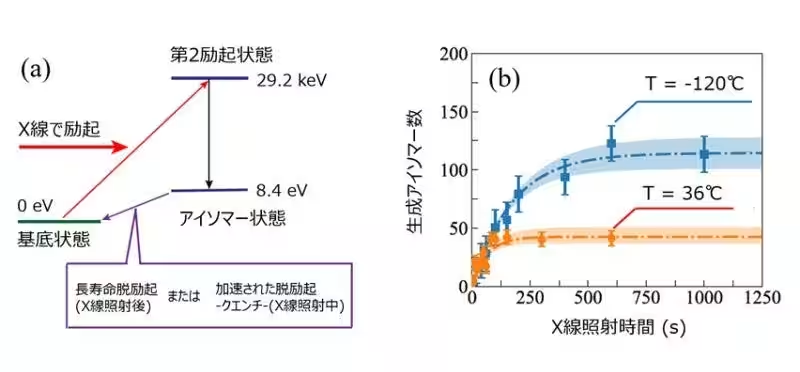
The team successfully measured how the deactivation of excited states within thorium-229 nuclei behaves under different temperature conditions. They discovered that the quenching effect is correlated with the diffusion of excited electrons and their interaction with thorium nuclei. A new model was established to explain these physical processes within the framework of nuclear physics, focusing specifically on their implications for solid-state nuclear clocks.
Importance of Thorium-229
Thorium-229 is unique due to its excited state, also known as an isomer, which can be directly excited using laser light. This special characteristic raises the possibility of establishing more stable time standards, thus offering prospects for advancements over traditional atomic clocks in both academic research and practical implementations. The goal is to achieve unprecedented accuracy that could revolutionize timekeeping technologies and applications in satellite positioning systems.
Implications for Future Technologies
The understanding gained from this research is pivotal for the development of portable and highly accurate solid-state nuclear clocks. Such advancements could lead to improved methodologies in a variety of fields, including satellite navigation, gravitational field observations, and fundamental physics research such as studies of dark matter and variations in physical constants.
Research Collaboration and Findings
The multidisciplinary project involved contributions from graduate students and professors along with affiliate researchers from Kyoto University, RIKEN, and Osaka University, among others. The experiments, conducted at the high-intensity X-ray facility SPring-8, utilized sophisticated techniques to accelerate the quenching processes within embedded thorium-229 isomers. This cooperative research underscores the necessity of interdisciplinary approaches in tackling complex scientific problems.
The lead researcher, Ming Guan, expressed immense gratitude toward the collaborative efforts that led to these findings. He remarked on the significance of this research, emphasizing how it connects condensed matter physics, nuclear science, and electronic behavior—an intricate dance of nature that creates groundbreaking opportunities for future scientists.
Next Steps and Future Applications
With this fundamental understanding, the research group is eager to continue exploring the practical applications of thorium-229 nuclei and their associated technologies. The ongoing development of high-precision nuclear clocks is just the beginning.
The major finding, detailed in Physical Review Letters, was supported by multiple grants from the Japan Society for the Promotion of Science and significant contributions from international funding agencies. The research showcases the potential of nuclear science to provide solutions to modern technological challenges.
For further insights, access the complete research documentation via this link.
This remarkable advancement not only reflects the immense potential of collaborative scientific efforts but also highlights the critical nature of understanding quantum phenomena which could play a crucial role in shaping our technological future.




Topics Consumer Technology)

【About Using Articles】
You can freely use the title and article content by linking to the page where the article is posted.
※ Images cannot be used.
【About Links】
Links are free to use.