




The Impact of Key Personnel on Workplace Dynamics: Insights from Recent Interviews
The Impact of Key Personnel on Workplace Dynamics
Introduction
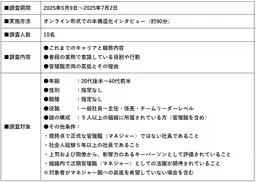
The Sanno University Research Institute in Setagaya, Tokyo, recently conducted a comprehensive interview survey focusing on 10 key personnel members in various workplaces. These individuals play significant roles in influencing workplace dynamics and contributing to organizational achievements. This article delves into their awareness and actions at three critical levels: individual, team, and organization, as well as factors affecting their aspirations for management roles.
Background of the Survey
With the changing landscape of work, the concept of a “playing manager” is increasingly common among many companies. In 2023, statistics revealed that only 5.1% of department managers did not engage in operational duties alongside their management responsibilities. This shift has expanded the roles and expectations of workplace management. As a result, managers often face challenges in nurturing subordinates and supporting their career development due to time constraints and a diversity of values and career views among employees. Key personnel—individuals acknowledged by their supervisors and colleagues as reliable and essential to workplace functioning—play crucial roles in supporting daily operations and fostering relationships.
Summary of Findings
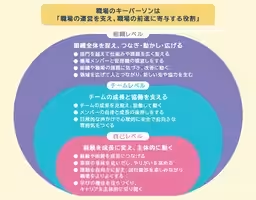
1. Key personnel have defined roles across the three levels of self, team, and organization, complementing functions that cannot be managed solely by department heads.
2. Although these individuals are potential candidates for management positions, many express uncertainty about pursuing such roles.
3. Factors influencing management aspirations include both motivating (facilitating) and inhibiting (restraining) elements.
In-Depth Findings
Roles of Key Personnel
The research emphasizes that key personnel fulfill important management roles that are often overlooked, particularly as the workload for playing managers increases. The awareness and actions of these individuals are categorized uniquely into three levels: self, team, and organization. This framework shows that they help supplement managerial functions that are lacking due to the increasing workload of traditional managers.
They have been identified as essential to sustaining the operational dynamics of their organizations and contributing to forward movement within their teams.
Uncertainty Among Management Aspirants
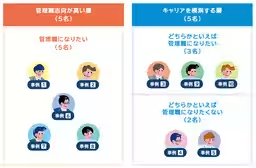
Prior to the interviews, a survey was conducted among the ten interviewees to gauge their career aspirations. The results indicated that only half of them explicitly expressed a desire to become managers. The remaining participants either showed ambivalence toward becoming managers or expressed uncertainty about their future roles. Notably, while none rejected the idea of becoming a manager outright, the division into two groups emerged: one that clearly aspired towards management and another that was still navigating their career path.
Factors Influencing Management Aspirations
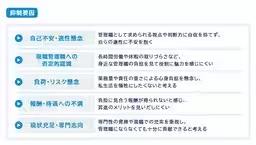
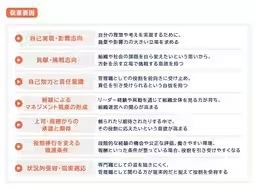
Upon further examination of the influences impacting their managerial aspirations, two categories emerged: facilitating factors and restraining factors.
- - Facilitating Factors
- - Restraining Factors
Conclusion
In conclusion, understanding the dynamics of workplace key personnel and the complexities of their roles in a management context is crucial. As organizations evolve, recognizing the contributions and aspirations of these individuals can lead to more effective management practices and better support for employees’ career development.
This study sheds light on the intricate balance between operational duties and managerial expectations, inviting further exploration into developing future leaders within organizations.


Topics Business Technology)
【About Using Articles】
You can freely use the title and article content by linking to the page where the article is posted.
※ Images cannot be used.
【About Links】
Links are free to use.