




Rising Average Prices of Newly Built Apartments in Tokyo's 23 Wards Surpass 100 Million Yen
Overview of Rising Property Prices in Tokyo
According to a recent analysis conducted by LIFULL HOME'S, the average price of newly built apartments in Tokyo's 23 wards has surged, with prices exceeding 100 million yen in 19 districts. As the housing demand continues to grow amid rising costs of materials and labor, the trend indicates a significant shift in the Tokyo real estate market.
Survey Details
Conducted between January and May 2026, the survey reviewed listings on LIFULL HOME'S, which is operated by LIFULL, a company focused on addressing social issues through their business. This survey marks the fourth installment since its inception in 2023. The findings reveal that, for the first time, districts such as Sumida, Arakawa, Itabashi, and Adachi have all surpassed the average price of 100 million yen.
District-Specific Pricing Trends
In 2026, Chiyoda Ward claims the top average price at an astonishing 351.5 million yen, making it the only area in the three-billion range. Following this, six wards fall into the two-hundred-million range, while twelve wards sit in the one-hundred-million range. Overall, about 80% of Tokyo's 23 wards are now classified as high-price districts.
Average Price Per Square Meter
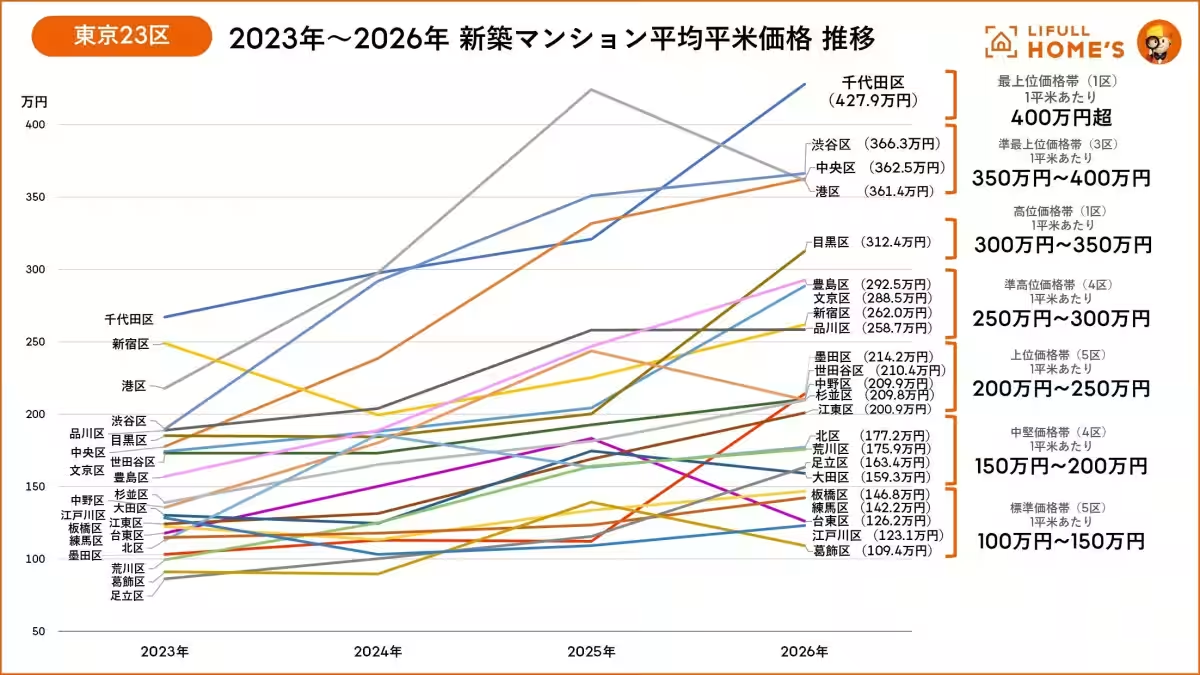
Analyzing the average price per square meter across Tokyo reveals an average of 2.305 million yen, which represents a notable increase of 11.3% from the previous year. Such increases are particularly evident in 18 out of 23 wards, demonstrating a strong demand and variability in pricing.
Significant Price Changes
Some wards have seen drastic increases. For instance, Sumida's average price per square meter skyrocketed by approximately 174.9% compared to the previous year, followed closely by Meguro with a 151.0% increase.
Implications of Rising Costs
The continuous rise in property prices can primarily be attributed to several key factors:
1. Increased material costs driven by a weaker yen.
2. Soaring labor costs impacted by a severe shortage of construction workers.
3. Escalating land prices in prime locations.
4. Stricter building regulations that demand higher quality materials for energy efficiency.
These challenges are compounded by the recent 'naphtha shock,' which has disrupted supply chains and increased construction costs further.
Moreover, the stunning rise in prices has led to distorted market behaviors. Previously high-priced properties provided advantages for inheritance tax strategies, yet changing tax regulations may impact speculative buying behaviors in the future.
Analyzing District Competitiveness
While many districts are seeing considerable price hikes, others such as Taito have responded by offering more compact apartment options, resulting in lower average prices. In contrast, prime districts showcase staggering price trends, reinforcing a growing divide in the market.
Conclusion
As the real estate landscape in Tokyo keeps evolving, LIFULL HOME'S implies that understanding these dynamics is crucial for potential buyers. With more wards entering the high-price category, the significance of market insights becomes clearer. This evolving scenario necessitates careful consideration for anyone looking to invest in the highly competitive Tokyo property market.
About LIFULL HOME'S
LIFULL HOME'S invites individuals to explore their diverse property listings and services that cater to various needs, ranging from renting to buying homes. The platform aims to help users realize their living aspirations amidst today’s complex market.
For further details about the survey, visit LIFULL HOME'S.



Topics Consumer Products & Retail)
【About Using Articles】
You can freely use the title and article content by linking to the page where the article is posted.
※ Images cannot be used.
【About Links】
Links are free to use.