




NAVEX's 2026 Incident Management Report Highlights Japan's Unique Challenges and Strengths in Whistleblowing Practices
The NAVEX 2026 Incident Management Benchmark Report
The global leader in Governance, Risk, and Compliance (GRC) solutions, NAVEX, headquartered in Lake Oswego, Oregon, has published its "2026 Incident Management Benchmark Report." This comprehensive analysis is derived from data provided by over 4,000 organizations and represents approximately 23.7 million individual reports from around 77 million employees.
According to the 2025 data, the global whistleblower reports have reached an unprecedented high, with Japan notably achieving a remarkable web reporting rate of 76%. This figure more than doubles the global average, indicating Japan's leadership in digital utilization. However, the country faces significant challenges, including a relatively low number of reports and extended investigation durations.
Disparities in Reporting Culture
Japan's whistleblowing culture has undoubtedly evolved, yet it reveals a stark contrast when compared to global averages. While the median number of reports per 100 employees worldwide stands at 1.65, Japanese organizations reported an increase from 0.44 in 2024 to 0.63 in 2025. This seems to indicate an improvement, but the gap remains wide, suggesting that critical issues may still be hidden due to cultural barriers and systemic flaws in reporting mechanisms.
The implications are serious: many unethical behaviors or problems that should typically be reported may not surface, indicating potential risks that go unnoticed within Japanese organizations.
A Shift Towards Digital Reporting
Amidst a global transition to digital platforms, Japan's speed of digital adoption is notably rapid, surpassing international rates significantly. The 76% web reporting frequency among Japanese organizations highlights this advancement, especially when compared to the global average of 34%. This shift underscores a strong demand for anonymity among whistleblowers, with anonymous reporting rates maintaining a high median of 64%.
Importantly, the effectiveness of web reporting has been evidenced by the increasing follow-up rates from anonymous reporters, rising from 38% the previous year to 41% in 2025. This trend illustrates a growing engagement from whistleblowers, indicating they are becoming more proactive in the investigative process while retaining their anonymity.
Notable Trends Unique to the Japanese Market
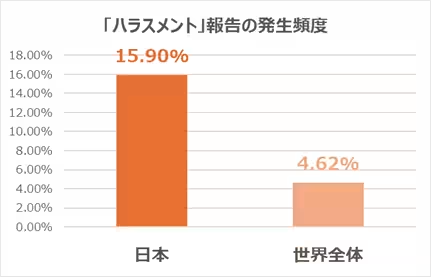
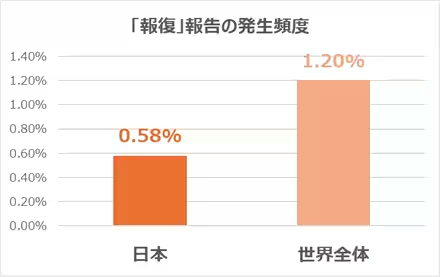
The report indicates distinctive trends in Japan's whistleblowing statistics, particularly in harassment reports, where Japan's rate of 15.90% starkly contrasts with the global average of 4.62%. Conversely, the reporting rate for reprisals is significantly lower in Japan at 0.58%, compared to 1.20% globally.
This discrepancy may reflect that while harassment is recognized as a significant issue, the low prevalence of reports concerning reprisals signifies a lingering cultural hesitance to speak out. Strong fears of social or professional retaliation inhibit individuals, even in cases where they have experienced retaliation themselves, leading to fewer overall reports. These categories fall under “Workplace Conduct,” which constitutes 50.0% of all reports from Japanese organizations. This situation highlights the unique nature of Japan's market, where interpersonal concerns coexist with deep-rooted cultural psychological barriers, necessitating further evolution towards a truly transparent environment conducive to openly raising concerns.
Quality of Reports vs. Investigation Timelines
While the quality of reports from Japan has reached global standards, evidenced by a median substantiation rate of 44%, the speed of resolution remains concerning. The median duration for investigations in Japanese organizations stands at 73 days, compared to a global median of 28 days. The complexity of cases, alongside procedural modifications due to the integration of AI tools for automated analysis and human verification, could be contributing factors to this delay.
Slow resolution poses a risk of eroding trust among whistleblowers, signaling that ensuring timely responses and transparency must become paramount in Japan's corporate governance on a global scale.
Insights from NAVEX Japan's Country Manager
Naoki Mitsuya, the Country Manager for NAVEX Japan, commented that while the report affirms the quality of Japan's whistleblowing processes meets global standards, it also reveals the hidden risks associated with the low volume of reports. To bolster organizational trust, it has become essential for leaders to foster a digital environment where employees feel safe to express their concerns and ensure thorough investigations that do not disregard these whistleblowers' inputs. The use of digital tools, including AI, can enhance accessibility and streamline investigation processes, leading to prompt and transparent problem resolution.
About NAVEX
NAVEX has earned trust from 75% of Fortune 100 and 500 companies across 13,000 organizations, standing as a global leader in governance, risk, and compliance management solutions. The NAVEX One platform enhances risk and compliance programs by leveraging industry-leading benchmark data and insights. Regardless of organization type, NAVEX One provides a comprehensive view of risks related to organizations, third parties, and ecosystems, fostering enhanced compliance and proactive risk management. NAVEX remains at the forefront of shaping the future of governance, risk, and compliance on a global scale. For more information, visit NAVEX.
Company Information
NAVEX Global, Inc.
Headquarters: 5885 Meadows Road, Suite 500, Lake Oswego, OR, 97035, United States
CEO: Andrew Bates
Website: NAVEX
NAVEX Japan LLC
Location: Tokyo Square Garden 14F, 3-1-1 Kyobashi, Chuo-ku, Tokyo
Establishment: January 2026
Country Manager: Naoki Mitsuya
Business: Sales, implementation support, and customer success for NAVEX products in the Japanese market.

Topics Business Technology)
【About Using Articles】
You can freely use the title and article content by linking to the page where the article is posted.
※ Images cannot be used.
【About Links】
Links are free to use.