




Advancements in High-Precision Image Recognition with Fractal NEXT Technology for Autonomous Trucks
Advancements in High-Precision Image Recognition
Recent developments have brought a revolutionary technology called Fractal NEXT—a high-precision image recognition method designed to enhance accuracy in various fields, particularly in the realm of autonomous vehicles. Developed by a team from Waseda University, this innovative approach aims to tackle challenges in image recognition, introducing new methods to minimize information loss in spatial and frequency data
while improving the performance of existing models.
Key Points of the Fractal NEXT Technology
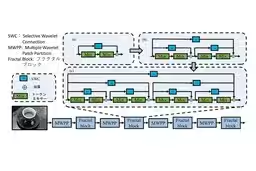
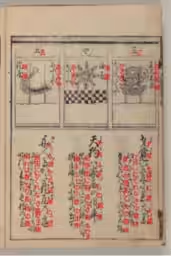
Fractal NEXT utilizes a novel approach called the fractal-wavelet method that combines wavelet transformation with the self-similar properties of fractal structures. This amalgamation allows for improved information propagation in image recognition processes, leading to higher accuracy than conventional models. Notably, evaluations using benchmark datasets, such as ResNet, have demonstrated superior recognition performance, reaching an accuracy of 76.8% on the ImageNet dataset and an impressive 81.2% on CIFAR-100. Moreover, this technology has shown exceptional results in multiple tasks, including Optical Character Recognition (OCR) for ancient scripts.
In terms of practical applications, the research team has laid ground for patent applications (Application No: 2025-154600) and is beginning collaborative research with Gunma University's CRANTS (Center for Next-Generation Mobility Social Implementation) to advance autonomous truck R&D. This technology not only holds promise for self-driving vehicles but also for areas that demand high-precision image processing, such as medical imaging.
The Challenges of Traditional Image Recognition Models
In recent years, neural networks utilized for image recognition have experienced accelerated advancements largely due to enhanced GPU performance. However, conventional models encounter limitations when extracting features from segmented images, which leads to a loss of essential information. While traditional models like ResNet focus on using residual connections to mitigate information loss, they still struggle to maintain stability in frequency information, making it difficult to recognize smaller objects reliably.
Development of Fractal NEXT
Professor Seiichiro Kamata and his research team at Waseda University have created the Fractal NEXT method, which preserves spatial information while effectively extracting tokens from image patches. This model integrates wavelet transformations to minimize information loss, creating a network structure that exhibits self-similarity within its layers. The team reported impressive results, surpassing ResNet’s performance in multiple tests, emphasizing the efficacy of the MWPP (Multiple Wavelet Patch Partition) and SWC (Selective Wavelet Connection) structures that sustain frequency information stability.
Future Implications and Societal Impact
The achievements with Fractal NEXT signify a shift in deep learning approaches within the image recognition domain. The introduction of fractal-wavelet underscores the potential for precise identification in complex images, which often contain varying scales and distances between objects. This technology opens pathways for applications in not only autonomous driving but also medical imaging and remote sensing analysis.
Recognizing Challenges and Road Ahead
While these advancements are promising, significant challenges remain before they can be widely implemented in real-world scenarios. For instance, the adaptation of this technology to autonomous trucks will necessitate accelerated processing speeds and integration with field-programmable gate arrays (FPGAs) for efficiency. The research team is focused on creating a complete dataset for autonomous vehicle sensor systems as part of their end-to-end deep learning model development.
In a community-driven effort, new research facilities like the Software-Defined Vehicle (SDV) research institute at Waseda University have been established to gather insights and partnerships among academia and industry to further this research. The long-term goal is the successful automation of trucks by 2030, covering critical routes between Tokyo and Kitakyushu with level 4 autonomy.
Conclusion
The introduction of Fractal NEXT marks a notable advancement in the pursuit of robust image recognition technologies. As further research unfolds, the potential applications could reshape numerous fields, making accurate image detection a feasible reality in both vehicular technology and healthcare.
This research was recently published in the journal Neural Networks, drawing widespread attention from both industry and academia, and paving the way for future explorations in fractal technology.
References
- - Neural Networks - FracNeXt: Enhancing visual representation learning in sequence models with fractal wavelets.
- - Research Funding: Japan Society for the Promotion of Science, Scientific Research Grant.

Topics Consumer Technology)
【About Using Articles】
You can freely use the title and article content by linking to the page where the article is posted.
※ Images cannot be used.
【About Links】
Links are free to use.