




Nihonbashi Office Rent Surpasses Marunouchi and Otemachi for the First Time
Overview of Tokyo's Office Market
A recent report by Cushman & Wakefield, a global real estate services firm based in Chicago, Illinois, indicates a significant shift in the Tokyo office rental market. For the first time, the average office rent in the Nihonbashi area has surpassed that of the Marunouchi and Otemachi districts, reflecting changing dynamics in the city's commercial property landscape.
Rental Trends and Market Outlook
The report projects that the demand for office space in Tokyo will remain high, driven by an increase in the number of office workers and limited new supply in the coming years, particularly in 2027 and 2028. Additionally, rising construction costs may lead to delays in the completion of new projects, further tightening demand and supply in the market.
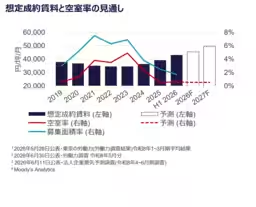
Currently, the average assumed transaction rent for Grade A office spaces in the central five districts stands at ¥43,096 per tsubo, marking a 14.5% increase year-on-year and a 4.9% increase from the previous quarter. Although the vacancy rate has risen slightly to 0.6%, it remains at a historically low level, consistently under 1% since the third quarter of 2025. This situation illustrates the ongoing disparity between high demand and constrained supply.
Regional Insights
Analysis shows that the average rent in the Kyobashi, Yaesu, and Nihonbashi areas, collectively referred to as the "Kyuhachidai area," has reached ¥55,458 per tsubo. This surpasses the Marunouchi and Otemachi area's average of ¥53,493 per tsubo, a trend that reflects a broader escalation in rental prices across various submarkets. In contrast, around 70% of the building portfolios in the Marunouchi and Otemachi areas saw increases in rental prices last quarter, while nearly 90% of the buildings in the Kyuhachidai area also experienced a rise, underscoring the heated competition for quality office spaces in these districts.
Future Projections
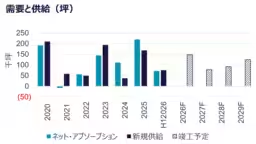
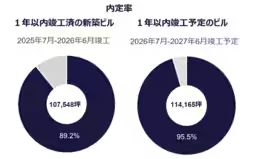
Looking ahead, the overall net absorption of office space during the first half of 2026 is expected to slightly lag behind new supply figures. Nevertheless, the net absorption had previously outpaced new supply significantly in 2024 and 2025, indicating a possible cooling off in demand despite the low availability of office space throughout the market.
The indices indicate that the inflation rate and market rental fluctuations tied to CPI-linked leases will also influence future rental rates, suggesting a complex road ahead for Tokyo's commercial real estate landscape. With anticipated consumer price index growth of approximately 1.2% to 2.4% until 2030, monitoring corporate performance remains paramount.
Conclusion
In conclusion, the Tokyo office market is grappling with conflicting forces: ongoing high demand for a dwindling supply of quality office spaces juxtaposed with potential economic downturns that may affect overall corporate earnings. As such, market participants must remain vigilant and adapt to the evolving dynamics that fundamentally shape Tokyo’s vibrant real estate landscape. For those interested in more detailed insights, the full report can be accessed through the Cushman & Wakefield's official website.
About Cushman & Wakefield
Cushman & Wakefield (C&W) is one of the world's leading commercial real estate service firms, listed on the New York Stock Exchange. With approximately 52,000 employees operating across 400 locations in about 60 countries, C&W provides a range of services, including facility management, brokerage, valuation, tenant representation, leasing, and project management. The company's ethos, "Better never settles," along with its award-winning corporate culture, has earned it accolades across various sectors. For more information, visit Cushman & Wakefield's official site.

Topics Business Technology)
【About Using Articles】
You can freely use the title and article content by linking to the page where the article is posted.
※ Images cannot be used.
【About Links】
Links are free to use.