



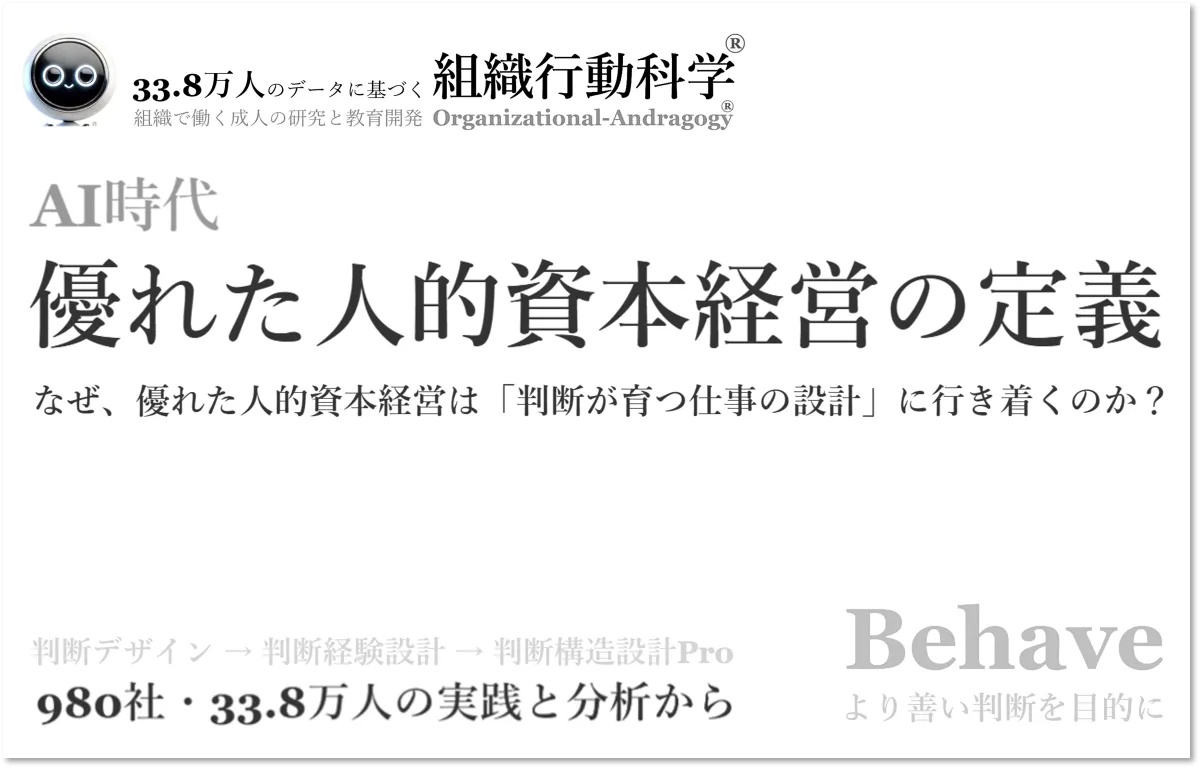
Defining Excellent Human Capital Management in the AI Era: Insights from Over 980 Companies
Defining Excellent Human Capital Management in the AI Era
Organizational Behavior Science® has recently published a report titled "Defining Excellent Human Capital Management: Why Excellent Human Capital Management Leads to 'Designing Work that Cultivates Judgment'". This in-depth analysis, spanning 29 pages and approximately 29,500 words, is based on empirical evidence from 338,000 workers across 980 companies.
Introduction
Human capital management has seen significant advancements in recent years. Companies are increasingly embracing practices such as human capital disclosures, reskilling initiatives, one-on-one meetings, and enhancements to employee engagement. Yet, there remains a pervasive sense of discontent in the workplace. Despite increased learning opportunities, not enough individuals are being entrusted with greater responsibilities, and changes in conditions often halt productivity. This report addresses these inconsistencies not as a matter of mere mental speculation but as a structural issue in job design.
Current Situation
A key concern raised by the report is that many companies, even while disclosing their human capital, have yet to reach the level of "excellent human capital management". This oversight is not due to a lack of interest in human capital management but rather a consequence of actively engaging in reforms such as work style changes, efficiency improvements, standardizations, IT updates, job-type restructuring, and compliance with human capital disclosures. As companies diligently pursue these changes, there has been a tendency for work to lean towards precedent-based practices, diminishing the opportunities for employees to cultivate judgment through experience.
While disclosures and organizational structures have improved, the design of work that nurtures judgment remains inadequate. This report seeks to visualize this gap, offering insights to advance human capital management to the next level.
Core Issues and Insights
The report emphasizes that the genuine issue within organizations is not the lack of opportunities for learning but the failure to retain learned insights as judgment within the workflow. While knowledge, information, manuals, systems, and training have proliferated, the development of individuals has stagnated. Employees are unable to take on responsibilities and the adaptability of the workforce has dwindled. A considerable analysis of operational experiences from the 980 companies shows that 82% have experienced a decrease in decision-making opportunities at work, while 58% report an increase in supervisor checks and 64% note a rise in precedent reliance. This does not indicate a diminishing need for decision-making; rather, it highlights the reality that there are many instances where jobs must adapt to customer differences, project specifics, local conditions, and stakeholder variances. Nonetheless, processes are reverting to supervisor confirmations and precedent checks, elucidating why the perception of development in human capital management remains feeble on the ground.
Deficiencies in Job Design
What has been lacking, according to this report, is not merely the insufficiency of initiatives but the inadequacies in job design. While it is crucial to establish frameworks, increase training, and enhance learning opportunities, these measures alone do not suffice to foster a growth environment where individuals can prosper, judge situations effectively, and enhance organizational responsiveness. To ensure effective human capital management, jobs must be designed in a way that cultivates and accumulates judgment, transforming individual capacity into organizational strength.
The report articulates that excellent human capital management should distinguish between jobs that can be replaced by AI and those that rely on human judgment. It advocates for designing work, experiences, and reflections that help nurture this judgment, changing it into a collective organizational strength. Thus, the core issue in human capital management transcends merely determining what to teach; it centers around ensuring that judgment remains and grows in the tasks performed.
The Shift in Focus
In the AI era, the crux of human capability is no longer the knowledge itself but the ability to determine what is important, what to verify, and how to proceed based on that knowledge and facts. With the proliferation of generative AI, knowledge retrieval, information organization, summarization, referencing existing cases, and routine processing have become increasingly replaceable. However, jobs that require adapting processes based on customer differences, project variations, local differences, and stakeholder distinctions still necessitate human involvement. Therefore, the next discussion point in human capital management shifts from "what to teach" to "how to design work so that judgments grow in the processes".
Action Points
This report outlines three key action points for companies:
1. Categorize their jobs into process-driven tasks and judgment-requiring tasks.
2. Visualize who makes decisions concerning judgment-driven tasks.
3. Specify the necessary fact-checking, delegation, and reflection practices that must be designed to support the decision-making process.
Without these foundations, human capital management will progress merely in terms of disclosures and structural adjustments, failing to enhance in-practice individual growth or organizational responsiveness.
Conclusion
Beyond providing a general overview, the report delves into specific inquiries regarding human capital management challenges, such as why enhancing training does not yield more decision-making personnel and why the measure of management should be judgment-processing capacity rather than mere staffing numbers. For organizations that aim to progress human capital management from mere initiatives to concrete job design that fosters judgment, this report is imperative reading. It showcases the subsequent steps lying beyond disclosure and initiatives, clearly articulating the next key points in the realm of human capital management.
To access the complete report and further insights, download here.

Topics Business Technology)

【About Using Articles】
You can freely use the title and article content by linking to the page where the article is posted.
※ Images cannot be used.
【About Links】
Links are free to use.