




Breaking the Long-Standing Dilemma in Organic Photovoltaics with a New Polymer Semiconductor
Addressing the Challenges in Organic Photovoltaics (OPVs)
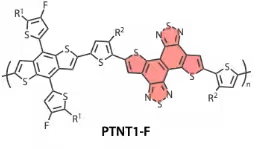
Researchers have made a significant stride in organic photovoltaics (OPVs) by addressing the traditional dilemma between voltage loss and current efficiency. This breakthrough, centered around a newly developed polymer semiconductor known as PTNT1-F, underscores the evolving capabilities of solar technology and its implications for a sustainable future.
Overview of the Research Findings
The collaboration involving Professor Itaru Osaka and Associate Professor Tsubasa Mikie at Hiroshima University has resulted in a remarkable feat: they have diminished voltage losses by up to 30% while enhancing charge generation rates by as much as 10%. This advancement is pivotal, as the interplay between voltage and current has long been a critical issue within the field of OPVs. Historically, efforts to mitigate voltage loss would lead to a decrease in current; however, the introduction of PTNT1-F has allowed for both variables to improve simultaneously.
The research was bolstered by state-of-the-art spectroscopic measurements from institutions including Kyoto University and RIKEN, as well as electronic microscopy studies conducted at Toray Research Center. These techniques played a crucial role in unraveling the underpinnings of this new material's unique characteristics.
The Significance of Organic Photovoltaics
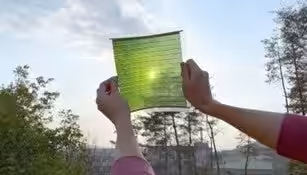
OPVs are drawing attention as a next-generation solar cell technology due to their light weight, flexibility, and the potential for manufacturing techniques that involve a coating process. Unlike perovskite solar cells, which contain harmful substances like lead, OPVs are composed solely of organic materials, making them more environmentally friendly. Despite these advantages, the energy conversion efficiency of OPVs remains lower than that of traditional silicon or perovskite cells, necessitating further enhancements.
Historically, the principles behind OPV operation suggest that increasing voltage to reduce losses would also lead to decreased current, creating a challenging trade-off. This research breaks new ground by achieving a balance that had previously seemed impossible.
Exploring the Technology Behind PTNT1-F
The researchers crafted OPV cells using PTNT1-F as the p-type semiconductor, which revealed superior voltage and current performance compared to benchmark materials. Tests indicated that the new material resulted in dramatically reduced radiative recombination, a key contributor to voltage loss, maintaining a healthy charge generation efficiency alongside reduced losses.
The analysis demonstrated that the new polymer’s molecular architecture allows for more effective charge delocalization while still stabilizing the energy differences (ΔE) necessary for charge separation—the mechanism that ultimately leads to power generation in OPVs.
The Role of Molecular Architecture
Further explorations, including X-ray diffraction and high-resolution electron microscopy, unveiled that PTNT1-F possessed a distinct structural organization, fostering better order within its nanoscale arrangements compared to traditional materials. Insights from quantum chemical calculations supported the claim that PTNT1-F permitted charges to delocalize over a wider area, easing movement and causing less voltage loss without sacrificing current.
This structural rigidity of PTNT1-F acts as a linchpin for overcoming the voltage-current trade-off, signaling a turning point for OPVs towards achieving higher efficiencies. This endeavor also represents a pivotal step towards realizing the goal of a carbon-neutral society, aligning with global sustainability efforts.
Future Prospects
The implications of this research extend well beyond its immediate findings. Researchers are optimistic that further optimization of polymer semiconductor structures will lead to even greater enhancements in OPV efficiency. As the demand for clean and sustainable energy sources escalates, the developments in OPV technology highlighted by this study could very well be at the forefront of renewable energy solutions.
In summary, this collaborative effort from various leading institutions not only addresses significant challenges in organic photovoltaic technology but also lays down crucial groundwork for future advancements. With the successful integration of PTNT1-F, the research team has not only illuminated a path for more effective OPVs but also invigorated the quest for innovative solar technologies.



Topics Energy)
【About Using Articles】
You can freely use the title and article content by linking to the page where the article is posted.
※ Images cannot be used.
【About Links】
Links are free to use.