



Hitachi Develops Innovative System for Real-Time Monitoring of Social Infrastructure Disruptions
Hitachi's New Approach to Social Infrastructure Monitoring
In a landmark development aimed at improving the response to disruptions in social infrastructure sectors such as railways, electricity, and telecommunications, Hitachi has introduced a prototype for a new situational sharing system. This system is designed to enhance the speed and effectiveness of information sharing and situational understanding when disruptions occur, with plans to launch it by the 2027 fiscal year after conducting performance verification with clients.
System Overview
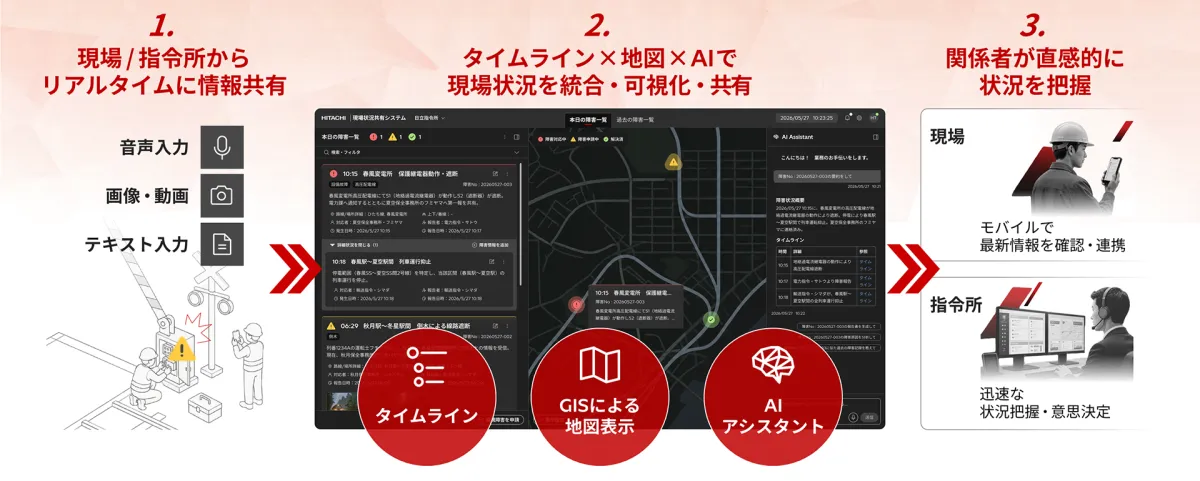
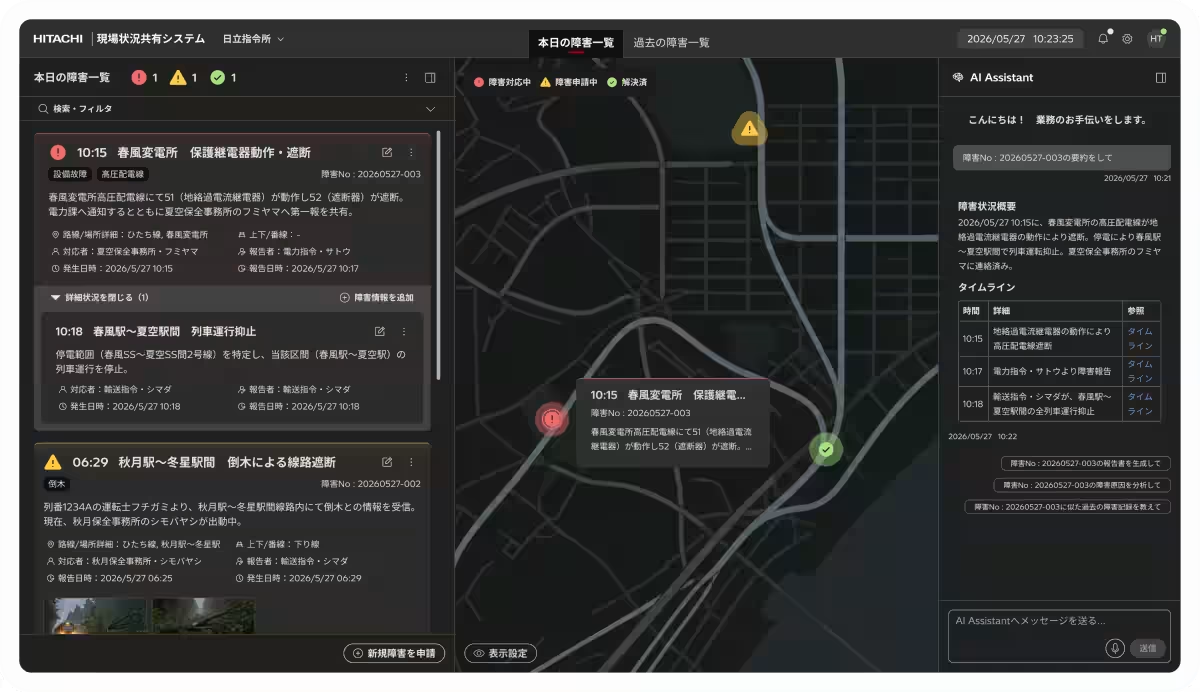
The innovative system operates by centralizing information related to equipment failures or disruptions, which are often dispersed across multiple platforms. It integrates relevant data into a cohesive timeline and visual map using GIS (Geographic Information System) technology. This allows operators to understand in real-time "when, where, what happened, and how the response is progressing" from both a temporal and spatial perspective.
Field workers can input real-time information directly from their smartphones. The system leverages AI to automatically organize this information, associating it with relevant incidents. This capability not only facilitates effective collaboration among on-site teams and command centers but also minimizes inquiries about the current status, thus speeding up decision-making and response times. Furthermore, the AI generates summaries and automated reports, streamlining the documentation process and making it easier to reference past incidents for lessons learned.
The Need for Enhanced Communication
The challenges addressed by this system stem from the inherent complexities in managing information during disruptions. In traditional settings, significant challenges arise as data regarding equipment status and response efforts are communicated through various means—such as phone calls and handwritten notes—often resulting in fragmented information sharing. This fragmentation complicates the ability to obtain a unified understanding of the incident or to track the progression of repair efforts, leading to bottlenecks in communication, particularly at command centers.
Unique Features of the System
The system offers three key strengths:
1. Centralized Information Visualization: The integration of real-time event data, equipment records, and response updates onto a single interface allows users to visually track incidents and responses on a timeline and map. This facilitates both broad situational awareness and detailed incident examination.
2. Real-Time Inputs with AI Support: On-site personnel can submit reports via text, images, videos, or voice recordings. The AI diligently extracts crucial details from these inputs, even supplementing incomplete reports to create a structured, manageable dataset.
3. Efficiency through Generative AI: By automating report generation and maintaining a historical database of responses, the system helps to alleviate the burden on personnel, making it easier to revisit and learn from past incidents, thus promoting the retention of institutional knowledge.
Future Directions
Looking ahead, Hitachi plans to conduct performance tests with railway operators in FY2026, enhancing the system's functionalities to optimize field operations and ensuring a successful rollout by FY2027. Additionally, the company is committed to further enhancements based on customer needs, including improved search capabilities and situational awareness accuracy across different infrastructure sectors.
Introduction at Hitachi Social Innovation Forum 2026
The new system will be showcased at the forthcoming Hitachi Social Innovation Forum 2026, scheduled for September 3-4, 2026, where attendees can view the innovative solutions designed to enhance field operation efficiencies and contribute to stable social infrastructure management. For additional details, interested parties can visit their official site. Hitachi Official Site
About Hitachi
Hitachi is a global leader focused on social innovation, integrating IT and operational technology to drive transformation in social infrastructure. Their vision is to create a Harmonized Society that aligns environmental sustainability with economic growth. With a gross revenue target of over 10 trillion yen for FY2025 and a workforce of approximately 290,000 employees worldwide, Hitachi aims to address societal issues through innovative digital solutions.
Topics Business Technology)
【About Using Articles】
You can freely use the title and article content by linking to the page where the article is posted.
※ Images cannot be used.
【About Links】
Links are free to use.