



Innovative Water-Based Enzyme Ink Supports Efficient Screen Printing of Electrodes
Revolutionary Development in Biomaterial Printing
In an exciting breakthrough, a collaborative research team from the Tokyo University of Science and Resonac Corporation has unveiled a cutting-edge water-based enzyme ink specifically designed for screen printing. This innovation allows for the direct creation of enzyme electrodes in a single step, significantly simplifying the manufacturing process and enhancing reproducibility.
Research Highlights
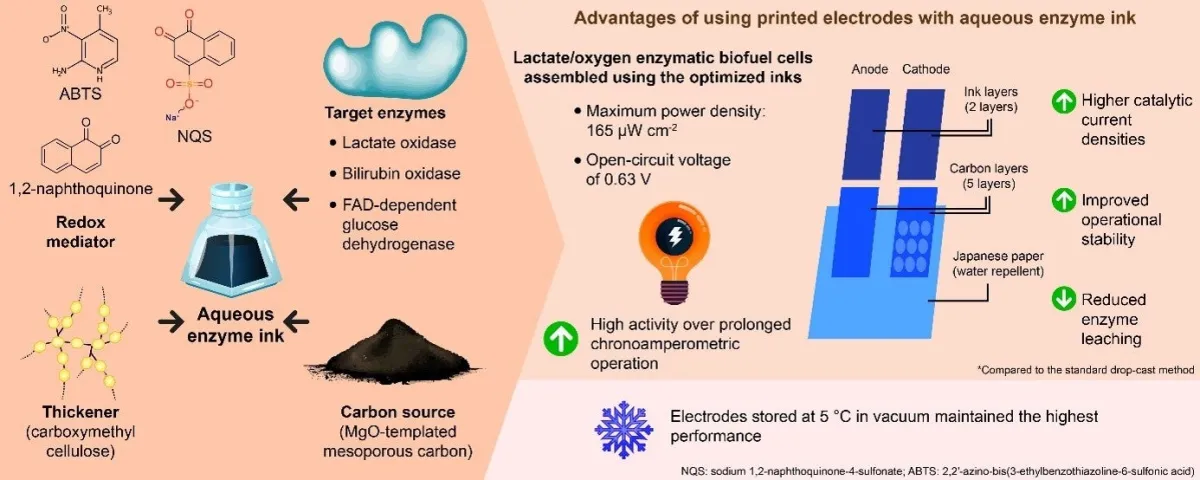
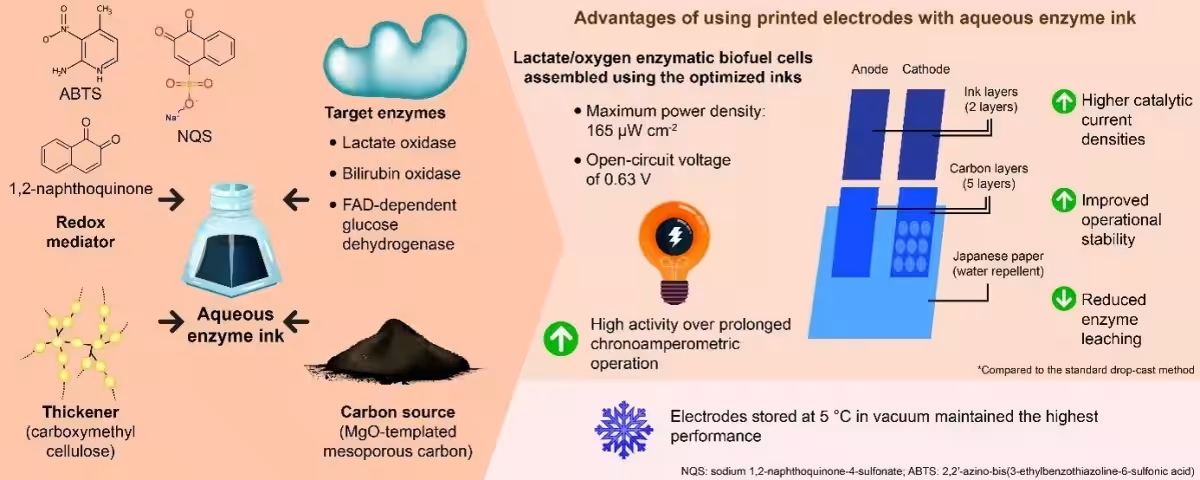
The team, led by Associate Professor Isao Shitanda and graduate student Mahiro Omori, introduced this unique enzyme ink that integrates various components such as enzymes, carbon materials, mediators, thickening agents, and a binder. By utilizing this amalgamated product, they successfully demonstrated the technology to produce biofuel cells with an open-circuit voltage of 0.63 V and a maximum power density of 165 μW/cm², along with prolonged enzyme activity retention.
Such advancements mark a substantial leap forward in the integration of biosensors and self-powered devices. With this new screen printing technology, a higher reproducibility and mass production capability are anticipated.
Background of the Research
Wearable sensors capable of continuously measuring vital parameters such as heart rate, body temperature, and sweat components have gained significant attention in recent years. However, many of these devices require external power, presenting challenges for battery replacements and long-term safety during usage.
To address this pressing issue, enzyme biofuel cells have emerged as a promising solution. They harness the catalytic properties of enzymes to convert lactate and glucose found in body fluids directly into electrical energy. By utilizing this technology, self-powered wearable sensors can potentially become a reality, eliminating the need for external power sources.
Traditional methods for electrode fabrication involved a complex, multi-stage process that often resulted in performance inconsistencies due to a separate addition of enzymes and mediators after carbon material printing. This complexity has hindered the practical deployment of such technologies.
Detailed Findings
Through meticulous research, the team developed a water-based enzyme ink composed of:
- - Enzymes such as lactate oxidase and glucose dehydrogenase
- - Carbon materials including mesoporous carbon molded with MgO
- - Redox mediators like sodium 1,2-naphthoquinone-4-sulfonate
- - A thickening agent (carboxymethyl cellulose)
- - A binder (polyvinyl alcohol LB-100)
This innovative ink made it feasible to produce electrodes via screen printing, showcasing improved electrochemical characteristics over conventional drop cast methods. Here are some significant outcomes:
1. Establishment of Functional Enzyme Ink: This project successfully created a user-friendly ink suitable for screen printing, preserving enzyme activity.
2. Simplified Electrode Formation: The one-step process eliminates performance variability, boosting the feasibility of mass production.
3. Successful Cathode Production: The research culminated in the ability to print cathode electrodes, which has been challenging until now.
4. Consistency in Performance: Demonstrating enhanced output and stable operation over extended periods, this development ensures reliability for wearable applications.
5. Broader Applications: Beyond fuel cells, it opens pathways for printing various biosensors that leverage lactate, glucose, and other biomarker measurements.
6. Roll-to-Roll Printing Capabilities: Scalability has been verified through continuous printing demonstrations, reinforcing prospects for industrial applications.
Future Prospects
Professor Shitanda expressed enthusiasm over the establishment of a practical enzyme ink technology that supports battery-free self-monitoring sensors. The applications span numerous fields, including sports training management, healthcare monitoring, and early detection systems for abnormalities, potentially contributing towards a safer and more responsive society.
In conclusion, this research represents a significant leap towards the practical implementation of enzyme-based technologies in everyday devices, holding promise for impactful innovations across various sectors. The study is set to be published on February 6, 2026, in the international journal “ACS Applied Engineering Materials.”
Topics Consumer Products & Retail)

【About Using Articles】
You can freely use the title and article content by linking to the page where the article is posted.
※ Images cannot be used.
【About Links】
Links are free to use.