




Revolutionizing Web Accessibility: Liberogic's Launch of Lente Scan Tool
Liberogic Unveils Lente Scan: A New Era in Web Accessibility
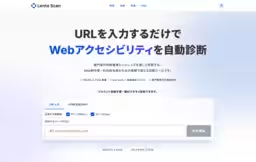
Liberogic Inc., headquartered in Minato, Tokyo, has officially launched Lente Scan, an innovative web accessibility automated diagnostic tool aimed at enhancing the accessibility of digital services. With increasing emphasis on inclusivity in the digital space, Lente Scan offers a user-friendly interface that allows users to simply input a URL to initiate a diagnostic test based on the WCAG 2.2 standards for levels A and AA. The best part? No account registration is needed for users to verify detected issues for free.
How Lente Scan Works
Lente Scan integrates open-source accessibility testing engine axe-core with Liberogic's proprietary detection engine called Lente Detect. This powerful combination not only identifies accessibility issues but also highlights areas that require human examination, thus lending clarity to the testing process. The tool systematically organizes the knowledge from certified Web Accessibility Specialists (WAS) to provide clear explanations of each detected problem along with potential solutions.
Understanding the Need
The launch of Lente Scan comes in response to the amended Disability Discrimination Act, which mandates businesses to provide reasonable accommodations for individuals with disabilities starting April 2024. This legislation raises awareness for creating environments where diverse users can access necessary information and features of websites and digital services. However, assessing web accessibility typically requires specialized knowledge. Existing automated diagnostic tools can present errors, but they often fail to elucidate the underlying issues or offer straightforward solutions. Approximately 30-40% of the WCAG success criteria can be identified through automated checks; however, human verification is crucial for assessing content semantics, keyboard navigation, and screen reader experiences.
Key Features of Lente Scan
1. Simple URL Input: Users can simply paste the URL of the public webpage into the tool and press ‘Start Diagnosis’ to commence testing. Additionally, there is an option to paste the HTML code for pages that require login or are still under development.
2. Integration of Testing Engines: Lente Scan employs both axe-core and Lente Detect. While axe-core conducts the primary assessments, Lente Detect augments the findings by checking landmark structures, table semantics, and the accuracy of ARIA attributes, thus ensuring a thorough analysis. This integration enables the detection of around 30 additional issues not caught by the axe-core ruleset.
3. Expert Insights: The tool displays explanations of each detected issue, its implications for users, and relevant WCAG success criteria based on a specialized dictionary created by IAAP-certified WAS experts. For those on the premium Pro plan, AI-generated correction proposals contextualized to specific HTML pages will be available, alongside recommendations for contrast improvements.
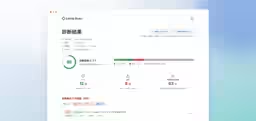
4. Identification of Human Review Areas: Lente Scan distinctly marks not only the issues found but also clarifies zones needing human verification. Result findings are categorized as 'Pass', 'Violation', and 'Manual Review Required' to provide a visual overview.
5. User-Friendly Report Generation: The diagnostic results present an automated score, significance level of issues, corresponding WCAG success criteria, and suggested directions for improvements in a format that facilitates prioritization of remediation efforts.
Pricing Plans and Accessibility
Utilization of Lente Scan’s automated diagnostic features is free; users can input URLs and view results without registration. When registered for a free account, users can track their diagnostic history for up to 30 days and access AI correction proposals. The Pro plan offers a more in-depth analysis for a monthly fee of ¥2,980 (excluding tax), featuring unlimited access to AI correction proposals and the capability to manage manual review need statuses.
Future Aspirations
Liberogic aims to normalize accessibility as a fundamental aspect of web quality rather than a specialized requirement. By employing the insights from Lente Scan to assess and continually enhance web accessibility, the company is also developing Lente Audit, a workspace dedicated to sharing diagnosis results and facilitating collaboration on remediation.
Expert Commentary
Ayumu Futamata, Chief Accessibility Officer at Liberogic, stated: “The name Lente signifies 'lens'. It encapsulates how we aim to shed light on aspects of web accessibility that are often overlooked, enabling developers to understand and improve the user experience based on established standards.”
By delivering the Lente Scan tool as an accessible resource for all, Liberogic aspires to bridge the gap between automated checks and critical human insights in the web accessibility landscape.
Conclusion
In conclusion, the introduction of Lente Scan marks a significant milestone in web accessibility. The tool not only aids in identifying issues but also provides users with the necessary information to create an inclusive digital environment. You can explore Lente Scan here.

Topics Consumer Technology)
【About Using Articles】
You can freely use the title and article content by linking to the page where the article is posted.
※ Images cannot be used.
【About Links】
Links are free to use.