



Rental Market Trends for Apartments Across Major Japanese Cities in March 2025
Overview of the Rental Market Trends in Japan
In March 2025, a comprehensive study conducted by At Home Co., Ltd. offers essential insights into the rental market trends across major cities in Japan. The analysis was executed by At Home Lab and published through the company's extensive real estate information network. The report highlights the shifts in rental prices for living spaces, particularly focusing on apartments and mansions across various regions.
General Observations
The analysis indicates that the average rental prices for apartments in major areas such as Tokyo, Kanagawa, Saitama, Chiba, Sapporo, Osaka, Kobe, and Fukuoka, have risen compared to the previous year. Specifically:
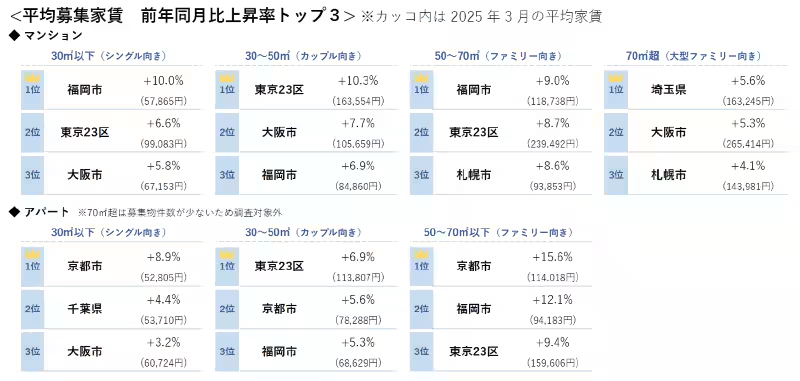
- - Among the 13 areas studied, 8 regions showcased a substantial year-on-year increase in apartment prices, indicating a robust rental market.
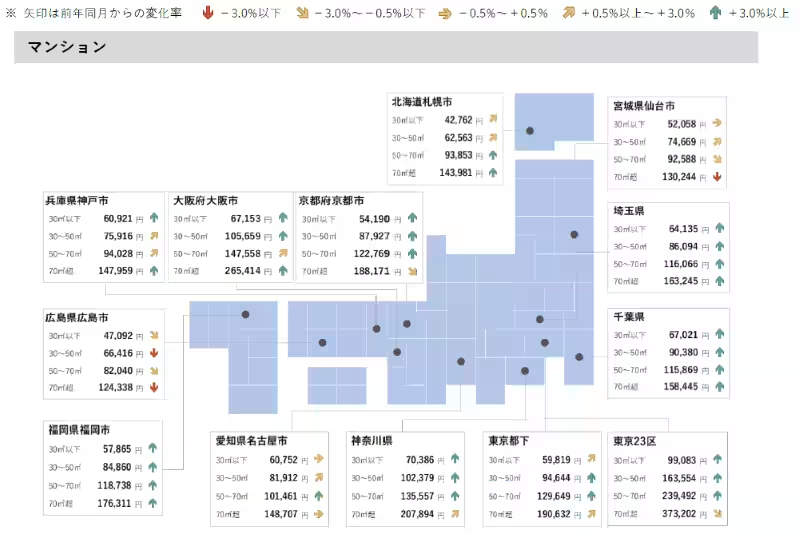
- - Notably, within the greater Tokyo area, comprising Tokyo’s 23 wards, the average rental prices hit the highest levels they have reached since January 2015, marking the 28th consecutive month of increases for the 23 wards of Tokyo.
This upward trend is generally optimistic for landlords but reflects the challenging rental landscape for potential tenants seeking affordable housing within urban centers.
A Closer Look at Rental Trends
The breakdown of rental trends uncovers specific preferences among different demographics. Apartments aimed at couples and families exhibit varying trends:
- - Couple-oriented Apartments: Data indicates rising demands in 12 regions excluding Hiroshima, with the greater Tokyo area, Sapporo, Sendai, Nagoya, Osaka, and Fukuoka recording their highest prices since January 2015. This is a crucial consideration for prospective tenants who prioritize areas with better amenities and access to public transport.
- - Family-oriented Apartments: The same report shows that family-oriented units have also experienced increased prices in 12 out of 13 areas, with all but Sendai seeing surges. Noteworthy areas include the greater Tokyo region, Kanagawa, Saitama, Nagoya, Kobe, and Fukuoka, which have recently achieved peak prices since 2015.
Survey Details
The survey encompassed data from 13 major regions across Japan:
- - Tokyo area: Tokyo’s 23 wards, Tokyo suburbs, Kanagawa, Saitama, Chiba.
- - Other Major Cities: Sapporo, Sendai, Nagoya, Kyoto, Osaka, Kobe, Hiroshima, and Fukuoka.
The data used for the analysis reflected apartments registered and made available on the At Home real estate information website, ensuring that duplicate listings were accounted for appropriately. The definition of rent in this study includes both rent and associated management fees.
Additionally, the categorization of apartment types based on size was as follows:
- - Single-oriented: 30 square meters or less
- - Couple-oriented: 30 to 50 square meters
- - Family-oriented: 50 to 70 square meters
- - Large Family-oriented: Over 70 square meters
The average rent index within this survey uses January 2015 as the baseline (100), illustrating the relative increases over time.
Conclusion
The findings present a mixed bag of opportunity and challenge in the rental market of Japan as of March 2025. With sustained rises in rental prices across various major cities, it calls for potential tenants to navigate a tighter housing market. Individuals looking to rent may need to consider different locations or be prepared for higher costs as trends continue to evolve. For more detailed insights and statistics, the complete report can be accessed via this link.

Topics Consumer Products & Retail)

【About Using Articles】
You can freely use the title and article content by linking to the page where the article is posted.
※ Images cannot be used.
【About Links】
Links are free to use.