



Transforming Wastewater Treatment from Disposal to Resource Recovery Through Microbial Control
Transforming Wastewater Treatment Techniques
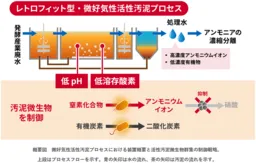
In an innovative breakthrough, a research team from the National Institute of Advanced Industrial Science and Technology (AIST), alongside Kirin Holdings and Tokyo University of Agriculture and Technology, has developed a technique to transition wastewater treatment from 'discarding' to 'utilizing.' The focus of this development is on controlling the microbial community within activated sludge to switch from nitrogen removal processes to nitrogen resource recovery.
The Need for Change
Nitrogen compounds are essential in various industries, notably agriculture and pharmaceuticals. However, their release into the environment has raised significant concerns. Traditional wastewater treatment plants convert nitrogen compounds into nitrogen gas for atmospheric release, a process that consumes substantial energy due to the required aeration. By halting this conversion at ammonium ions, the team aims to recover nitrogen as an energy resource, thus reducing energy consumption while promoting sustainability.
Technical Innovation: Microaerobic Activated Sludge Process
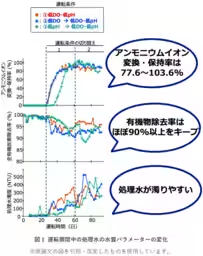
The developed technique employs a microaerobic activated sludge process. This approach has been successfully tested using scaled-down models of actual wastewater treatment plants, demonstrating that low-concentration nitrogen compounds can be effectively converted into ammonium ions. By prioritizing the recovery of ammonium, the team proposes a significant shift in wastewater processing—transitioning from merely purifying wastewater to recovering valuable resources.
Achievements and Future Prospects
The team's findings indicate that utilizing this process could greatly reduce energy usage in treatment plants while facilitating the recovery of valuable nitrogen resources. This initiative is timely, especially given the increasing demand for sustainable practices in industrial wastewater management.
The technique's details are scheduled to be published in the journal Water Research on June 15, 2026. Prior to this, the researchers plan to continue refining the process across various scales and types of wastewater, thereby paving the way for broader applications and enhanced resource recovery technologies.
Challenges Addressed
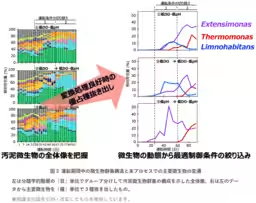
Historically, controlling the microbial activity in activated sludge has presented challenges. The research tackled several bottlenecks by optimizing conditions such as low dissolved oxygen (DO) and low pH, effectively suppressing nitro-oxidizing microbial activities while enhancing ammonium recovery. This delicate balance allows for improved efficiency in nitrogen recovery without the drastic infrastructure changes typically required for adopting new ecological methods.
Research Significance
Given the alarming warnings surrounding nitrogen emissions surpassing planetary boundaries, this research represents an important step towards mitigating environmental impacts while also providing valuable resources. The implications suggest not just a transformation in how wastewater is treated but also a potential model for future environmental policies aiming for sustainable industrial practices.
Conclusion
In conclusion, this revolutionary approach to wastewater treatment underscores the critical need for innovation in managing our environmental impacts while simultaneously creating economic opportunities. Effective microbial control could symbolize a new era in ecological engineering, fulfilling both industrial and environmental responsibilities in resource recovery.
Topics Environment)
【About Using Articles】
You can freely use the title and article content by linking to the page where the article is posted.
※ Images cannot be used.
【About Links】
Links are free to use.