



ACROBiosystems Hosts Innovation Day in Zurich, Uniting Biotech Leaders
ACROBiosystems Hosts Innovation Day in Zurich
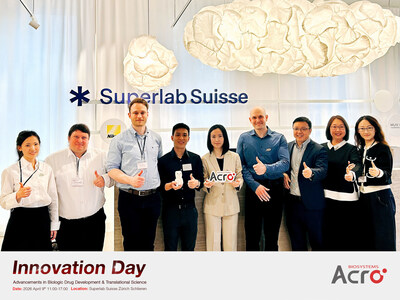
Zurich, Switzerland - On May 17, 2026, ACROBiosystems successfully held its much-anticipated Innovation Day at the Superlab Suisse Zürich Schlieren, a vibrant hub of Swiss innovation and talent. This event brought together leading scientists, translational research experts, and industry innovators to delve into advancements in biopharmaceutical development and translational science.
The atmosphere was electric, filled with engaging discussions and active networking opportunities. Designed to explore emerging technologies, evolving regulatory landscapes, and new strategies that expedite the transition from discovery to clinic, the event featured state-of-the-art development platforms and real-world case studies. Participants were provided with a high-value program aimed at fostering collaboration and inciting fresh perspectives.
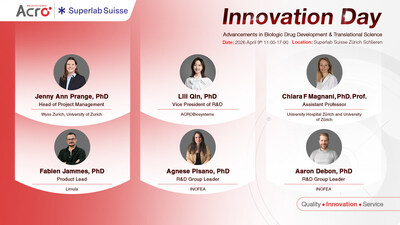
Prominent speakers included Dr. Jenny Ann Prange, Project Management Lead at Wyss Zurich; Dr. Lili Qin, Vice President of RD at ACROBiosystems; Dr. Chiara F. Magnani from the University Hospital of Zurich; Dr. Fabien Jammes from Limula; as well as Dr. Agnese Pisano and Dr. Aaron Debon from INOFEA.
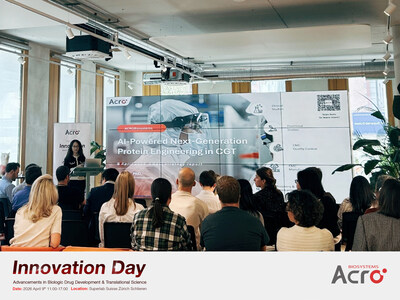
Dr. Lili Qin’s keynote, "AI-Powered Next-Generation Protein Engineering in CGT," highlighted how ACROBiosystems integrates artificial intelligence throughout the protein development process—from structure prediction and de novo design to expression optimization, purification process design, and formulation optimization. She presented compelling examples including an AI-optimized cytokine yielding a 20-fold increase in expression, a thermostable FGF2 mutant that maintains activity after three days at 37°C, and a highly specific antibody capable of distinguishing between Claudin18.2 and Claudin18.1 without cross-reactivity.
These breakthroughs are made possible by ACROBiosystems' proprietary AI-driven platform, which combines computational predictions with high-throughput experimental validation in a closed-loop dry-wet system. This capability allows the company to address long-standing bottlenecks in the industry, such as low expression titers, thermal instability, and specificity issues, which have historically slowed the development of biopharmaceutical products and cellular therapies. By incorporating AI at every stage of protein reagent development, ACROBiosystems aids the industry in achieving higher success rates, shorter timelines, and more scalable pathways from discovery to clinic.
The Innovation Day also showcased insights from leading translational research institutes. Dr. Jenny Ann Prange discussed bridging the gap between early-stage discovery and clinical application in her talk titled "Translating Ideas to Reach The Ones in Need." She highlighted one of the critical bottlenecks in drug development: transitioning from exploratory RD to a regulated GMP environment, outlining how Wyss Zurich's platform combines funding, infrastructure, and translational expertise to assist promising projects through this complex stage.
Following her, Dr. Chiara Magnani shared valuable clinical insights on CAR-T cell therapy in her presentation "Advancing CAR T-cell Therapy Non-viral Engineering, Immune Evasion, and Modular Platform," showcasing data from 36 patients with B-ALL treated with Sleeping Beauty-engineered anti-CD19 CAR-T cells, achieving an 83% complete remission rate with long-term persistence.
Dr. Fabien Jammes dissected a key barrier to the adoption of cell therapy in his talk titled "Decentralised Manufacturing of Cell Therapies: How Compact Automation is Changing the Landscape." He introduced Limula’s all-in-one platform, LimONE, which integrates bioreactor and centrifuge functions into a single closed device. He presented proof-of-concept data demonstrating fully automated CAR-T production in seven days at clinical scale, explaining how decentralized manufacturing could hasten access and reduce costs by bringing production closer to patients.
Finally, Agnese Pisano and Aaron Debon addressed immobilized enzyme manufacturing challenges in their talk "Immobilized Enzymes for Smart Biologics Manufacturing Applications in mRNA and ADC Production," presenting patented technology that enhances enzyme stability and reusability. They detailed two case studies demonstrating the immobilization of T7 RNA polymerase for in vitro semi-continuous transcription systems and sortase for antibody-drug conjugate production, achieving conjugation efficiency and drug-antibody ratios comparable to soluble enzymes.
These presentations collectively illustrated both the promise and challenges of modern biological development, covering AI-optimized proteins, non-viral CAR-T technologies, and automated manufacturing. Despite approaching the topic from various angles, all speakers emphasized the importance of open collaboration to drive innovation.
"This is an important event bringing together leaders from both academia and industry in the Zurich area. Many thanks to ACROBiosystems for their organization. I would be interested in more events like this - please keep me informed," remarked Giacomo Cattaruzzi, Director of Innovation at Muvon Therapeutics AG.
Mike Chen, President, Founder, and CEO of ACROBiosystems, expressed enthusiasm for the event's success in Europe, stating, "Innovation is one of our brand's core commitments. We look forward to continuing this event to encourage global biotechnological innovation and contribute more meaningfully to advancing the sector."
About ACROBiosystems Group: Established in 2010 and publicly traded since 2021, ACROBiosystems aims to be a cornerstone in global biopharmaceutical and healthcare industries by providing innovative products and business models. The company operates globally, with offices, RD centers, and production bases across over 15 cities in the US, Switzerland, the UK, and Germany. ACROBiosystems has formed many stable, long-term partnerships with the world’s largest pharmaceutical companies, including Pfizer, Novartis, and Johnson & Johnson, along with numerous prestigious academic institutions. The company encompasses several subsidiaries such as ACROBiosystems, bioSeedin, Condense Capital, and ACRODiagnostics, offering products ranging from recombinant proteins and kits to antibodies and scientific services. With strict quality control systems for its products utilized in biopharmaceutical RD, manufacturing, and clinical applications, ACROBiosystems is dedicated to accelerating drug development processes, including targeted therapies and immunotherapeutic drugs, thereby significantly contributing to global health.
Topics Health)
【About Using Articles】
You can freely use the title and article content by linking to the page where the article is posted.
※ Images cannot be used.
【About Links】
Links are free to use.