



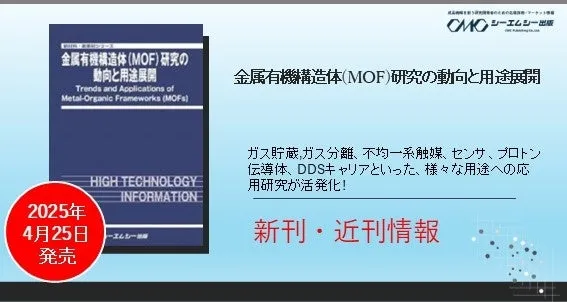
An In-Depth Look into Metal-Organic Frameworks: Trends and Applications
Exploring Metal-Organic Frameworks and Their Applications
On April 25, 2025, CMC Publishing House in Tokyo will release a comprehensive book titled 'Trends and Applications in Metal-Organic Framework Research', priced at ¥67,100 (including tax). This publication delves into the current research trends surrounding metal-organic frameworks (MOFs), a class of crystalline porous materials made from metal ions and organic compounds. The unique structural characteristics of MOFs allow them to adsorb various substances, presenting a wide array of application possibilities.
The Rise of MOFs
Research on MOFs gained momentum in the late 1990s. Initially, focus revolved around the synthesis techniques and fundamental physical properties. However, over time, the potential applications of MOFs have been widely recognized. Recent studies are increasingly oriented towards their applications in gas adsorption, separation processes, and pharmaceutical storage, marking a significant shift in the research landscape.
Structure of the Book
The book is structured into four main parts:
Part 1: Synthesis and Design of MOFs
This section covers:
- - Machine learning applications in the synthesis of metal-organic frameworks.
- - Development and potential of metal-peptide frameworks (MPFs).
- - Creation of MOF materials aimed at quantum sensing.
- - Incorporation of molecules into cyclodextrin-based MOFs for nanoreactor functionalities.
- - Elucidation of gel formation conditions for MOF utilization.
- - Control of physical properties through the introduction of ionic liquids.
- - Construction of nanofilms via Layer-by-Layer methods.
- - Continuous synthesis and morphological control through spray synthesis techniques.
Part 2: Gas Adsorption, Separation, and Recovery Using MOFs
This segment presents:
- - Production of MOF separation membranes and their applications in gas separation.
- - Advances in energy-saving gas separation technologies using PCP and MOFs.
- - CO2 recovery systems based on energy-efficient MOF platforms.
- - Monolith synthesis methods for MOFs using direct conversion techniques.
- - Examination of CO2 adsorption mechanisms in SIFSIX MOFs targeted for direct air capture (DAC) applications.
Part 3: Catalytic Functions and Uses of MOFs
Key highlights include:
- - Utilizing the unique characteristics of MOFs in catalytic processes.
- - Development of visible-light responsive MOF photocatalysts for water-splitting applications.
- - MOF photocatalysts aimed at hydrogen peroxide production.
- - High-performance catalysts formed by integrating metal nanoparticles with porous metal complexes.
- - Research advancements concerning biomass conversion utilizing MOF catalysts.
Part 4: Application Development for Practical Use of MOFs
Topics discussed in this part cover:
- - Applications of MOFs in the battery industry and electrochemical sectors.
- - Creation and uses of MOF-oriented thin films based on metal hydroxides.
- - Development of conductive MOF thin film devices for simultaneous analysis of various amine gases.
- - Techniques for enzyme immobilization using MOFs.
- - Understanding drug inclusion mechanisms within MOF particles.
- - Creation of functional polymers employing MOFs.
- - Structural recognition and separation of polymers facilitated by MOFs.
- - PFAS adsorption characteristics in intentionally defected MOFs.
Availability
The book will be available for purchase on the CMC Publishing’s e-commerce platform as well as in bookstores across Japan. This detailed compilation not only reflects the latest advancements in MOF research but also highlights their diverse applications and contributions to various scientific fields.
In summary, 'Trends and Applications in Metal-Organic Framework Research' serves as an essential resource for researchers, academics, and industry professionals eager to explore the innovative world of MOFs and their immense potential across different applications. Stay tuned for this insightful addition to the scientific literature!
Topics Consumer Products & Retail)








【About Using Articles】
You can freely use the title and article content by linking to the page where the article is posted.
※ Images cannot be used.
【About Links】
Links are free to use.