



Discovering New Control Methods for Superconductivity in Kagome Metals
Breakthrough Discovery in Kagome Metal Superconductivity
A team of researchers from Okayama University has made significant strides in understanding superconductivity through their recent experiments on Kagome metals. The unique three-dimensional structure of Kagome metals has garnered worldwide attention for its potential in various applications, including next-generation quantum devices. The study conducted by a joint research group, led by graduate student Yusuke Takeuchi and Professor Shinji Kawasaki, has introduced a novel method for manipulating superconductive properties through strain.
The Experimental Breakthrough
Using a custom-designed uniaxial strain cell, the research team was able to apply precise tensile and compressive stresses to the Kagome superconductors. This meticulous approach allowed them to explore the material's quantum phenomena in ways that had not been previously documented.
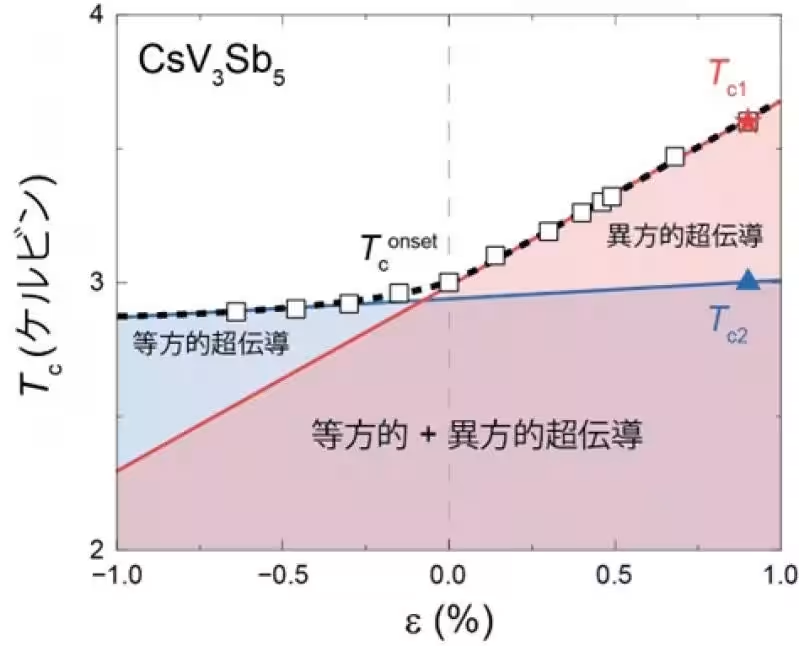
Their investigations revealed an astonishing outcome: as the crystal was subjected to tensile strain, what was once perceived as a single superconductive state was found to split into two distinct phases. The first is a standard superconductive state that is largely resistant to strain, while the second is a special, non-conventional superconductive state that shows a remarkable sensitivity to strain.
Enhanced Control and Performance
The key finding of the study is that the special superconductive state can be markedly enhanced through the application of tensile strain. This means that by simply adjusting the mechanical stress, researchers can not only amplify the superconductivity but also control the transition temperature (Tc) effectively. The implications of this breakthrough could lead to the development of superconducting materials with even higher transition temperatures, paving the way for innovative applications in energy transmission and storage.
Global Recognition
On August 28, 2026, the findings were published in the Physical Review Letters, a prestigious journal by the American Physical Society. The paper received the Editors' Suggestion designation, highlighting its importance and potential impact in the field of physical science. The research answers longstanding questions surrounding the superconductivity mechanisms in Kagome metals, which have been a topic of scientific debate and curiosity.
Future Directions
Professor Shinji Kawasaki expressed his profound joy regarding the recognition of their paper, emphasizing that the success of this research is the result of years of diligent work by dedicated students through many iterations of experimentation. The concept of using strain to affect electronic pathways introduces a new parameter in solid-state physics and enhances our understanding of superconductors' hidden properties.
Moreover, the researchers assert that the insights gained from this study could be instrumental in demystifying the complexities of unconventional superconductors, such as cuprates, and propel innovations in quantum technology.
Conclusion
The ability to manipulate superconducting states through strain invites further inquiry and collaboration. Professor Kawasaki looks forward to engaging with other researchers interested in exploring the facets of strain experiments. The research community is encouraged to consider how this groundbreaking method can be applied in advancing our understanding of quantum materials and superconductivity.
Overall, the work conducted at Okayama University represents a significant leap forward in the study of superconductivity and its applications in tech and energy solutions, ideal for fostering sustainable innovation.
References
- - For more detailed information on this groundbreaking research, visit the Okayama University Press Release.
- - Access the official publication in Physical Review Letters here.

Topics Other)


【About Using Articles】
You can freely use the title and article content by linking to the page where the article is posted.
※ Images cannot be used.
【About Links】
Links are free to use.