



Thermal Self-Organization of Resistance Switching in Organic Conductors Revealed by NMR & Transport Measurements
Overview of the Research
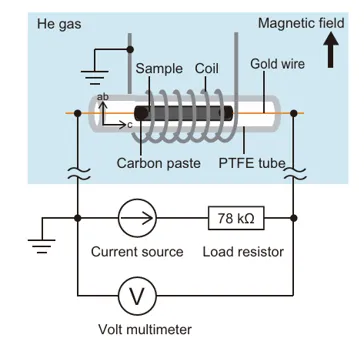
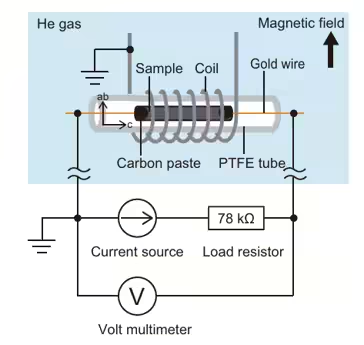
Recent breakthroughs in the realm of organic conductors have shed light on the intricate mechanisms underlying resistance switching phenomena. A joint research team led by Professor Tetsuaki Itou at Tokyo University of Science has leveraged sensitive 1H-NMR measurements to elucidate the coexistence of metallic and insulating phases in the resistance switching state of the organic conductor (d7-DMe-DCNQI)2Cu. The study has revealed novel thermal effects, such as temperature locking and inverse Ohm's law, emerging from the interplay of Joule heating and surrounding thermal dissipation, which are pivotal to the concept of thermal self-organization.
The Significance of Resistance Switching
Resistance switching is a state where external stimuli like voltage or current induce a dramatic and reversible change in a material's electrical resistance. This phenomenon is pivotal not only in fundamental physics but also in potential applications ranging from memory devices to neuromorphic elements. However, it has predominantly been studied in inorganic thin films, where the complexity of thermal dynamics often obscures the understanding of the coupling between heating, dissipation, and phase transition.
Research Methodology
In addressing these challenges, the research group utilized bulk organic conductors exhibiting a sharp first-order metal-insulator transition near 79 K. The absence of a substrate and weak thermal coupling with the environment made this material particularly suitable for isolating the effects of Joule heating. By combining electric transport measurements with 1H-NMR, they could micrometrically investigate the electronic state within the resistance switching state and validate the underlying thermal mechanisms.
Findings from the Study
1. Resistance Switching Under Current: The team observed a steep resistance change from metallic to insulating states while applying a low current (0.3 mA). Surprisingly, at a higher current (2.0 mA), an intermediate resistance switching state was formed that remained stable even when the ambient temperature was reduced to near absolute zero. This situation indicates the establishment of a non-equilibrium steady state where Joule heating balances with thermal dissipation.
2. Coexistence of Phases and Temperature Locking: Through 1H-NMR relaxation measurements, it was found that within the resistance switching state, metals and insulators coexist rather than forming a uniform electronic phase. Notably, even when the surrounding temperature dropped below the transition temperature, the sample's temperature remained concentrated around 79 K, known as the temperature locking effect. This results from a strong non-linear thermal response maintaining a balance between Joule heating and environmental cooling.
3. Inverse Ohm's Law: The research unveiled an unusual relationship where voltage (V) exhibited an inverse proportionality to the current (I) within a certain range, termed as the inverse Ohm's law. This finding aligns with the temperature locking effect, as under steady-state conditions, maintaining a constant thermal flow would require adjusting the balance between the metal and insulator phases to regulate the heat generated by Joule heating.
Implications and Future Directions
These research findings emphasize the necessity to view resistance switching not merely as a uniform temperature rise but as a non-equilibrium steady state where phase transitions, thermal flows, and electrical conductivity are intricately coupled through thermal self-organization. Such insights may lead to advancements in designing more energy-efficient resistance switching devices by properly controlling thermal flows and phase coexistence.
Professor Itou stated, "Through direct microscopic examination using NMR, we have uncovered that resistance switching involves coexistence of metallic and insulating states. Coupling these observations with transport measurements has revealed unexpected responses like temperature locking and inverse Ohm's law, offering critical insights into understanding non-linear thermal phenomena within resistance switching."
Conclusion
This study represents a vital step towards unraveling the complexities of resistance switching in organic conductors, facilitating future research aimed at harnessing these phenomena for advanced technological applications. The paper detailing these findings will be published in the Physical Review Applied, highlighting its significance as an Editors' Suggestion.
Acknowledgments
This research was supported by grants from the Japan Society for the Promotion of Science (JSPS) and the Japan Science and Technology Agency (JST).
Topics Consumer Technology)
【About Using Articles】
You can freely use the title and article content by linking to the page where the article is posted.
※ Images cannot be used.
【About Links】
Links are free to use.