




Streamlined Process for Obtaining Eco-Labeling with Kubota's KSAS Integration
Simplified Eco-Labeling Process with Kubota's KSAS Integration
The Ministry of Agriculture, Forestry and Fisheries (MAFF) of Japan has made significant strides in enhancing the accessibility of its 'Mieru Label' program, which allows agricultural producers to communicate their environmental efforts transparently to consumers. By partnering with Kubota Corporation's Kubota Smart Agri System (KSAS), MAFF has implemented an automated system designed to streamline the process of obtaining environmental eco-labels for producers, particularly for rice products at this stage.
Background on the Eco-Labeling System
The 'Mieru Label' initiative is a part of the Ministry's broader goal of visualizing and reducing the environmental impact of agricultural production. The eco-labeling system assesses and computes the greenhouse gas emissions and absorption rates during the agricultural production phase, issuing grades and registration numbers automatically.
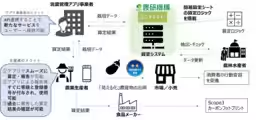
MAFF developed this system in March of the seventh year of the Reiwa era and is set to make it available through the agricultural data integration platform (WAGRI) via APIs starting in June. The guidelines for this system are based on the 'Evaluations and Display Guidelines for Environmental Impact Reduction in Agricultural Products.' This design allows interfacing with farming management applications without requiring them to develop unique calculation algorithms. Using data on cultivation practices, producers can easily determine their greenhouse gas emissions and absorption levels as well as the contribution to reduction compared to conventional local agricultural practices. Moreover, reporting the required calculation results to MAFF for eco-labeling can now be efficiently managed through the eco-labeling system.
Benefits of the New Integrated System
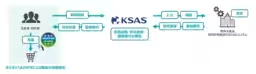
With the integration of KSAS, producers using connected farming management applications can now report to MAFF without the need for previous spreadsheet entries and manual email reporting. This new automated approach is expected to significantly reduce the time required to acquire registration numbers necessary for utilizing the 'Mieru Label.' Therefore, producers will experience decreased burdens and enhanced convenience, providing a more user-friendly experience in the process.
Features of KSAS
The KSAS system developed by Kubota supports farmers in managing records of agricultural land, work history, yield data, and machine usage through a user-friendly interface accessible across computers and smartphones. It was designed to leverage data intelligently for improved agricultural productivity and sustainability.
With the recent integration of KSAS and the Eco-Labeling System, a new feature has been introduced specifically for rice products aimed at promoting greenhouse gas reduction efforts. Producers interested in environmental impact reduction and visualization are encouraged to utilize this innovative tool offered by Kubota.
Invitation to Agriculture App Developers
MAFF is actively inviting developers of farming management applications to consider API integration with the Eco-Labeling System. This presents an excellent opportunity for developers aiming to enhance their software with advanced climate impact assessment capabilities. For more details on utilizing the Eco-Labeling System, please consult the official MAFF website.
In conclusion, the collaboration between MAFF and Kubota is a significant move towards promoting eco-friendly agricultural practices and making it easier for producers to showcase their sustainability efforts, ultimately benefiting consumers and the environment alike. By simplifying the eco-labeling process, Japan continues its commitment to sustainable agriculture.

Topics Environment)
【About Using Articles】
You can freely use the title and article content by linking to the page where the article is posted.
※ Images cannot be used.
【About Links】
Links are free to use.