




The Next Generation Bio-Measurement Enabled by Terahertz Biophotonics
The Next Generation Bio-Measurement Enabled by Terahertz Biophotonics
In recent years, terahertz waves have garnered considerable attention as a non-invasive and non-destructive electromagnetic wave capable of investigating the state of biological tissues, cells, and molecules. Despite this potential, the practical application of terahertz technology in medicine and life sciences has made limited progress until now. The research team led by Kazunori Serita, Associate Professor at Waseda University, and Masayoshi Tonouchi, Professor at Okayama University, has systematically summarized the essential challenges hindering the advancement of terahertz biophotonics—the research field dedicated to the application of terahertz waves in bio-measurement—and presented a clear technological roadmap for overcoming these hurdles.
Key Points from the Research:
- - Challenges Identified: The study presents a systematic analysis of the core issues that have impeded the development of terahertz biophotonics, namely:
2. Sensitivity affected by strong absorption by water
3. Slow measurement speed
4. Bulky and high-cost equipment.
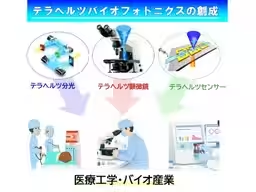
- - Development of New Technologies: The team also organized research trends on new microscope technologies, high-sensitivity sensor technologies, and provided a realistic roadmap for applying these innovations in the medical and bio-measurement fields. By overcoming the aforementioned challenges, they aim to promote terahertz biophotonics as a viable candidate to support next-generation medical and bio-measurement technologies.
- - Predicting Future Applications: The study indicates the emergence of terahertz diagnostic devices, especially for skin cancer diagnosis and wound assessment, which are on course for potential clinical application.
As a significant milestone, the study will be published in the Journal of Physics Photonics on May 29, 2026. This research showcases the possibilities of utilizing terahertz biophotonics in non-invasive and label-free acquisition of biological information. The potential applications in fields such as skin cancer diagnosis, wound assessment, tissue analysis, and trace bioanalysis promise substantial advancements in the healthcare sector, alongside developments in drug discovery, food safety, environmental monitoring, and the semiconductor industry.
State of Current Research:
Prior research has already indicated promising outcomes in various fields using terahertz waves to investigate different biological targets, including cancerous tissues, wounds, blood, cells, DNA, and proteins. However, compared to optical methods using visible and near-infrared light, the practical use of terahertz technology has lagged significantly. Prior studies raised doubts about the interpretation of terahertz signals since the observed differences may not be specific to diseases, but rather reflect variations in water content. This has necessitated further inquiries into exactly what biological information can be captured by terahertz waves.
Vision for Future Research:
The current research endeavor highlights not only the possibility of measuring biological information using terahertz technology but also sets forth a detailed outline of the technological advancements necessary for its success. By developing high-resolution terahertz time-domain spectroscopy and terahertz microscopy, the current study aims to enhance measurement reliability and expand observational capabilities to cellular and molecular levels. Additionally, this project emphasizes the integration of terahertz metamaterials for enhanced sensing abilities, leading to increased sensitivity in detecting minute biological substances, which could pave the way for the development of compact and sensitive bio-analysis chips.
Conclusion and Implications:
The research team's findings illuminate a pathway for the practical implementation of terahertz biophotonics and represent a substantial leap from the status of merely being able to measure biological entities to deeply understanding the specific information that terahertz waves can provide regarding biological states. With anticipated integration into clinical settings, the research holds the promise of instigating a new wave of diagnostic tools revolutionizing current medical practices.
Researchers underscore the importance of this study in fostering interdisciplinary collaboration and accelerating the convergence of physics, optical engineering, electronic engineering, life sciences, and medicine. Such efforts may lead to the establishment of a new research community that further integrates terahertz technology into daily medical applications.
In essence, while significant opportunities lie ahead with terahertz biophotonics, the field still confronts critical challenges that need to be addressed, including enhancing understanding of terahertz signal origins within biological samples and refining the equipment for practicality. Continued innovation in microscopy and sensor technologies, coupled with advances in artificial intelligence for data analysis, could forge the way for rapid clinical adaptation in the future.

Topics Health)



【About Using Articles】
You can freely use the title and article content by linking to the page where the article is posted.
※ Images cannot be used.
【About Links】
Links are free to use.