




Innovative Kirigami-Based Thermoelectric Generator for IoT Devices
Innovative Kirigami-Based Thermoelectric Generator: Enhancing Flexibility and Power Generation
In recent years, the demand for self-sufficient power sources for IoT (Internet of Things) devices has skyrocketed. Among these, flexible thermoelectric generators that harness temperature gradients have garnered significant attention. However, achieving a balance between flexibility and high energy conversion efficiency has posed considerable challenges. A research team led by Professor Eiji Iwase and Lecturer Shingo Terashima from Waseda University has recently unveiled a groundbreaking solution: a kirigami-style thermoelectric generator that excels in both dimensions.
The Kirigami Structure
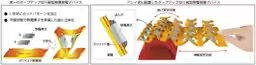
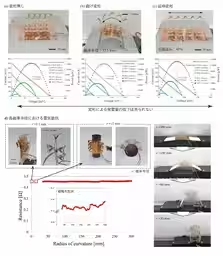
Utilizing a thin film substrate, the device employs a unique kirigami technique—essentially a form of paper folding—to achieve a three-dimensional structure that adheres to curved thermal sources, such as the human body. The key feature of this pop-up kirigami structure allows for easy integration of elongated thermoelectric elements in a flat state, ensuring superior power generation capabilities when deployed in three-dimensional form. This innovative approach not only enhances the efficiency of temperature differentials between the thermoelectric elements but also allows for a remarkable flexibility, accommodating distortions as tight as a 0.1mm radius and stretching up to 1.7 times its original length.
Performance and Applications
The team has conducted extensive performance evaluations, proving that even under deformation, the generator maintains its energy output—surpassing previous models of flexible thermoelectric devices. This capability is demonstrated by its application on the human skin, where it effectively converts the temperature difference between body heat (approximately 34°C) and ambient air (around 22°C) into electricity, capable of powering wireless transmissions of body temperature. This achievement opens a new frontier for wearable IoT devices that can continuously monitor health metrics like temperature and blood pressure without the need for battery replacements.
Impact on Future Technologies
The implications of this research are vast. With the ability to produce power autonomously through everyday heat sources, the kirigami thermoelectric generator could revolutionize IoT networks, especially in areas such as smart cities and environmental monitoring. By reducing dependency on battery replacements, it increases the reliability and sustainability of sensor networks. Additionally, its application in wearable health devices allows constant health monitoring, thereby facilitating remote healthcare advancements and improving support for elderly care.
Addressing Challenges and Future Outlook
While the research has shown promising results, the scalability and economic production of this innovative generator remain key considerations. Utilizing common materials like polyimide copper substrates, the design is compatible with existing manufacturing processes, suggesting potential for mass production. Furthermore, the flexibility of the kirigami structure allows integration of various thermoelectric materials, such as thin-film carbon nanotubes, which would further enhance its applicability in diverse settings.
As the researchers continue to refine the technology, they anticipate that its widespread application could lead to a fundamental shift in how we power IoT devices. The integration of kirigami structures into electronic devices not only presents a technological advancement but also represents a convergence of art and engineering, heralding a new era for flexible electronic solutions.
Research Publication
This pioneering study was published in the international journal npj Flexible Electronics on October 21, 2025, under the title “Pop-up kirigami thermoelectric generator with high stretchability and conformal thermal interfaces.”
For further information, you can access the publication at Nature's website or reference the DOI link here. This research not only promises advancements in technology but also sheds light on sustainable energy solutions in our increasingly connected world.

Topics Consumer Technology)
【About Using Articles】
You can freely use the title and article content by linking to the page where the article is posted.
※ Images cannot be used.
【About Links】
Links are free to use.