



New Study Reveals How Garnet Influences the 660 km Boundary in Earth's Mantle
New Insights into Earth's Mantle
A groundbreaking study conducted by a research team from Okayama University and Gakushuin University has provided new insights into the formation of the Earth's mantle's 660 km boundary, a significant seismic discontinuity that has long perplexed scientists. Published in the renowned journal Nature Communications on May 25, 2026, the research highlights the crucial role of garnet in the high-pressure phase transformation that governs this boundary.
Understanding the 660 km Discontinuity
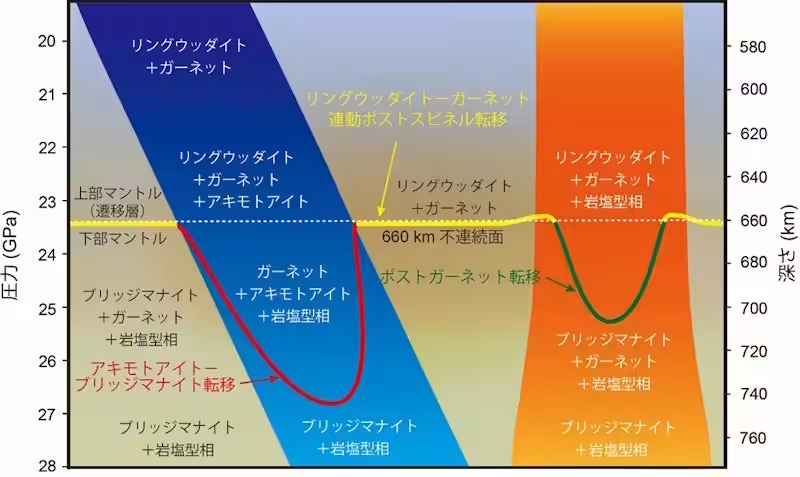
Located approximately 660 kilometers below the Earth's surface, the 660 km discontinuity is characterized by a rapid change in seismic wave velocities. Traditionally, the decomposition of the main mantle mineral, ringwoodite, was considered the primary cause of this phenomenon. However, the complexity of the observed structure at this depth posed challenges for this explanation. The new study suggests that garnet, the second most abundant mineral in the mantle, plays a more central role than previously thought.
The research team, led by Associate Professor Takayuki Ishii from Okayama University's Planetary Material Research Institute and Professor Hiroshi Kojitani and Professor Emeritus Masaki Akaogi from Gakushuin University, performed high-temperature and high-pressure experiments. Their findings revealed that phase transitions in garnet occur before those in ringwoodite, initiating a linked reaction that subsequently causes the decomposition of ringwoodite. This linked reaction paradigm was previously unrecognized and offers a more coherent explanation for the seismic features at the 660 km boundary.
A Uniform Composition
By taking garnet's presence into account, the researchers demonstrated that the observed discontinuity can consistently be explained, regardless of variations in temperature or environmental conditions within the mantle, such as cold subduction zones or warm hot plumes. This evidence suggests that the mantle is not merely a mix of different rocks but maintains a more uniform pyrolite composition.
Expert Insights
Associate Professor Ishii shared his reflections on the study, stating, "This accomplishment is the culmination of 15 years of research on questions I have pondered since my student days. The evolution of earth sciences during this time has transformed what were once overlooked queries into critical research themes. Science continuously advances and builds upon itself, and only through this process do new perspectives emerge. I encourage students and young researchers to cherish their own questions; even small doubts can lead to groundbreaking discoveries that alter our understanding of the world."
As the scientific community delves deeper into the mysteries of Earth's interior, this study opens the door for further investigations into mantle composition and dynamics. The findings contribute significantly to our understanding of geological processes and seismic behavior, which may have implications for various applications, including earthquake prediction and understanding volcanic activity.
Conclusion
Ultimately, the collaborative efforts of Okayama University and Gakushuin University highlight the importance of interdisciplinary research in unraveling complex geological phenomena. The role of garnet in shaping the Earth's physics offers exciting potential for future studies aimed at further exploring the depths of our planet.
For more detailed information, you can access the full research paper titled Role of garnet shaping the 660-km seismic discontinuity at Nature Communications.


Topics Other)
【About Using Articles】
You can freely use the title and article content by linking to the page where the article is posted.
※ Images cannot be used.
【About Links】
Links are free to use.