



Innovative Method Developed for Accurate Assessment of Microplastic Concentrations Across Rivers
Understanding Microplastic Pollution in Rivers
Recent concerns about environmental pollution due to microplastics (MP) have spurred significant research efforts. A team led by Kota Egoshi from the Graduate School of Science and Technology at Tokyo University of Science has made a significant advancement in this field by developing a consistent method for assessing the concentration of microplastics across various sizes in river waters. This study, conducted on the Tsurumi River, is a crucial step towards understanding and mitigating environmental pollution caused by microplastics.
The Importance of Microplastic Research
Microplastics, the minute fragments of plastic littering our ecosystems, can now be found in diverse environments ranging from oceans and rivers to the atmosphere and groundwater. With alarming frequency, these particles are also detected in drinking water and even human blood, emphasizing their pervasive and growing presence in our daily lives.
These microplastic particles pose serious biological and physical threats to aquatic organisms, their effects heavily dependent on particle size. Thus, accurately identifying sources and the extent of microplastic contamination across various sizes is critical to informing future environmental protection strategies.
Research Background and Objectives
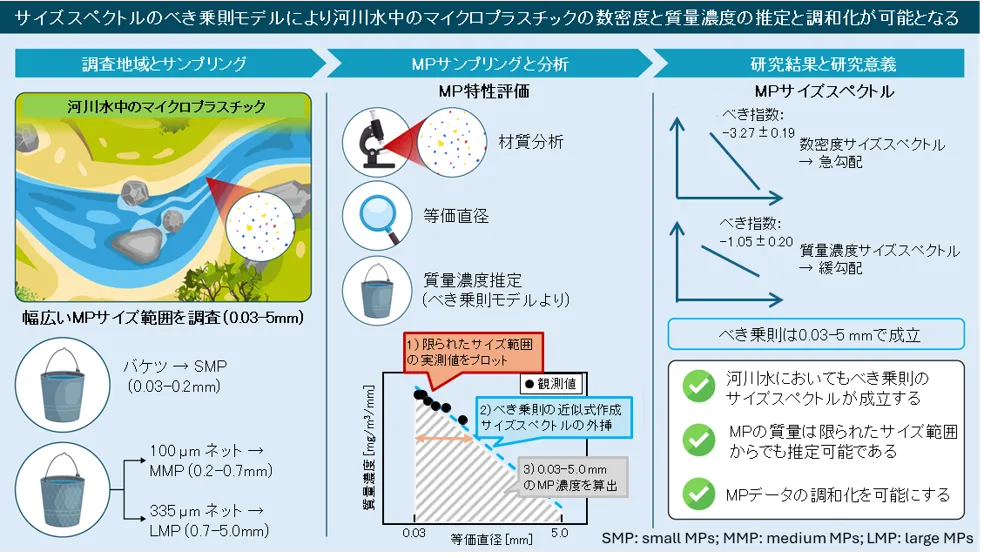
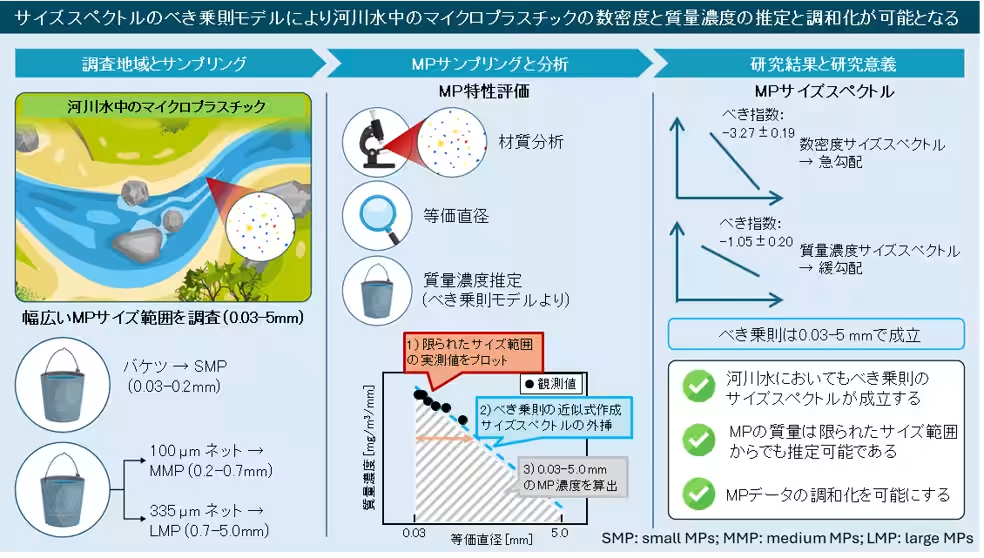
A notable challenge within existing research on microplastics arises from a lack of standardization in sampling and analysis, particularly concerning smaller microplastics (SMP). Egoshi's research team harnessed advanced statistical models to calculate the particle number and mass concentration size spectrum of microplastics in the Tsurumi River, ultimately providing a clearer understanding of their environmental impact.
The study adopted three distinct sampling techniques tailored to various sizes of microplastics, resulting in seven collected samples. The analyses revealed that both the number and mass concentration spectra of microplastics could be statistically approximated using a power-law model, validating earlier theoretical hypotheses. This statistical approach allowed researchers to extrapolate important environmental data from limited size ranges to broader, unmeasured spectra.
Methodology and Results
The sampling process categorized microplastics into three size groups: Small (SMP: 1-200 μm), Medium (MMP: 200-700 μm), and Large (LMP: 700-5000 μm). Each group employed specific techniques to collect accurate samples. For instance, LMP and MMP were recovered using nets with mesh sizes of 335 μm and 100 μm, whereas SMP was gathered through a 10-liter surface water collection effort.
By effectively utilizing this data, the research team calculated the composite size spectrum across all particle sizes. Their findings revealed a clear trend: the smaller the microplastic, the higher its concentration, showcasing a typical result aligned with power-law distributions in environmental studies.
The application of this statistical model not only demonstrated its effectiveness across sampled sizes but also bridged gaps hindering effective research comparisons across different studies. These results empower researchers to index and analyze microplastic data at an unprecedented scale, contributing to a deeper understanding of microplastic contamination in rivers and potentially other environments.
Future Directions
With the results published in the journal Environmental Pollution, the study paves the way for better standardization and comprehensive evaluations regarding microplastic pollution. Egoshi expresses hope that this unified assessment method facilitates future research, enabling consistent evaluations of microplastic concentrations irrespective of geographical or methodological variations.
This aligns with calls for urgent action to combat microplastic pollution, stressing the need for expanded awareness and proactive environmental policies.
In summary, Egoshi and his colleagues have unlocked a significant advancement in the scientific understanding of microplastics, with a suite of methodologies applicable in future studies. As the conversation around environmental contamination continues, these findings will serve as a foundation for enhanced standards in assessing risks posed by microplastics to various ecosystems and human health alike.
Conclusion
Through meticulous methodology and innovative analysis, the team at Tokyo University of Science highlights an unprecedented resolve to combat microplastic pollution in rivers, leading to increased awareness and future preventative strategies. This research is just one of many critical efforts to ensure cleaner environments for future generations.
Topics Environment)
【About Using Articles】
You can freely use the title and article content by linking to the page where the article is posted.
※ Images cannot be used.
【About Links】
Links are free to use.