



Exploring the Effects of Intrinsic and Extrinsic Motivation on Sales Performance
The Impact of Motivation Quality on Sales Outcomes
In a recent comprehensive study, Alvas Design, in collaboration with HR dock and researcher Kaede Kido from Nara Medical University, investigated the effects of different types of motivation on sales professionals. The research involved 800 B2B sales personnel from various sectors and aimed to unravel how motivation, both intrinsic and extrinsic, affects behavior and performance in the field. Conducted via an online survey in September 2025, the study sought to clarify the relationship between motivational factors and sales outcomes, marking a significant step toward understanding what drives success in sales roles.
Background
Historically, sales experts have relied on extrinsic motivators such as goals and incentives to drive performance. However, recent discussions suggest that the key differentiator between successful and less successful salespeople lies in the quality of motivation rather than merely the quantity. This study aimed to measure both intrinsic and extrinsic motivations to better understand their structural impacts on behaviors and results within the sales domain.
Research Overview
Objectives
The primary aim was to elucidate how the differences in motivational factors among sales professionals influence behavioral traits, performance metrics, and evaluations in the workplace.
Methodology
- - Conducting Entities: Alvas Design, HR dock, and Kaede Kido (Nara Medical University)
- - Participants: 800 B2B sales professionals (738 males and 62 females)
- - Timing: September 2025
- - Method: Online questionnaire
- - Key Indicators: Types of motivation (extrinsic, integration, identification, intrinsic), customer-oriented behavior, job adaptation, performance, and personnel evaluations.
Key Findings
Intrinsic Motivation as a Catalyst
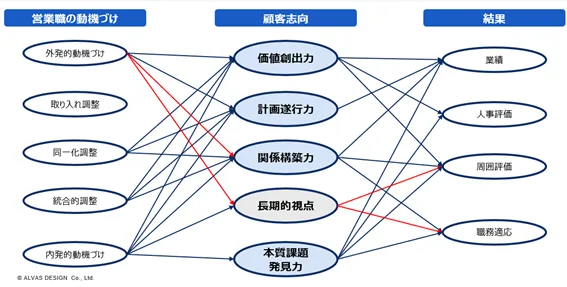
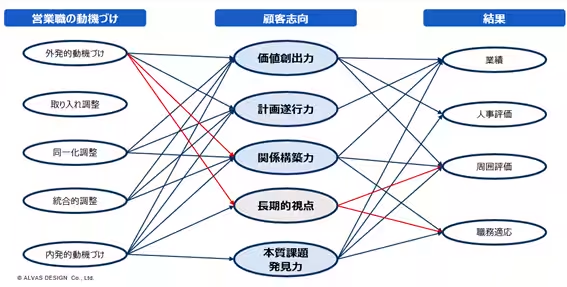
The study found that intrinsic motivation positively influences all customer-oriented behaviors, serving as a critical driver for success.
Extrinsic Motivation's Double-Edged Sword
While extrinsic motivation may lead to short-term achievements—enhancing abilities like value creation and planning—its long-term impact can be detrimental. Sales professionals who heavily depend on extrinsic motivators were observed to have worse outcomes regarding customer relationships, evaluations, and job adaptability over time.
Long-Term Results Matter
Evidence from the study pointed out that while extrinsic motivators can yield immediate results, they may impede aspects essential for building trust and long-lasting customer relations. This raises a pivotal question about how organizations can effectively nurture sales talent.
Structural Equation Modeling Insights
The research employed structural equation modeling to validate the importance of customer-oriented and intrinsic motivation scales. Findings indicated that motivation significantly impacts customer-centric behavior, which in turn influences sales performance and peer evaluations.
In this context, the connections illustrated in the model make it clear: certain motivational elements have strong statistical relationships with outcomes in the sales environment.
Conclusion
This study underscores that sales performance is profoundly affected, not by the sheer amount of motivation, but by its quality. Elements that lead to sustained success—such as understanding customer needs, proposal skills, and relationship-building—are strongly supported by intrinsic motivation. On the contrary, while extrinsic motivators aid short-term performance, they can undermine essential relationship-building behaviors over time.
The implications of these results are critical for sales organizations. They must consider not just the strategies for goal-setting and incentivizing performance but also how to cultivate environments that enhance intrinsic motivation. By doing so, organizations can create learning opportunities that foster customer-oriented behavior.
Future Implications
Alvas Design is committed to its philosophy of unlocking human potential and creating a joyful work environment for sales professionals. The structural insights into customer orientation gained from this research lead us to believe in the dual potential of sales roles to foster both enjoyment and value creation.
We plan to explore how customer orientation shapes job satisfaction and connects to performance metrics, striving toward a scenario where sales professionals can proactively collaborate with customers to create value. Further studies will continue to delve into these dynamics.
Topics Business Technology)
【About Using Articles】
You can freely use the title and article content by linking to the page where the article is posted.
※ Images cannot be used.
【About Links】
Links are free to use.