



Understanding the Role of Serpentinite in Accretionary Complexes: A New Model
Investigating Serpentinite in the Kii Peninsula
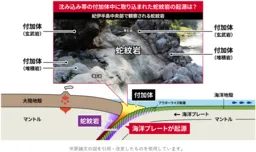
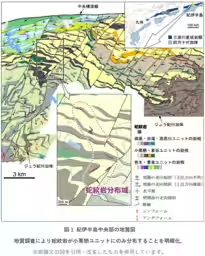
In recent research led by Yoshisuke Shimura and his team at AIST, significant insights into serpentinite's origin and behaviors have emerged. Focusing on the Cretaceous accretionary complex of the Kii Peninsula, they explored the distribution and characteristics of serpentinite, which is found intertwined with various geological formations. This new research illuminates the processes by which serpentinite, derived from oceanic mantle materials, infiltrates tectonic zones, offering a fresh perspective on its geological significance.
The Research Background
Japan's geological framework is predominantly shaped by the interactions between oceanic and continental plates. When marine plates descend, they bring along marine sediments and lavas, leading to the formation of accretionary complexes. Among these, serpentinite plays a notable role due to its unique ability to store water and its influential properties in facilitating seismic activities and magma formation. Until recently, the precise origins of serpentinite found within shallow accretionary complex contexts remained largely obscure.
Extensive Geological Analysis
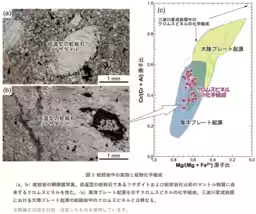
The research team conducted thorough geological investigations and various analytical techniques to determine the origins and developmental processes of serpentinite within the Shimanto Accretionary Complex. They discovered that the serpentinite originates from oceanic plates, contradicting the earlier beliefs of continental origins. This conclusion was drawn from robust rock and mineral analyses demonstrating the distinct characteristics of serpentinite and its formation sequences.
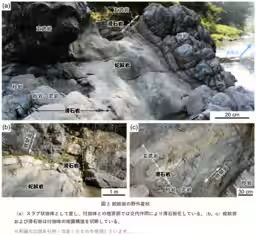
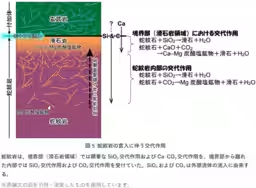
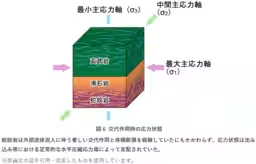
The investigations revealed that serpentinite emerges predominantly in specific geological units, notably near the boundaries where notable metamorphic changes occur. The serpentinite, identified as a slab-like rock body, often shows signs of alteration at its interfaces, indicating that it intrudes the accretionary complex after its formation. These findings suggest that serpentinite both influences and is influenced by the geological structures around it.
A Novel Intrusion Model
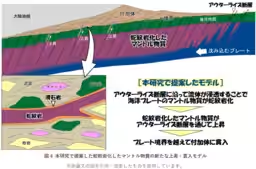
One striking aspect of this study is the development of a new model explaining how serpentinite infiltrates accretionary complexes. The research postulates that serpentinite ascends through faults known as outer rise faults, originating from the bending of the oceanic plates before they subduct. This model emphasizes the dual role of serpentinite as not merely a passive geological byproduct but as an active participant in the geological processes occurring in subduction zones.
Implications for Seismicity and Magma Formation
The implications of this research extend far beyond academic curiosity. Understanding the processes involving serpentinite can shed light on the mechanisms behind earthquake occurrences and magma genesis in subduction zones. With its capability to hold significant quantities of water, serpentinite may influence fluid dynamics in these regions, leading to increased seismic activity or the formation of new magma. This work lays groundwork for future explorations, aiding scientists in pinpointing potential seismic hazards and understanding magma evolution in real-time.
Future Directions
Moving forward, the research community anticipates further studies that could validate these findings across other subduction zones. By employing seismic wave explorations and geothermal techniques, researchers hope to delineate more detailed profiles of serpentinite distributions and their dynamic processes. Additionally, studies investing in the historical trajectories of serpentinite through different geological epochs may provide crucial insights into the long-term implications of these geological processes.
Conclusion
The latest findings regarding serpentinite in the Kii Peninsula not only advance our comprehension of accretionary complexes but also pave the way for understanding crucial geological processes affecting seismicity and magmatism. As the Earth continues to evolve, unraveling the tightly-knit relationships among various geological materials like serpentinite becomes paramount in forecasting natural events and understanding our planet's dynamic systems.
This study will be detailed in an article scheduled for publication on July 24, 2026, in the journal Tectonics.
Topics Other)
【About Using Articles】
You can freely use the title and article content by linking to the page where the article is posted.
※ Images cannot be used.
【About Links】
Links are free to use.