



Achievements in Photocatalytic Water Splitting for Sustainable Hydrogen Production
Introduction
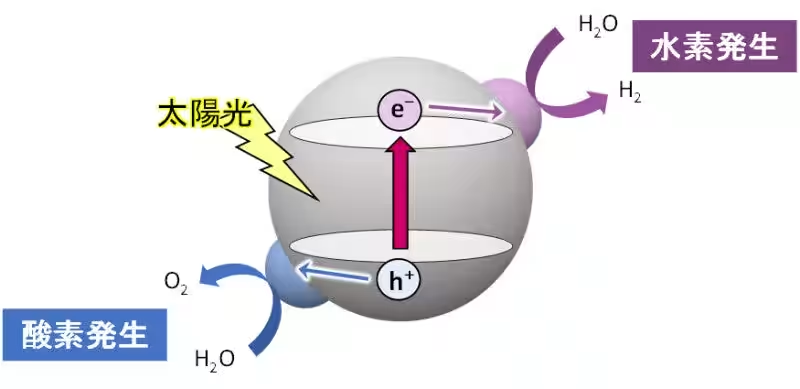
As the world strives for a decarbonized society, the generation of clean hydrogen through photocatalytic overall water splitting (OWS) is gaining attention as a promising approach. This innovative method integrates both hydrogen evolution reaction (HER) and oxygen evolution reaction (OER) effectively, highlighting the significance of both reactions' catalysis surfaces. However, challenges such as complex multi-step processes and the difficulty of completely suppressing reverse reactions with durable oxygen-blocking layers have remained, prompting researchers to seek new solutions.
Breakthrough Discovery
In a groundbreaking study led by Professor Ryota Sakamoto's research group at Tohoku University, the team discovered that a type of conductive two-dimensional metal-organic framework (2D-MOF), specifically Co-HHTP, could serve as an all-in-one cocatalyst for OWS. This discovery is crucial in enabling efficient photocatalytic processes without the requirement of oxygen-blocking layers, which have proven to be a limitation in previous methodologies.
Through a one-step self-organization method, Co-HHTP was effectively integrated onto the photocatalyst SrTiO3:Al, achieving a remarkable apparent quantum efficiency (AQE) of 31.5% at 350 nm. This stability enables continuous OWS, pushing forward the feasibility of implementing such systems on a larger scale. The innovative approach provided by 2D-MOF as an all-in-one cocatalyst signifies a paradigm shift in the design of practical OWS systems.
Scientific Publication
The findings of this research were published online in the esteemed journal Nature Chemistry on April 23, 2026, at 18:00 JST, confirming the study's importance and potential impact on hydrogen production technologies. The title of the paper is "Two-dimensional metal-organic frameworks offer all-in-one cocatalysts for photocatalytic overall water-splitting.”
Conclusion
With continuous support from Japan's scientific institutions, including numerous competitive research grants, this groundbreaking research holds significant promise for future sustainable energy solutions. The findings not only pave the way for a cleaner hydrogen economy but also challenge the traditional methods previously considered essential for photocatalysis, emphasizing the role of innovative materials like 2D-MOF in overcoming existing limitations in the field.
As we move closer to realizing a sustainable hydrogen society, the role of diverse research, including that from institutions like Okayama University, becomes increasingly vital. This study exemplifies the potential for academic research to significantly influence technological advancements in clean energy sectors across the globe.
For further inquiry or details about the research, contact the respective research teams at Tohoku University and Kyoto University, as they continue to explore advanced materials and methods in the realm of photocatalysis.



Topics Energy)
【About Using Articles】
You can freely use the title and article content by linking to the page where the article is posted.
※ Images cannot be used.
【About Links】
Links are free to use.