



Geo-Technologies Conducts Study on Media Touchpoints in Major Japanese Cities
Geo-Technologies Conducts Study on Urban Media Touchpoints
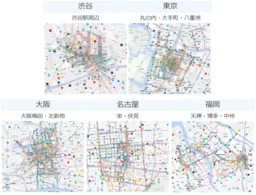
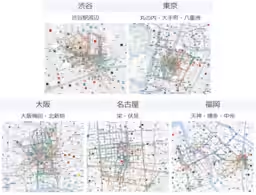
Geo-Technologies Inc., based in Bunkyo, Tokyo, is known for its popular point-earning app, Torima, which has surpassed 22 million downloads. Recently, the company undertook an extensive study through its polling function, Geo-Research, to assess media usage and advertising touchpoints across five major areas in Japan: Shibuya, Tokyo, Nagoya, Osaka, and Fukuoka.
OOH Advertising Trends in Japan
The out-of-home (OOH) advertising market has seen significant growth and diversification in recent years. The proliferation of digital signage and an increase in inbound tourists have led to a surge in demand for advertising at train stations and airports. This evolution has highlighted the necessity to grasp regional and generational differences in media consumption.
By visualizing and analyzing traffic data from the target areas, Geo-Research combines online advertising statistics from social media (SNS) and video services with offline metrics from transportation advertising. This strategic approach aims to provide advertising firms and agencies with valuable reference materials for more effective ad placements.
Key Findings from the Study
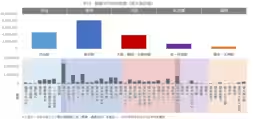
- - The number of rail users in Tokyo is approximately twelve times greater than that in Fukuoka.
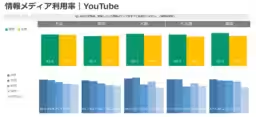
- - YouTube emerges as the most utilized platform across all areas, demonstrating its deep penetration among users of all ages.
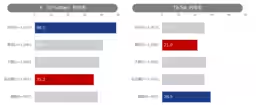
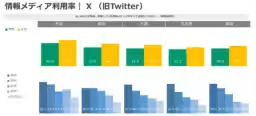
- - X (formerly Twitter) sees a high usage rate of 48.5% in Shibuya, contrasting with just 35.2% in Nagoya, showing clear regional differences.
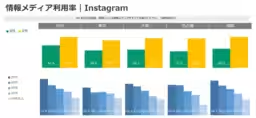
- - Instagram usage among women outweighs that of men in every area, with around 70% of users in their twenties in Shibuya and Fukuoka identifying it as a key platform.
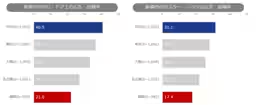
- - A staggering difference of roughly two times in contact rates for transportation advertising between urban and rural areas, with urban locales showing high effectiveness.
Population Flow Indicators
On a particular weekday in June 2025, pedestrian flow data was visualized, revealing clear concentration areas within each urban setting. The rail user average estimated for that day indicated Tokyo's dominance with twelve times the users compared to Fukuoka, suggesting its potential as a massive media space beyond just a transport hub. Meanwhile, Osaka's Umeda and Kitashinchi stations emerged as leading advertising centers in Western Japan, demonstrating traffic levels comparable to those in Shibuya.
YouTube’s Dominance
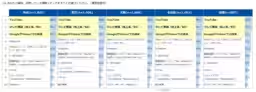
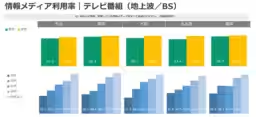
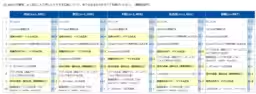
In terms of information media utilization across all locations surveyed, YouTube ranks highest in use, followed by TV shows and search engines like Google and Yahoo!. The numbers indicate that nearly 70% of users in their twenties to thirties engage with YouTube, and even over 50% of those aged sixty or above. Contrarily, TV exhibits significant age-related disparities, with over 70% of older adults tuning in versus only 30-40% among younger viewers.
Social Media Usage Patterns
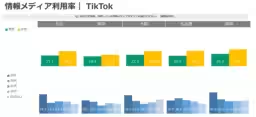
Examining social media usage reveals notable regional disparities. X shows the highest user engagement in Shibuya at 48.5%, compared to only 35.2% in Nagoya, highlighting a 13.3 percentage point gap, while TikTok leads in Fukuoka at 28.9% and the lowest in Tokyo at 21.0%, reflecting shifts in local media engagement.
Overall, usage trends for social platforms like Instagram exhibit strong female dominance across all demographics, with notable female usage ratios (around 70%) in the younger age bracket (twenties) in Shibuya and Fukuoka, establishing Instagram as a principal social platform. Conversely, while X shows a preference based primarily on age, TikTok displays a similar low disparity across categories, still predominantly used by younger demographics.
Localized Advertising Dynamics
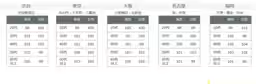
Focusing on OOH advertising effectiveness, Shibuya, Tokyo, and Osaka rank high in transport media usage, with
Topics Consumer Products & Retail)
【About Using Articles】
You can freely use the title and article content by linking to the page where the article is posted.
※ Images cannot be used.
【About Links】
Links are free to use.