



Clinical Organizational Science: An Innovative Approach to Structuring Feedback Loops in Organizations
Exploring Clinical Organizational Science (COS) and the Power of 3Good1More
Introduction to Clinical Organizational Science
Clinical Organizational Science (COS) is revolutionizing how we understand organizational dynamics. Integrating complex systems science, neuroscience, organizational psychology, and behavioral science, COS provides a framework for actively reproducing the interaction structures that maintain organizational stability. Unlike traditional theories which view organizational change as merely a product of individual behavior, COS perceives it as a transition of the organizational attractor, presenting foundational techniques such as Field Gradient Theory, Loop Conversion Design, and Neural Base Design. A key concept introduced within this framework is the 'emergence bridge,' linking individual habits to organizational-level changes.
Understanding Appreciative Inquiry (AI) and Its Role in COS
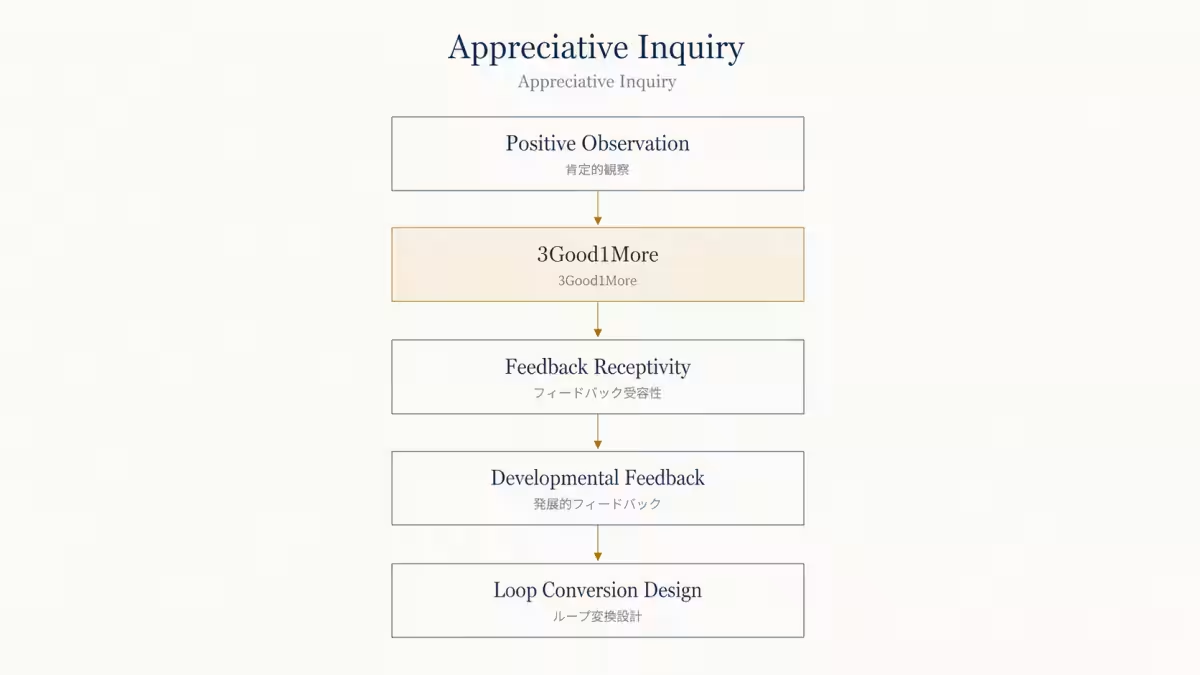
Appreciative Inquiry (AI) contrasts with conventional problem-solving approaches by focusing not solely on flaws but on strengths and successes as the springboard for transformation. It operates under the premise that organizational reality is constructed through the nature of questioning and dialogue. In this light, AI's positive inquiries unlock new possibilities and opportunities for growth. COS fully recognizes these insights, integrating positive observations as essential elements within its Loop Conversion Design, particularly through the lens of its 3Good1More concept. However, COS aims to reposition positive observation within a cybernetic architecture framework, rather than simply adopting AI's approach.
3Good1More: More Than Just Positive Thinking
The 3Good1More method moves beyond superficial positive thinking; it serves as a structural protocol designed to transform self-amplifying loops of criticism and defense into self-correcting feedback structures. The emphasis on three positive observations before a critical input is not merely to please others but to create conditions where improvement information is processed constructively rather than as personal attacks. In this way, COS enhances receptivity to feedback, promoting the transition of developmentally constructive feedback into self-correcting loops.
Contrasting AI and COS: A Complementary Dynamics
| Aspect | Appreciative Inquiry | COS 3Good1More |
|---|---|---|
| ----- | ---------- | --------- |
| Focus | Transformation stemming from strengths | Structural change of feedback loops |
| Framework | Generative epistemology | Cybernetic architecture |
| Practice | Conversations, questions, stories | Embedded 3Good1More protocol in rhythms |
| Purpose | Uncovering organizational potential | Transforming criticism into correction |
AI and COS should be viewed not as conflicting frameworks, but as complementary forces. While AI demonstrates how positive questioning can reshape organizational realities, COS focuses on designing feedback loops that embody this positive observation. By integrating both practices, organizations can not only unlock potential through dialogue but embed positive observations into daily interactions, leading to sustained change.
Caution Regarding the 3:1 Ratio
COS does not claim that the 3:1 ratio of positive to critical feedback is universally optimal. It considers this ratio a practical starting point, acknowledging that one observation is too easy to formalize while more than five can overwhelm cognitive load. The exploration of the optimal ratio, context dependency, cultural differences, and longevity of effects presents further research opportunities.
Insights from Makoto Yamanaka, CEO of DroR
Makoto Yamanaka, the CEO of DroR and co-author of a pivotal paper on COS, emphasizes that the introduction of positive observation into organizational development does not negate prior methodologies like AI. Instead, it presents an alternative framework. The essence of 3Good1More is not merely to express positivity but to design organizational feedback loops conducive to productive interaction. Integrating positive observations into everyday structures is paramount for transforming organizations.
Release Positioning: Conceptual Analysis
The paper detailing these insights has been framed as a Conceptual Analysis, offering a theoretical structure for understanding how COS techniques redeploy existing fragmented scientific knowledge and reconceptualize organizational transformation as a structural intervention challenge.
What's Next?
On June 2, we will delve into 'What Does Clinical Mean in Clinical Organizational Science? The Integration with Schein’s Process Consultation.', further exploring the embedded practitioner tradition within COS.
Conclusion
In conclusion, the emerging framework of Clinical Organizational Science indicates a profound shift in thinking, emphasizing the design of feedback structures that allow organizations to flourish under the influence of positive observations and constructive criticism. With supportive empirical evaluations to come, the relevance of COS in contemporary organizational America could redefine our approach to development and change.
References
- - Yamanaka, M., & Nakamori, M. (2026). Clinical Organizational Science: An Integrative Framework for Structural Intervention in Complex Organizations. Frontiers in Psychology, Organizational Psychology. DOI: 10.3389/fpsyg.2026.1827324
- - For further details, visit DroR Official Site.
Topics People & Culture)


【About Using Articles】
You can freely use the title and article content by linking to the page where the article is posted.
※ Images cannot be used.
【About Links】
Links are free to use.