



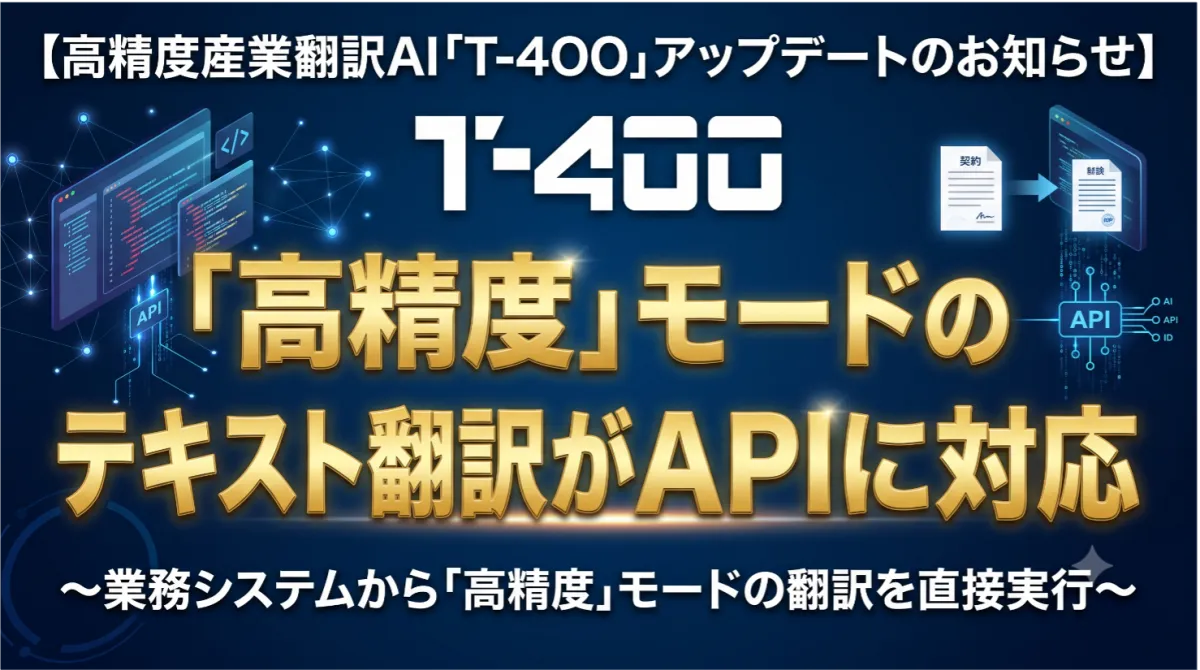
Rosetta’s T-400 Enhances Translation AI with API for Text Processing
On September 3, 2026, Rosetta, a leading provider of AI translation services in Japan, announced a significant upgrade to its high-accuracy industrial translation AI, T-400. This advancement introduces text-based translations via API, enhancing the flexibility and usability of the tool for various industries. Previously, the T-400's high-accuracy mode, initiated on July 30, 2026, was confined to file translation. Now, users can directly call translations from their business systems without the need to interface with T-400’s graphical interface. This enhancement means that short text snippets and items can now be translated with ease, saving time and reducing operational complexities.
API support for text translation enables seamless integration into industry workflows. Businesses can now initiate high-accuracy translations directly from their systems, streamlining what used to be a cumbersome process. In the past, employees had to copy and paste original texts into the T-400 interface, then return the translated content to their systems. With this API transition, translation processes will be quicker and more efficient.
This new functionality is expected to benefit various sectors, including:
By adopting this API integration, companies will significantly reduce the time needed for text translation, leading to a smoother operational workflow. This means that professionals need not switch screens or manually transfer texts and translations, integrating T-400 directly into their daily tasks.
The elimination of the need for screen switching improves operational efficiency by cutting down on the time it takes to copy and paste text translations. Additionally, by embedding translations into existing business systems and workflows, it becomes easier for professionals to manage specialized translation needs without disrupting their usual processes. The API’s ability to handle both file-based and real-time text translations empowers organizations to meet diverse translation demands more effectively.
Atsunori Shinoda, the lead developer of T-400, remarked, "With the introduction of API support for text translation, customers can now leverage high-accuracy translations directly from their business systems. This expands our capabilities beyond file translations, accommodating a variety of industry-specific documentation needs. We are committed to further expanding T-400's features to ensure that businesses can integrate our solutions seamlessly into their workflows."
Looking ahead, Rosetta aims to further enhance the integration capabilities with various business systems, fostering environments where specialized translations are readily available within routine workflows. By continuing to refine T-400's API qualifications, the company is poised to make industrial translation more accessible and efficient within multiple sectors.
T-400 is recognized for its customization and fluency, merging advanced AI translation capabilities while accurately reflecting in-house terminology and style through its high-accuracy mode. Unlike traditional industrial translations, T-400 allows users to utilize existing translation assets without investing in costly bespoke engines. Furthermore, with the addition of agent-based AI, the system has seen a remarkable increase in translation accuracy, now boasting an incredibly low correction rate of just 0.05% for sentence corrections, paving the way for near-complete automated translations.
To learn more about T-400 or to try the free trial, visit Rosetta or reach out for inquiries regarding sales partnerships.
The evolution of T-400 with API support marks a pivotal moment for industries reliant on precise translations. As these technologies continue to advance, businesses can look forward to harnessing the power of AI to enhance their operational capabilities significantly.
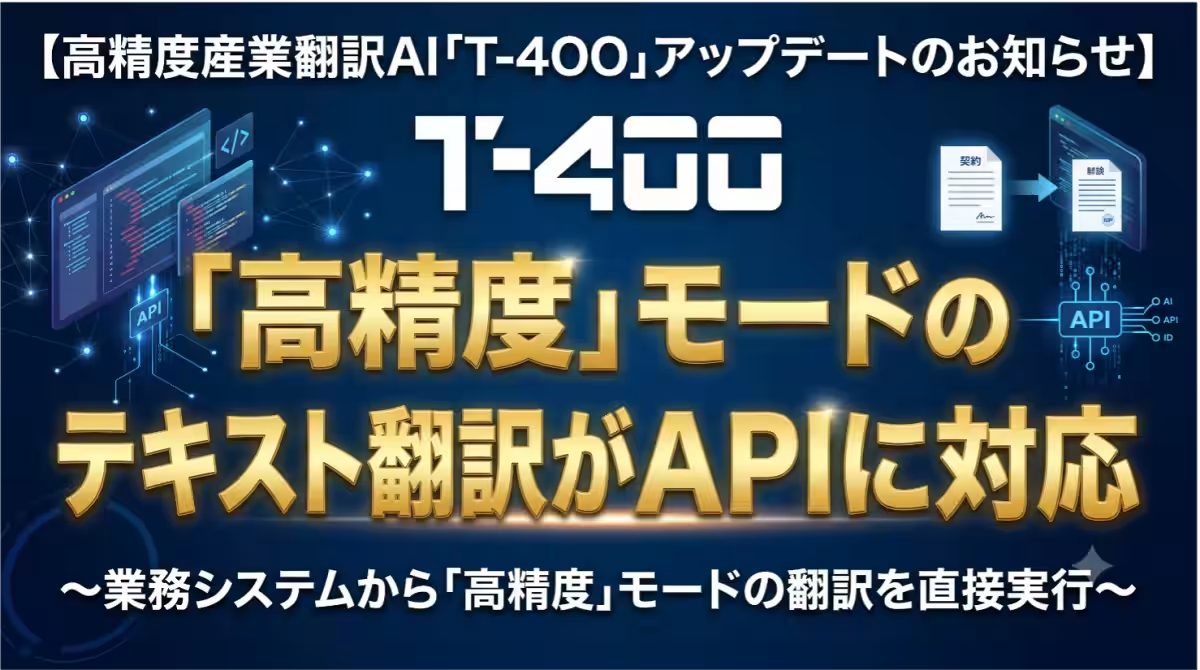
What Does API Support Mean?
API support for text translation enables seamless integration into industry workflows. Businesses can now initiate high-accuracy translations directly from their systems, streamlining what used to be a cumbersome process. In the past, employees had to copy and paste original texts into the T-400 interface, then return the translated content to their systems. With this API transition, translation processes will be quicker and more efficient.
Anticipated Use Cases
This new functionality is expected to benefit various sectors, including:
- - Manufacturing: Translating instructions and specifications within user manuals.
- - Pharmaceutical and Medical Fields: Handling regulatory documents and clinical data translations.
- - Legal Services: Translating clauses in contracts.
- - Patent Documentation: Facilitating translations of specific patent descriptions.
- - Product Databases: Translating product information stored within internal systems.
By adopting this API integration, companies will significantly reduce the time needed for text translation, leading to a smoother operational workflow. This means that professionals need not switch screens or manually transfer texts and translations, integrating T-400 directly into their daily tasks.
Advantages of API Integration
The elimination of the need for screen switching improves operational efficiency by cutting down on the time it takes to copy and paste text translations. Additionally, by embedding translations into existing business systems and workflows, it becomes easier for professionals to manage specialized translation needs without disrupting their usual processes. The API’s ability to handle both file-based and real-time text translations empowers organizations to meet diverse translation demands more effectively.
Insights from Atsunori Shinoda, T-400 Development Lead
Atsunori Shinoda, the lead developer of T-400, remarked, "With the introduction of API support for text translation, customers can now leverage high-accuracy translations directly from their business systems. This expands our capabilities beyond file translations, accommodating a variety of industry-specific documentation needs. We are committed to further expanding T-400's features to ensure that businesses can integrate our solutions seamlessly into their workflows."
Future Prospects
Looking ahead, Rosetta aims to further enhance the integration capabilities with various business systems, fostering environments where specialized translations are readily available within routine workflows. By continuing to refine T-400's API qualifications, the company is poised to make industrial translation more accessible and efficient within multiple sectors.
About T-400
T-400 is recognized for its customization and fluency, merging advanced AI translation capabilities while accurately reflecting in-house terminology and style through its high-accuracy mode. Unlike traditional industrial translations, T-400 allows users to utilize existing translation assets without investing in costly bespoke engines. Furthermore, with the addition of agent-based AI, the system has seen a remarkable increase in translation accuracy, now boasting an incredibly low correction rate of just 0.05% for sentence corrections, paving the way for near-complete automated translations.
To learn more about T-400 or to try the free trial, visit Rosetta or reach out for inquiries regarding sales partnerships.
Conclusion
The evolution of T-400 with API support marks a pivotal moment for industries reliant on precise translations. As these technologies continue to advance, businesses can look forward to harnessing the power of AI to enhance their operational capabilities significantly.
Topics Consumer Technology)
【About Using Articles】
You can freely use the title and article content by linking to the page where the article is posted.
※ Images cannot be used.
【About Links】
Links are free to use.