



NOK Showcases Innovative Sealing Solutions at Battery Japan 2026
NOK's Participation in Battery Japan 2026
NOK Corporation, headquartered in Minato-ku, Tokyo, is gearing up to showcase its latest technologies at the upcoming "BATTERY JAPAN [International] Secondary Battery Exhibition". The event is scheduled to be held at Tokyo Big Sight from March 17 to 19, 2026. With a focus on contributing to the dissemination of next-generation energy, NOK’s booth will feature several new products such as low dew point grease, hydrogen O-rings, and water electrolysis gaskets, highlighting innovative solutions essential for energy manufacturing processes.
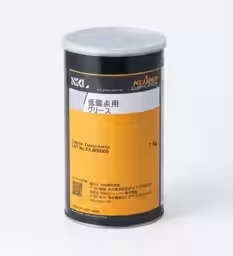
Low Dew Point Grease: A New Development
The low dew point grease introduced by NOK has been specifically developed to cater to the ultra-dry environments encountered during the manufacturing of lithium-ion and solid-state batteries. Operating within a dew point range of -50°C to -70°C, this product effectively mitigates the increased friction resistance associated with critical moving parts like bearings and ball screws. By prolonging the lifespan of equipment components, this grease not only enhances operational stability but also boosts productivity within manufacturing settings. Notably, it does not include certain metallic elements, such as Cu, Zn, or Fe, that could adversely affect battery characteristics, significantly reducing the risk of performance degradation.
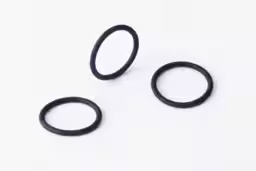
Hydrogen O-Rings: First-Time Showcase
In the context of hydrogen applications, NOK’s newly showcased O-rings are engineered to address the challenges posed by hydrogen penetration and the subsequent blistering effects that can occur during pressurization and depressurization cycles. Featuring low-temperature EPDM and specialized VMQ materials, these O-rings exhibit outstanding blister resistance essential for maintaining sealing integrity under high-pressure conditions. The innovative design incorporates a dedicated backup ring to address potential extrusion from grooves, while the softer material hardness reduces installation force by a third, improving overall assembly efficiency. The low-temperature EPDM material is rated to -50°C, while the VMQ variant ranges down to -60°C, ensuring reliability in extreme conditions.
Water Electrolysis Gaskets: Pioneering Design
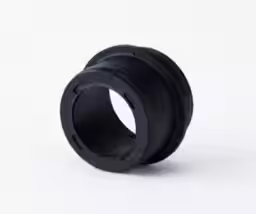
NOK will also present its water electrolysis gaskets, which play a crucial role in ensuring airtightness, insulation, and retention of the electrolyte between electrodes. This innovative solution aids in preventing gas mixing and leakage, thereby enhancing hydrogen production efficiency and stabilizing operational parameters. The gasket features a resin frame integrated with a seal structure that facilitates easy membrane replacement, contributing to more efficient assembly processes and a reduction in component count. Additionally, the use of rubber seals enhances performance in high-pressure environments, fostering increased durability compared to traditional resin-based products. Collaborative research with AIST (National Institute of Advanced Industrial Science and Technology) has enabled optimization of the materials and design, supporting effective energy conversion in electrolysis systems.
Cooling System Seal Solutions
NOK is set to highlight its advanced sealing solutions for cooling systems, including seals for multi-channel switching valves and piping joints. The designs incorporate both rubber and low-friction materials, ensuring high sealing performance while minimizing torque requirements for smooth flow switching. Each variant—rotor type and disc type—is engineered to optimize heat utilization while streamlining surrounding component assembly.
The piping joint seals flexibly accommodate displacement during installation, ensuring effective sealing through a unique structure that combines rubber with metal rings for press-in simplicity. This innovation aids in maximizing space utilization whilst offering greater design freedom, especially in multi-pipe cooling systems.
Tracking Resistant Rubber Solutions
Moreover, NOK has developed rubber materials designed to suppress tracking phenomena in high-voltage environments. Meeting the maximum value of 600 CTI (Comparative Tracking Index) under JIS standards, these materials can be molded into sealing shapes, contributing to compact designs and a reduction in components around inverters and motors. Depending on applications, rubber materials exhibiting water and oil resistance can be selected for optimal performance.
Rust Prevention Seal: RUSTECTOR Coating
Lastly, NOK introduces the RUSTECTOR coating, an innovative gasket solution for aluminum housings in electric vehicle units, specifically engineered to combat saltwater corrosion. This coating enhances corrosion resistance by filling surface roughness on aluminum housings, ultimately improving durability.
Booth Overview
- - Theme:





Topics Other)
【About Using Articles】
You can freely use the title and article content by linking to the page where the article is posted.
※ Images cannot be used.
【About Links】
Links are free to use.