



Accelerating Drug Discovery: The Role of AI in the Life Sciences and Pharmaceutical Industry
Accelerating Drug Discovery: The Role of AI in the Life Sciences and Pharmaceutical Industry
The introduction of AI technology in the life sciences and pharmaceutical sector is paving the way for rapid advancements in drug discovery and clinical trials. A recent report by Randstad highlights both the promising potential of AI—projected to generate up to $110 billion annually—and the various challenges that remain within the industry regarding talent acquisition and employee development.
Overview of Randstad's Talent Trend Report
Starting August 27, Randstad, a global leader in human resource services, will release its "2025 Talent Trend Report: Life Sciences and Pharmaceutical Sector Edition." This report emphasizes the critical importance of Learning and Development (L&D) investments, the integration of a skills-first model, and the cultivation of next-generation leaders in the industry. With only 41% of leaders in the sector noting a strong connection between talent acquisition and L&D—lower than the global average of 48%—the report underscores the need for strategic advancements.
AI's Impact on Skill Matching and Employee Reallocation
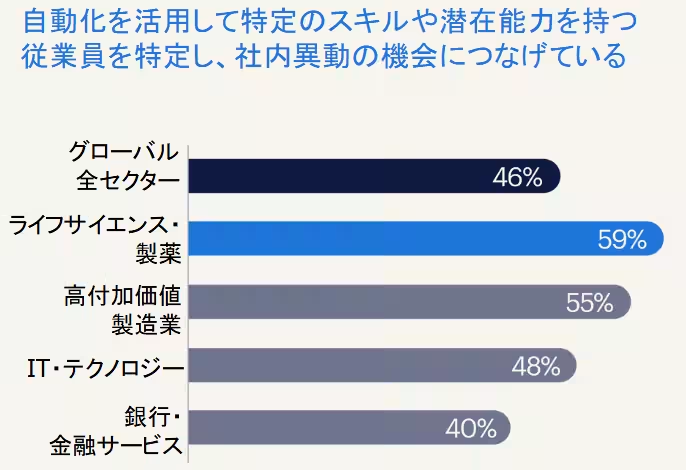
Analyzing data reveals that 59% of life sciences companies are utilizing AI to identify employee skills and match them to new roles, significantly higher than the global average of 46%. This reflects a robust commitment to technological adoption within the sector. Conversely, there remains a discernable lag; only 33% of companies express alignment with employees' values, far behind the global benchmark of 41%. Moreover, L&D investment stands at 37% compared to the global average of 53%, indicating further opportunities for enhancement.
Urgency in Embracing Diverse Workforce Models
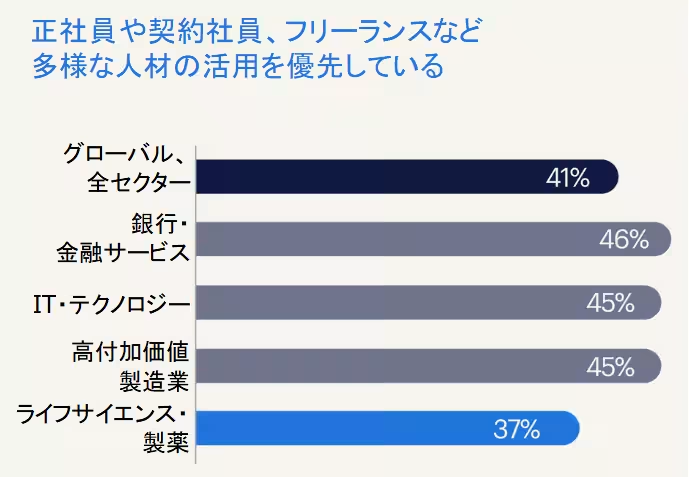
Despite 73% of leaders prioritizing workforce agility this year, this figure is considerably below the global average of 87%. A mere 37% reported a commitment to utilizing diverse forms of employment—such as full-time, part-time, and freelance workers—making it the lowest in major industries. This signals an urgent need to transition from rigid job roles to a more skill-centric framework. The report advocates for the fragmentation of tasks into modules, termed "pixelization," which breaks traditional role structures and facilitates integration of flexible employment models, including hybrid or project-based work.
Adapting to a Skills-First Model
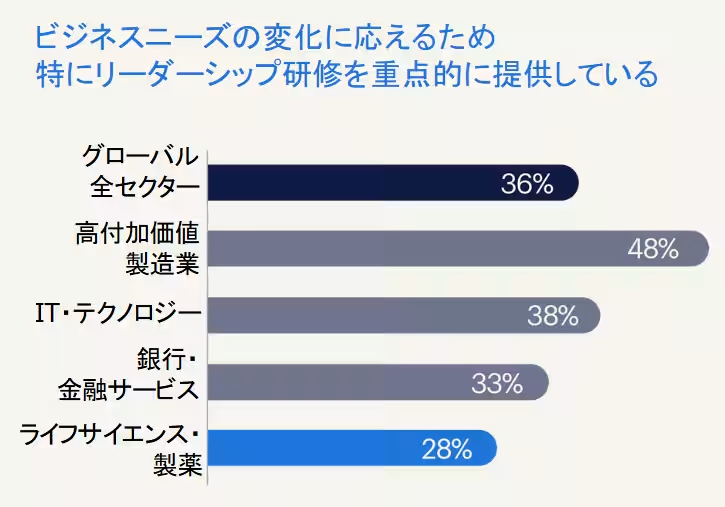
The life sciences and pharmaceutical sectors are actively moving toward a skills-first paradigm, with 82% of leaders claiming they are either transitioning or have transitioned to this model. Emphasizing potential over fixed job experience is essential for adapting to rapid technological changes. However, a worrying trend is observed: frontline management is often rigidly focused on specific roles, revealing a 43% gap—higher than the global average of 30%. Furthermore, only 28% of companies prioritize leadership training for business needs, falling below the global average of 36%.
Future Directions for Workforce Strategies
In order to lead in AI implementation within the life sciences and pharma sector, companies must evolve their workforce strategies while leveraging their strengths. Accelerating investments in talent acquisition, reskilling, and L&D is crucial. Closing the gap between HR and frontline managers, along with nurturing next-generation leaders using AI, is vital for fostering an adaptive organizational culture that ensures sustainable growth.
Insights from Randstad's Leadership
According to Tsukasa Yamakawa, Manager of the Life Sciences Team at Randstad Professional Talent Solutions Division, the report identifies two significant challenges: "The acceleration of AI utilization and a shortage of specialized talent." Despite overall job openings across the industry remaining unchanged, areas like bioinformatics and cell and gene therapy are facing fierce competition, greatly increasing the demand for AI experts. With a shortage of personnel possessing AI skills, businesses are resorting to hiring talent from other industries. The prevailing focus on traditional career backgrounds is insufficient for adapting to changing needs; thus, a shift to "skills-first" and "agile" workforce models is essential.
To achieve this, organizations must leverage AI for skill visualization and establish a talent marketplace to rapidly deploy the right individuals to necessary projects—enhancing talent fluidity both internally and externally. With this strategic approach, Randstad aims to partner with companies in driving meaningful changes in management and HR practices.
For further details, the full report is available for download at Randstad Talent Trend Report.

Topics Business Technology)
【About Using Articles】
You can freely use the title and article content by linking to the page where the article is posted.
※ Images cannot be used.
【About Links】
Links are free to use.