



Tier IV Joins JST's Next-Gen Edge AI Semiconductor Research Initiative
Tier IV's Commitment to Autonomous Driving Development
In a significant move towards advancing autonomous vehicle technology, Tier IV, a Tokyo-based company dedicated to democratizing self-driving solutions, has officially joined the Next-Generation Edge AI Semiconductor Research and Development project initiated by Japan's National Research and Development Agency, JST. The collaboration aims to innovate and develop software-defined systems on chips (SoC) tailored for Level 4 autonomous driving.
With the prestigious Professor Kei Hiroshi Kawahara from the University of Tokyo's Graduate School of Engineering leading the research efforts, Tier IV’s involvement focuses on creating an AI chip designed for efficient end-to-end (E2E) processing of autonomous driving AI inference. This project emphasizes open-source design, paving the way for a collaborative ecosystem in semiconductor development.
Leveraging High-Performance Computing
Graphics Processing Units (GPUs) have been at the forefront of AI evolution. However, as autonomous vehicles approach practical application, they require AI models to function in real-world and real-time constraints. This necessitates a fresh approach that not only enhances power efficiency but also boosts adaptability, transparency, and verifiability of the AI systems.
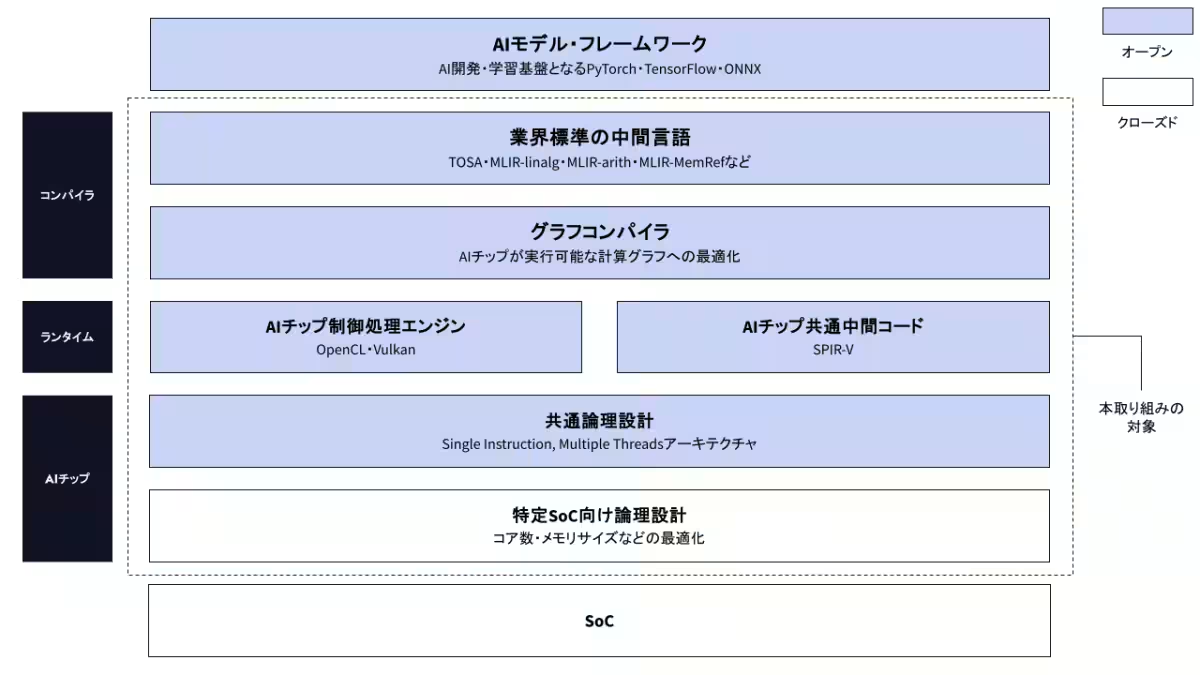
Tier IV's strategy includes the design of an AI chip that supports the autonomous driving open-source software, Autoware. This chip will be integrated into the SoC architecture, with tests conducted to evaluate its effectiveness. In addition to the chip design, Tier IV commits to open-sourcing the associated tools and compiler, encouraging various semiconductor manufacturers to utilize its platform technology for efficiently developing Level 4 autonomous SoCs.
Software-Hardware Collaboration
The development of the SoC involves intricate software and hardware architecture to optimize power efficiency. The use of Transformer models enables a comprehensive analysis from sensor input, like camera images and point clouds, to decision-making processes in autonomous AI. By creating a dedicated architecture that simplifies complex control mechanisms necessary for general computational processing, Tier IV aims to increase efficiency significantly.
The team will address common challenges such as extensive data transfer and computational control, targeting reductions in power consumption during external memory data exchange. This approach will integrate specialized circuits for efficient processing of matrix operations and attention mechanisms that are prevalent in Transformer models, thereby optimizing AI performance both in isolation and within the broader autonomous system employing Autoware.
Ensuring Adaptability and Transparency
The rapid evolution of AI technology means static designs based on specific models or hardware configurations will struggle to keep pace with changes. To counter this, Tier IV plans to implement a standardized intermediate representation called Tensor Operator Set Architecture (TOSA) between AI models and chips, facilitating a loosely coupled framework. This innovative strategy allows for seamless adjustments even as AI model configurations change, leading to continual optimization of power and performance.
Moreover, as safety is paramount in Level 4 autonomous driving scenarios, transparency in AI operations is crucial. Thus, Tier IV intends to make its chip design and the toolchain, including the compiler, available as open-source. This commitment grants semiconductor manufacturers and developers insights into the chip's internal structure and software functionality, facilitating tailored improvements based on individual vehicle, AI model, performance, and power needs. By expanding the open-source philosophy that has thrived in the development of Autoware, this initiative seeks to construct a sustainable, evolving ecosystem centered around autonomous AI technology.
Building a Verifiable Environment
In executing AI models on chips, various processes such as model transformation, optimization, quantization, and rounding occur which are essential for enhancing performance and power efficiency. To ensure these transformations do not impair output accuracy, a robust verification mechanism is to be integrated based on TOSA. This method will systematically track transformations while leveraging mathematical techniques to validate numeric consistency and error ranges.
Through these rigorous validation protocols, Tier IV strives not just for high processing performance but also to establish a trustworthy execution environment for autonomous driving AI systems.
Insight from Leadership
Comments from Tier IV’s CEO, Shinpei Kato, emphasize the acceleration of AI advancements through high-performance computing technologies. He notes the significance of adapting to real-world constraints in developing computational architectures suitable for Level 4 autonomy. Kato highlights the importance of understanding the execution processes of AI models and ensuring verifiable procedures as crucial elements for deploying self-driving systems in safety-critical environments.
Professor Kawahara from the University of Tokyo echoes this sentiment, pointing out the transformative approach of Tier IV in addressing power consumption issues of GPUs in mobile applications. By concentrating on differentiated chip designs derived from use-case stemming, this partnership marks a turning point in the autonomous field, aiming for democratization of semiconductor innovations that can spur a new wave of high-value startups in Japan’s technology sector.
About Tier IV
Founded in December 2015, Tier IV has positioned itself as a leading deep tech company focused on the democratization of autonomous driving through its open-source software, Autoware. With a commitment to contributing to a safer and more sustainable society, Tier IV actively engages with global partners to broaden the potential of autonomous systems via its comprehensive platform. Their focus on building a collaborative environment will pave the way for groundbreaking developments in the rapidly evolving domain of autonomous driving technologies.
Topics Consumer Technology)
【About Using Articles】
You can freely use the title and article content by linking to the page where the article is posted.
※ Images cannot be used.
【About Links】
Links are free to use.