



Revolutionizing Solid-State Battery Research with Automated Robotic Experiment Systems
Revolutionizing Solid-State Battery Research with Automated Robotic Experiment Systems
In a landmark achievement, a team led by Yuuki Yamaguchi from the National Institute of Advanced Industrial Science and Technology (AIST), in collaboration with Denso Wave, Aichi Institute of Technology, and the Aichi Science and Technology Center, has developed a groundbreaking robotic experiment system aimed at enhancing the exploration of solid-state battery materials. This innovative human-robot collaborative system is designed to automate the entire process of mecano-chemical synthesis, effectively reducing the experimental workload and improving research efficiency.
The System and Its Functionality
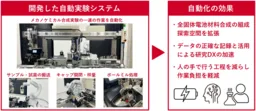
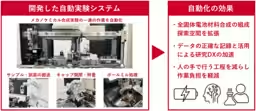
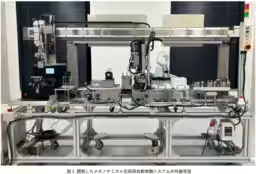
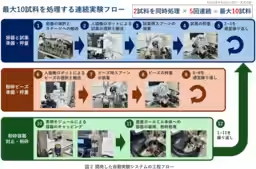
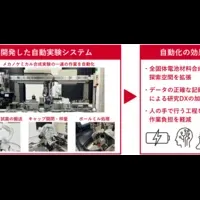
The newly developed system offers a comprehensive automation of the mecano-chemical synthesis of solid-state battery materials, allowing for the continuous processing of up to ten samples in a single command. It performs various tasks including weighing of powder samples, opening and closing container lids, processing with a planetary ball mill, and storing samples. This automation mitigates the burden on researchers and streamlines the exploration process for materials crucial for solid-state batteries, which promise enhanced safety and energy density compared to traditional lithium-ion batteries.
Solid-state batteries stand at the forefront of energy technology, relying on solid materials as electrolytes. Despite their potential, the development of efficient solid electrolytes and electrodes necessitates comprehensive experiments involving changes in both the composition and synthesis conditions. The previous manual handling of powders in glove boxes—an essential requirement to prevent contamination—was cumbersome and time-consuming, impacting the research pace significantly.
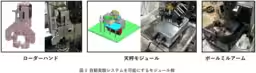
To tackle these challenges, the research team integrated a compact collaborative robot designed for limited workspace operations, supported by custom modules that facilitate tasks such as lid manipulation and handling of heavy materials. This enables the system to perform tasks that are typically sensitive to moisture and oxygen in sealed environments.
Societal Impact of Solid-State Battery Research
The demand for improved battery technology is growing alongside the push for electric vehicles and renewable energy solutions, making solid-state batteries, which replace traditional liquid electrolytes with solid forms, an area of utmost importance. This shift not only enhances safety but also significantly increases the storage capacity of batteries, marking solid-state options as a powerful alternative in the pursuit of next-generation power storage solutions.
The performance of solid-state batteries hinges on not only the composition of the solid electrolytes and electrodes but also on factors such as grinding and mixing conditions and processing times. The mecano-chemical synthesis technique, widely adopted in these experiments, leverages mechanical energy to facilitate chemical reactions and structural transformations, typically involving several intricate steps. This includes the transfer of reagents from storage, weighing, microwave treatment setup, and extraction of processed samples—previously executed manually, which presented a significant burden on researchers.
In utilizing autonomous robotics, AIST capitalizes on its years of expertise in synthesizing ceramic materials, developing a broad spectrum solution that incorporates robots for the automation of all experimental stages while ensuring safety and efficiency.
The Future of Materials Research Automation
The system operates with the capability to handle two samples per run of the planetary ball mill, thereby enabling ten samples to be processed in a single session. This versatility allows researchers to variate different experimental parameters such as reagent quantities, types of beads used, mixer rotation rates, processing times, and steps, systematically exploring various combinations at unprecedented speeds. As a result, the research community can carry out a larger volume of experiments with differing compositions and conditions while minimizing exposure to degradation from environmental factors.
Looking ahead, the research team is poised to assess the conductivity and structural integrity of samples produced by their system, integrating AI for data analysis to further streamline material development processes. Plans to enhance the autonomous system are also underway, aiming at establishing a materials development platform capable of autonomously repeating experiments, evaluations, analyses, and condition proposals—a leap forward designed to amplify research efficiency and effectiveness significantly.
With these innovations, the potential for expanding the system's application to ceramic materials development and beyond presents exciting prospects for regional industries and the broader technology sector. Future showcases at events such as the xEV Testing Initiative and Messe Nagoya are anticipated to unveil these groundbreaking advancements, contributing valuable knowledge and fostering collaboration across industries.
Conclusion
In summary, the development of this robotic experiment system marks a significant milestone in solid-state battery research, offering a promising solution to the complexities inherent in materials synthesis and exploration. The continued evolution of this technology not only enhances efficiency in research but also supports the broader goals of increasing the safety and efficacy of battery technologies critical for the energy transitions of the future.
Topics Consumer Technology)

【About Using Articles】
You can freely use the title and article content by linking to the page where the article is posted.
※ Images cannot be used.
【About Links】
Links are free to use.