



Fujikura and MIT Collaborate to Advance 3D Nanofabrication Technology
Fujikura and MIT Collaborate to Advance 3D Nanofabrication Technology
In a remarkable joint research endeavor, Fujikura Ltd., led by CEO Naoki Okada, has teamed up with esteemed researchers from the Massachusetts Institute of Technology (MIT). This collaboration has resulted in the development of advanced 3D nanofabrication technology, culminating in the publication of their findings in the prestigious journal, Nature Photonics.
Founded in 2019, Fujikura’s Advanced Research Core (ARC) has been at the forefront of pioneering studies in nanoscience and nanoengineering, working alongside various MIT research labs to push the boundaries of fundamental research.
Understanding 3D Nanofabrication Technology
The essence of 3D nanofabrication lies in its ability to create intricate, nanoscale structures with unparalleled precision. To put it into perspective, 1 nanometer is one-millionth of a millimeter. Traditional methods such as lithography, which is widely used in semiconductor fabrication, typically excel in forming flat surfaces but lack the versatility to shape complex three-dimensional structures.
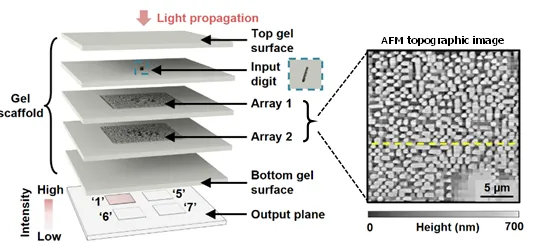
The newly introduced method, dubbed ImpCarv, revolutionizes this process by employing dynamic light projection techniques to carve out sophisticated 3D designs. This innovation significantly surpasses the previously established limits of resolution due to light diffraction, heralding a new era in nanofabrication.
The Promise of Light-Based Fabrication
The ImpCarv technique allows for the manipulation of light to build multiple structures within a relatively small physical volume of polymer material. This capability enables the integration of numerous functional elements into a single substrate, which enhances production efficiency as multiple components can be manufactured simultaneously without the need for precise positioning during assembly.
Moreover, the nanoscale structures produced through this method can precisely control various physical phenomena, making them applicable across diverse fields. In optics, for instance, the ability to meticulously fine-tune the shape, intensity, and phase of light opens the door to groundbreaking optical devices and components, especially in domains like optical communications.
Demonstrating the Potential of Optical Neural Networks
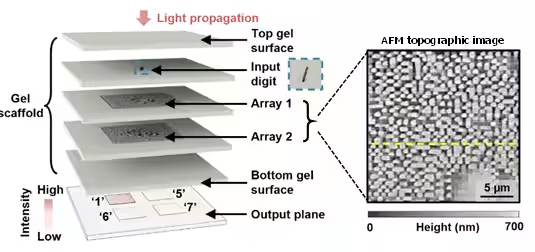
In their publication, the researchers also showcased a demonstration of an optical neural network crafted using the ImpCarv technology. This network was tested using basic numeric classifications, simulating processes akin to artificial intelligence, confirming its potential to categorize numbers accurately. The implications of this optical neural network extend beyond optical communications; it paves the way for rapid computational methodologies that replace electronics with light, offering prospects for next-generation robotics and optical computing.
Fujikura's commitment to fostering nanoinnovation solidifies its role in addressing social challenges through technological advancements. The future appears bright as they continue their research endeavors in this exciting field, with the potential for transformative impacts on countless industries.
Paper Information
- - Title: Isotropic shrinkage of photopatterned vacancies enables nanoprecise 3D metastructures for visible-light optical computing
- - Authors: Quansan Yang, Gaojie Yang, Takahiro Nambara, Hiroyuki Kusaka, Yuichiro Kunai, Alex C. Matlock, Corban Swain, Brett Pryor, Yannick Salamin, Daniel Oran, and others
- - Affiliations: MIT, Harvard University, University of Washington
- - Published in: Nature Photonics
- - Publication Date: May 12, 2026
- - URL: Nature Photonics Article
Topics Consumer Products & Retail)





【About Using Articles】
You can freely use the title and article content by linking to the page where the article is posted.
※ Images cannot be used.
【About Links】
Links are free to use.