




The Impact of Foreign Direct Investment on Startup Dynamics: Opportunities or Threats?
The Impact of Foreign Direct Investment on Startup Dynamics: Opportunities or Threats?
Foreign Direct Investment (FDI) plays a significant role in shaping the entrepreneurial landscape of various regions and industries. Recent research has delved into this complex relationship, emphasizing that FDI's impact on startups is not universally beneficial; rather, it can act as both a catalyst for innovation and a source of competitive threats. This article aims to unpack the nuanced effects of FDI on new business creation based on recent studies undertaken by a collaborative team from Zhejiang University and Waseda University.
Key Findings
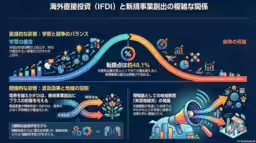
A groundbreaking study conducted by Lingli Luo, Junichi Yamanoi, Xufei Ma, and Linan Lei analyzed FDI's effects at the industry and regional levels rather than merely at the national scale. Their findings suggest a non-linear, inversed U-shaped relationship between FDI and the number of new startups in specific sectors, indicating that moderate levels of FDI can enhance entrepreneurial opportunities and lead to an increase in startups. However, beyond a certain threshold, the intensified competition from foreign entities can suppress the entrepreneurial spirit.
1. Learning Opportunities vs. Competitive Threats: The research highlights that entrepreneurs benefit from learning opportunities presented by foreign companies, contributing to innovation and business growth. Nevertheless, once the FDI influx exceeds a critical point, the threat of increased competition can undermine the startup ecosystem, ultimately curtailing new business ventures.
2. Geographical Spillover: Regions that receive FDI also influence their adjacent areas. The study reported positive spillover effects where nearby regions benefit from related industry investments. This interconnectedness between regional economies showcases the broader implications of FDI that extend beyond the immediate locality.
3. Role of Institutional Environment: The local non-state economic environment plays a vital role in magnifying or diminishing the effects of FDI on startups. Well-developed non-state sectors provide a fertile ground for entrepreneurial growth spurred by foreign investments, further illustrating the importance of considering the institutional context when evaluating FDI impacts.
Implications for Policy Makers
The findings from this study suggest significant implications for policymakers and industrial leaders aiming to foster a robust entrepreneurial climate. To stimulate new venture creation through FDI, it is crucial to design policies that balance the benefits of learning opportunities against competitive pressures. Here are some recommendations:
- - Monitor FDI Levels: Policymakers should keep FDI levels in check to ensure that they remain conducive for new business formation, avoiding thresholds that lead to a competitive chokehold.
- - Foster Spillover Effects: Strategic planning around FDI can maximize spillover benefits. Encouraging investments not just in isolated sectors but also in surrounding industries can create synergies that bolster startup activity across regions.
- - Strengthening Local Institutions: A robust local institutional framework is essential to exploit the potential of FDI. Improving the development of non-state sectors can create an environment where startups can thrive in the presence of foreign competitors.
Conclusion
The recent shifts in understanding FDI's multifaceted effects on startups underscore the necessity for nuanced research and policy formulation. This study provides essential insights into how foreign investment can fuel innovation and entrepreneurship if managed correctly while also serving as a cautionary tale about overwhelming competition. The dynamics of FDI and startups are intricate, but by harnessing the right strategies and maintaining balance, regions can cultivate vibrant entrepreneurial ecosystems.
As further research unfolds, it will be crucial to explore these findings in different cultural and institutional contexts to understand better the global applicability of such dynamics.
Future Research Directions
The focus on China gives unique insights, but the applicability of these findings to other environments remains a point of exploration. Future studies could expand this research scope to other developing nations to evaluate whether similar trends occur under varied institutional frameworks.
This study ultimately aims to reshape how we regard FDI's impact on entrepreneurship and encourage further explorations of foreign investment's role in driving economic growth and innovation.
Topics Business Technology)



【About Using Articles】
You can freely use the title and article content by linking to the page where the article is posted.
※ Images cannot be used.
【About Links】
Links are free to use.