



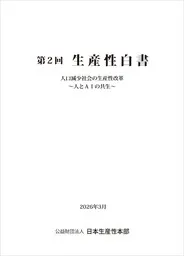
The Second Productivity White Paper: Advancing Productivity Amid a Declining Population
The Second Productivity White Paper: A Vision for Coexisting with AI
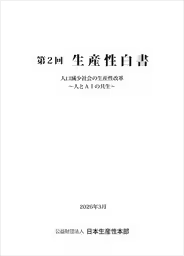
On March 30, 2023, the Japan Productivity Center (JPC) published its second edition of the "Productivity White Paper", titled "Productivity Reform in a Declining Population Society: Coexisting with Humans and AI." This edition seeks to address Japan's pressing concerns, such as workforce shortages due to demographic decline, rising income disparities, and the overarching need for a carbon-neutral society. The insights are drawn from discussions among key stakeholders—employees, employers, and academics—over the past year and a half, culminating in a comprehensive framework to enhance productivity and the economy.
The Challenges Facing Japanese Society
Japan is grappling with multifaceted issues, including labor shortages driven by population decline, income reduction, and widening economic gaps, coupled with heightened geopolitical tensions and national divisions. Meanwhile, global economic dynamics are shifting, influenced by technology innovation and the rise of emerging markets, causing strains on the post-World War II free trade system, with protectionist sentiments gaining ground.
To counter these challenges, the white paper emphasizes the necessity for enhancing productivity, proposing a cyclical relationship between productivity improvements and wage increases under the "Three Principles of the Productivity Movement". This approach aims to unify various sectors, including labor and management, to cultivate shared guidelines for productivity reform.
Key Components of the White Paper
Volume 1: General Overview
Chapter 1: High Value-Added Management
The white paper argues that in response to declining international competitiveness, it is crucial to fundamentally increase value-added per capita through expanded investment. Business leaders bear the responsibility to ensure the growth of total value added, benefiting all stakeholders.
Chapter 2: Innovation and AI
While concerns around job losses due to AI are prevalent in the West, Japan faces a critical labor shortage, making AI a partner in maintaining and enhancing productivity rather than a threat. AI can complement the workforce, fostering growth and innovation.
Chapter 3: Investment in Human Resources and Labor Market Reforms
Human resources are paramount in creating value. Companies must broaden their investment in talent alongside wages, fostering diverse and flexible working arrangements that empower workers to acquire professional skills and make autonomous career choices.
Chapter 4: Three Principles of the Productivity Movement
The productivity initiative is grounded in collaboration among management, labor, and academia. These principles serve as the foundation for advancing productivity efforts.
Volume 2: In-Depth Discussions (Contributions)
The second volume includes contributions covering key themes:
1. Current state and challenges of productivity in Japan.
2. The interplay of innovation and productivity.
3. Human resources required for a society where humans and AI coexist.
4. High value-added management methodologies.
5. The relationship between labor and productivity.
6. Perspectives on productivity enhancement and sustainable prosperity through investment.
Final Thoughts
As the JPC seeks to disseminate the white paper widely, it aims to collaborate with national productivity organizations and labor unions across Japan to implement innovative management practices. Emphasizing the importance of coexistence between humans and AI in future productivity reform not only sets a precedent for current industry practices but also shapes a resilient economic future for Japan. By leveraging the insights of this comprehensive report, stakeholders can strive toward a more prosperous, inclusive society.
For more details on the second edition of the Productivity White Paper, please refer to the official document.
Topics General Business)
【About Using Articles】
You can freely use the title and article content by linking to the page where the article is posted.
※ Images cannot be used.
【About Links】
Links are free to use.