




Teenagers' Perspectives on Education: High Satisfaction Yet Evolving Learning Needs Revealed
Understanding Teenagers' Educational Satisfaction and Their Learning Preferences
Recent research conducted by Premaseed, a company based in Shibuya, Tokyo, running the introduction site 'Go通信制高校', presents significant insights into teenagers’ views on education. The study focuses on the learning values held by teenagers (aged 15-19) and their parents (aged 40-59). While the satisfaction rate with school education among teenagers is high, there is an evident evolution in their learning needs.
Study Details
Conducted between May 15 and May 19, 2026, the survey included responses from 600 individuals, comprising 300 teenagers and 300 parents. The aim was to understand the issues that teenagers face, whom they consult for support, and what type of learning environments they consider essential for their development.
Satisfaction with Current Education
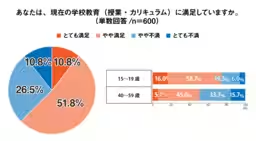
The results showed that 62.7% of participants expressed satisfaction with the current school education, with a notable 74.7% of teenagers indicating they were “very satisfied” or “somewhat satisfied.” This figure is 24% higher than that of their parents, illustrating an optimistic view of their educational environment.
Preferred Learning Approaches
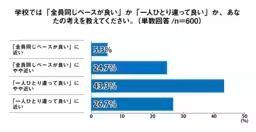
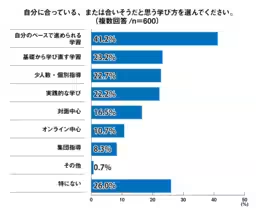
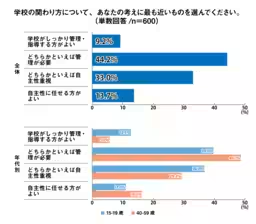
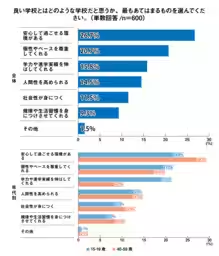
When asked about their preferred learning methods, 41.2% of teenagers selected “learning at their own pace,” followed by 23.2% for “rethinking foundational knowledge,” and 22.7% for “small group or individualized instruction.” These preferences reveal a distinct generational gap, emphasizing teenagers' desire for personalized education that suits their unique learning styles.
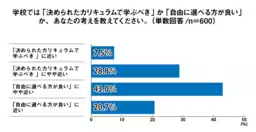
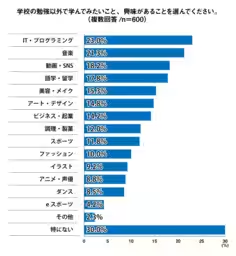
In another section of the survey, regarding subjects of interest outside the standard curriculum, teenagers expressed a strong desire to learn about IT and programming (23%), music (21.3%), and various aspects of social media (18.2%). These interests starkly contrast with the responses of the parent generation, of which 40.3% indicated they had no particular interest outside the standard subjects. This shift in focus towards practical, modern skills is significant.
Value of Education for the Future
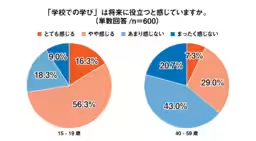
When evaluating the perceived utility of their education for their future, 72.7% of teenagers felt that their school learning would benefit them in the long run. In contrast, only 36.3% of parents shared this belief, revealing a disconnection between the two generations regarding the benefits of traditional schooling.
Ideal Learning Environments
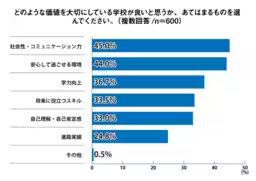
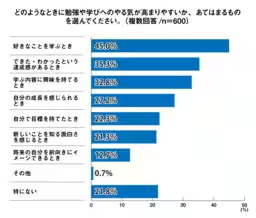
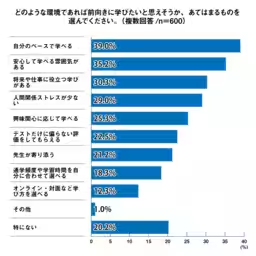
The survey also explored what kind of environment would motivate them to engage positively in learning. A total of 39% cited “the ability to learn at their own pace” as a crucial factor, while 35.2% emphasized the need for a “safe learning atmosphere.” This indicates that beyond knowledge acquisition, emotional and physical comfort plays a significant role in how effectively teenagers learn.
Responding to the Needs
Premaseed’s CEO, Akito Iwata, noted that teenagers are not only looking for academic knowledge but are also seeking safe environments where they can express themselves and explore their interests. The growing accessibility of information through social media has facilitated a cultural shift where learning extends beyond traditional academic boundaries. This offers teenagers the chance to connect with influential figures from various fields, further shaping their aspirations and interests.
Bridging the Generational Gap
The disparity in educational expectations underscores the evolving landscape of learning. The findings suggest that while teenagers value core subjects, they are keen to pursue personal interests that align with their passions. This realization prompts a call for educational reform that embraces flexibility and accommodates diverse learning paths, reinforcing the importance of catering to individual strengths and preferences without dismissing foundational knowledge.
Conclusion: A Call for Educational Transformation
In conclusion, the data collected from the study reflect the shifting attitudes of teenagers towards education, emphasizing the need for personalized learning experiences that respect individuality while still covering essential subjects. The premise is clear: modern education must evolve to foster environments in which each student can thrive according to their unique capabilities and interests. By allowing teenagers to shape their learning journey, we not only foster their academic growth but also nurture their confidence as they prepare for the world beyond school.



Topics Other)

【About Using Articles】
You can freely use the title and article content by linking to the page where the article is posted.
※ Images cannot be used.
【About Links】
Links are free to use.